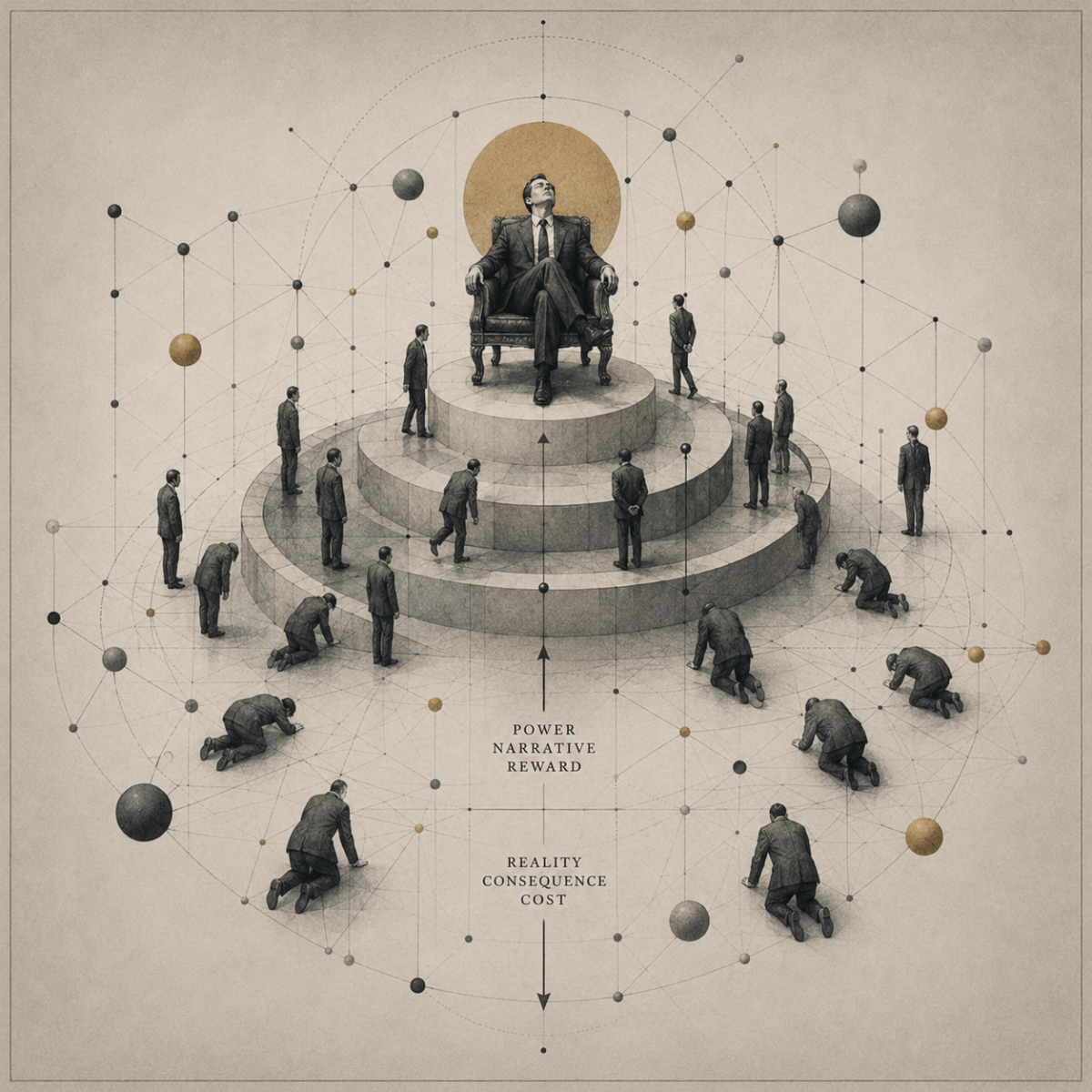
The spectacle unfolding in the United States is often described as though an otherwise healthy political system has suddenly been overtaken by greed, corruption and the pursuit of private power. That framing is comforting because it implies an external cause: a handful of bad actors, an unfortunate election, an institutional failure that can eventually be repaired. The more difficult question is not how such a system became so grotesquely corrupt, but why its underlying corruption was not obvious from the start.
Extreme wealth is not a self-contained virtue. It is a dependency. No billionaire contains billions of dollars in any meaningful sense. That wealth exists only because legal systems recognise ownership, financial systems preserve claims, governments enforce contracts, infrastructure enables production, workers sustain organisations, and millions of people continue to participate in the symbolic order that gives money its force. The greater the fortune, the larger the network of social, political and institutional dependencies required to maintain it. What appears as personal independence is often an unusually successful dependence upon everybody else.
This is where the category mistake begins. Wealth and personhood are different kinds of things. A person is a living process. Wealth is a distributed social relation. Yet American political culture repeatedly treats economic position as evidence of personal superiority, as though the individual standing at the centre of a vast network had somehow generated the network from within themselves. The systems disappear from view, leaving only the mythology of exceptional talent, private genius and heroic self-creation.
The current scramble for money, influence and institutional control is not alien to this arrangement. It is continuous with it. Large competitive systems do not invent greed, ambition or selfishness; they organise and reward them. Constitutions, markets and legal frameworks are often spoken of as neutral structures standing above human motives, but they are nothing of the sort. They determine which behaviours become easier, more profitable and more durable than others. When wealth can purchase access, shape law, influence public discourse and protect itself from consequence, accumulation ceases to be merely economic. It becomes a method for reorganising the state around its own persistence.
The problem, then, is not that some ugly and foreign corruption has percolated upward and seized the Senate, the courts or the executive. The greed was always present. The ugliness was always available. What has changed is the degree to which the legal and financial systems now reveal their capacity to sustain the wealth of a few at the cost of everyone else. The mythology of meritocracy, exceptionalism and equal opportunity has concealed this by presenting distributed social dependence as individual achievement and structural advantage as personal worth.
This is the essential American crisis. The institutions assumed to restrain concentrated wealth and power increasingly appear organised to preserve them. The billionaire is treated as the source of the wealth rather than the temporary beneficiary of a civilisation-wide network that makes it possible. Corruption is then misread as a deviation from the system, when it may be the system expressing its most stable incentives.
The question is no longer how something so grotesque could have happened. It is how the stories told about freedom, merit and democracy prevented so many people from seeing what had been there all along. Nothing fundamentally new has emerged. Layer by layer, the mythology has simply fallen away, revealing the underlying organisation beneath it. The greed, arrogance, extraction and concentration of power were never foreign to the system. They were among the behaviours it proved increasingly capable of rewarding, reproducing and protecting. What appears to be a collapse of the American ideal may instead be an act of revelation. As the stories dissolve, the underlying structure comes into view, exposing a system that has long rewarded precisely the behaviours it now appears unable to restrain.
Categories
the strange ontology of power
Extreme wealth is not independence. It is an unusually successful dependence upon everyone else.