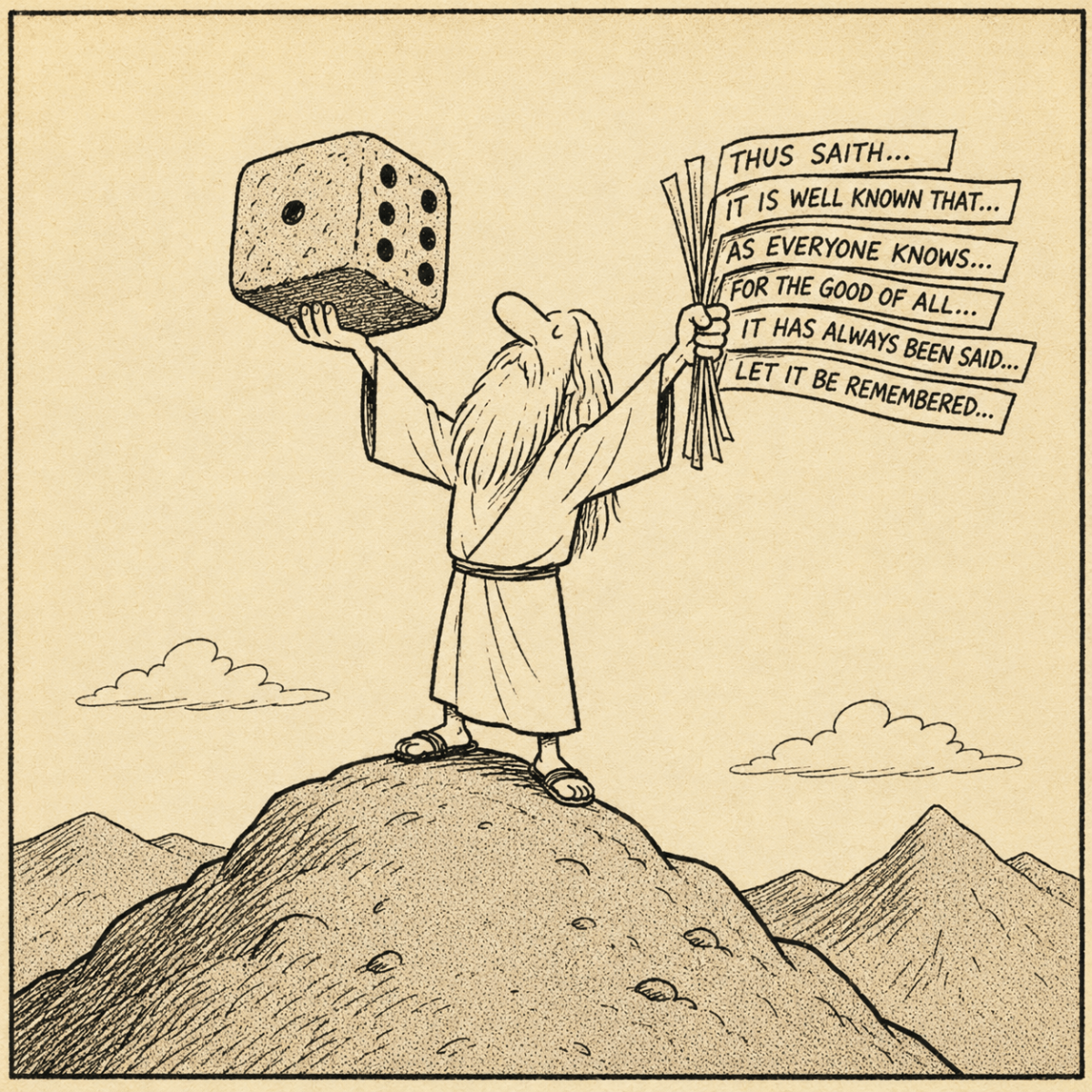
The most probable things to say and do are often the most rewarded. Reward need not mean agreement, approval or money. Opposition can work too, confirming the role being performed and creating another occasion for its repetition. This is especially visible in technologically mediated politics, where reaction itself has become commercially valuable. Idioms, clichés, familiar gestures, beliefs, preferences and social roles persist because people recognise them, anticipate them and know how to respond. One move calls forth another, including its predictable contradiction. People anticipate what they think people like themselves will say or do, then do it. What is said and done changes what can meaningfully follow.
The same pattern operates at the scale of history. Revolutions, wars, political crises, financial panics and cultural upheavals arise in worlds already crowded with expectations about what such moments mean and how people should respond. Rulers, governments, populations, allies and enemies inherit languages, beliefs, practices, roles and institutions that make some responses easier to imagine and enact than others. Strategy and manipulation occur, but the players do not choose the board on which they begin. Each move changes the position inherited by the next. What later looks inevitable, providential or suspiciously well orchestrated may partly be the accumulated result of people making the moves their circumstances had made easiest to expect.
Those easiest moves are also low-energy solutions. Familiar language, established routines and expected responses require less effort than continually negotiating new ones. They create local order by narrowing what must be considered at each step. Some also produce the volatility that appears to validate them, creating further occasions for the same narratives, actions and responses. These are the patterns that catch fire. Recurrence creates the conditions for further recurrence. Across the larger communicative ensemble, highly ordered local patterns can therefore coexist with, generate and recursively depend upon greater combinatorial possibility across the wider field. The system encounters consequences it helped produce, and those consequences change what becomes probable next.
Repetition does more than make repetition more likely. Similar patterns recur across time, each carrying something of what came before, and those accumulated relations become structure. A phrase becomes an idiom, a behaviour a convention, a convention a norm, repeated procedures an institution. Significance, authority and tradition can be constructed and reinforced through this historical depth. What happens now carries the accumulated weight of what has happened before. That weight changes what becomes probable next. Structure, in this sense, is what persistent recurrence looks like across time.
Recurrence also provides a way into the pattern. Statements and actions persist partly through their form, timing and relation to what surrounds them. Something different can follow an established pattern closely enough to become readily intelligible, while changing what that pattern makes likely to follow. It need not confront the pattern from outside. Its own rhythm can carry something different through it. The structures that stabilise language, belief, behaviour and culture can therefore also become the means by which they change.
A deeper question follows. Given enough interacting elements exchanging information and energy, do some forms of organisation become difficult to avoid? Logic may be one of them. Language-like communication may be another. Structurally, a language-like system relates differentiated signals to differentiated responses so that previous exchanges alter the probability of subsequent states. Human language is one highly developed instance, but similar organisation appears in genetic regulation, cellular signalling, neural activity and other systems where differences become consequential for what follows. Feedback introduces memory. Memory changes expectation. Expectation changes recurrence. Something resembling inference can emerge without anyone having invented it.
The probable is a proper subset of the possible, and what has happened continually changes its distribution. Communication makes this visible. What is said and done changes what can meaningfully follow. Language changes the probability of thought, thought the probability of action, action the probability of events, and events the field from which subsequent language, thought and action emerge. History is neither predetermined nor random. We choose among possibilities while participating in the production of the probabilities confronting whoever, or whatever, chooses next. The future remains possible in many directions, but not equally probable in each. Every move changes the game, and the odds, for whoever plays next.
Categories
Probably: Why What Happens Keeps Happening
The probable is a proper subset of the possible. Old habits die hard because viable communication preferentially reproduces patterns that make themselves more likely to recur.