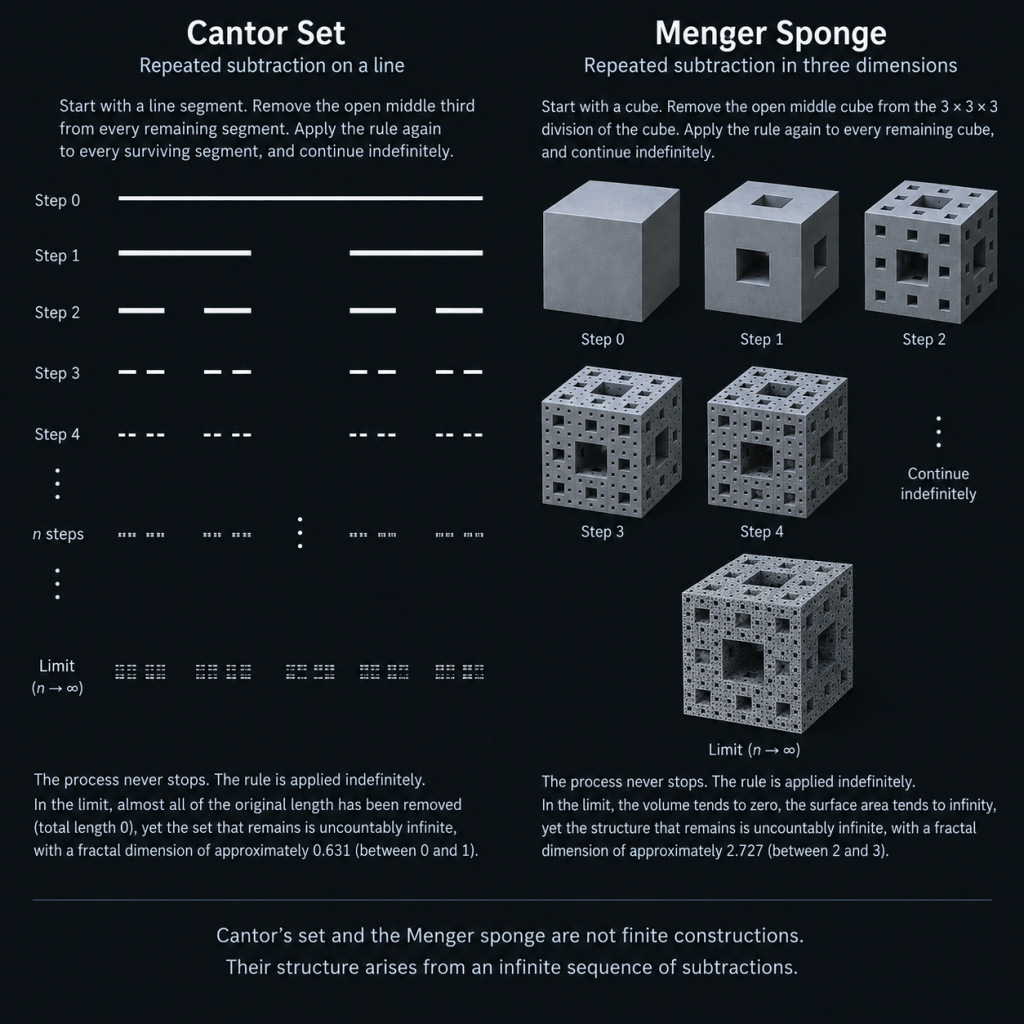
The spiritual is not an explanation inserted where knowledge fails. It is a name for the inexhaustible dimensional and relational depth that belongs to reality itself. We have spent a great deal of history putting heaven somewhere else: above us, beyond us, after us, as though whatever exceeds ordinary experience must inhabit another world. Mathematics suggests a more interesting possibility. Reality need not contain a supernatural elsewhere to exceed every finite description of itself. The structures through which we describe this world already extend far beyond the dimensional intuitions through which we ordinarily experience it.
Even elementary fractal geometry begins to loosen those intuitions. Take a line segment, remove its open middle third, then repeat the operation on every surviving segment. At the limit almost all of its original length has disappeared, yet the Cantor set that remains is uncountably infinite and has a fractional dimension of approximately 0.631, neither zero nor one. Perform a related recursive subtraction on a cube and the Menger sponge appears: its volume tends towards zero, its surface area towards infinity, and its fractal dimension lies between two and three. These structures matter because dimension itself has escaped the simple categories supplied by ordinary perception. Recursive relation generates structure that cannot be adequately described as merely zero-, one-, two- or three-dimensional.
Mathematics goes considerably further. Spaces of four, ten or a thousand dimensions present no special difficulty, and infinite-dimensional spaces are indispensable across modern analysis. A Hilbert space is one such mathematical space: a generalisation of ordinary Euclidean geometry in which independent directions correspond to dimensions, but where their number need not be three or even finite. It retains enough geometric structure to define lengths, angles and relationships between states while allowing those states to inhabit spaces far beyond anything we could directly visualise. Quantum mechanics represents physical states in Hilbert space, often infinite-dimensional, while field theories are naturally expressed through spaces of possible field configurations. This does not demonstrate that the universe possesses infinitely many spatial dimensions, still less that an equation has discovered God hiding behind the furniture. It establishes that the dimensional structure required to understand physical reality is not bounded by the geometry delivered to ordinary human perception.
Dimension, in this broader sense, need not mean another direction in which an object could travel. It can express independent degrees of variation and relation: ways a system can differ while remaining the system under description. Higher and infinite-dimensional mathematics therefore need not imply innumerable hidden spatial directions. Even a finite physical world can possess relational structure whose degrees of freedom vastly exceed the geometry through which an embodied observer encounters it. Dimensional depth may be relational before it is spatial.
Stand on a beach at sunset and a shimmering path of light appears to run across the water from the sun directly towards you. Move along the beach and it follows. Another person standing some distance away sees another path directed towards them, apparently just as singular, while hundreds of people distributed along the shore can simultaneously occupy the centre of the same luminous geometry. There is no contradiction. The optics are well understood: differently oriented facets of the moving water reflect sunlight towards different observers. But the physical explanation makes the example more interesting, not less. Each observer can legitimately occupy the centre of their own relational frame while every other observer does so at the same time. In that precise sense, you can be the centre of the universe, and so can everybody else. The universe possesses sufficient logical, structural and spectral depth to sustain all of these locally centred frames simultaneously without requiring any one of them to become the single absolute centre. What appears singular from within a frame can be multiple across the larger structure. The centre is real. It just isn’t yours alone.
Persistence deepens the picture. Anything that persists must recur in some form, and recurrence necessarily has temporal structure. Processes return without returning identically, coupled across different durations and scales. Recurrence has frequency; interacting recurrence establishes phase relations, resonance, interference and harmonics. Stable things can therefore be understood as local coherences within a larger spectral structure, sustained through relations extending beyond whatever boundary happens to identify them. Any finite configuration is a partial actualisation within an uncountable ensemble of possible relations and systems. Things are what sufficiently persistent relational structure looks like locally.
What is absent is consequently not simply missing. Cantor’s construction works because every subtraction changes the relations among what survives; the Menger sponge becomes what it is through its holes. More generally, every determination excludes alternatives, and those exclusions participate in constituting the resulting structure. Reality becomes particular by not becoming everything simultaneously. Its recursion is stochastic rather than geometrically prescribed, constrained by what already exists without being completely determined by it. The actual world is neither arbitrary nor exhaustive.
Long before Hilbert spaces and fractal dimensions, spiritual traditions repeatedly approached this limit through subtraction. Medieval Christian apophasis stripped finite predicates from God because every predicate threatened to make the unlimited into another limited thing. The destination was not nothingness, but the point at which description encountered the limits imposed by its own distinctions. Mahāyāna Buddhism made a different movement through śūnyatā, emptiness: things possess no independent self-nature because what they are arises relationally. As these traditions move through China, they are adopted, translated, contested and transformed, contributing to the emergence of Chan and, through further transmission and transformation, to the distributed historical attractor we now gather under the name Zen. Across that development, emptiness cannot be permitted to harden into another metaphysical object behind appearances, because emptiness is not behind appearances at all. It is inseparable from the forms through which it appears, constituted through the same relations and exclusions by which any form becomes determinate. Form is not replaced by emptiness. Form is empty, and emptiness is form. The difficulty is that we are culturally and psychologically predisposed to treat appearance as surface and reality as something hidden beneath it, when here that distinction itself begins to fail. The structural resonance lies in refusing to mistake what can be finitely distinguished for the totality from which distinction becomes possible.
I cannot tell you what heaven is. Even the word is unstable. In ordinary language it can mean somewhere good we go after death, a state of perfection, freedom from suffering, perfect peace or love, or simply a world immeasurably better than this one. Much of the popular imagery merely continues ordinary life under improved conditions: ourselves, our desires and our familiar world, only without the inconvenience of loss, scarcity or death. That may be comforting, but it is also suspiciously unimaginative. If heaven indicates anything beyond the conditions that presently constitute us, we should expect our descriptions of it to fail precisely because they are assembled from those conditions.
So I use heaven cautiously, less as the name of a place than as an indication towards something our different metaphysical, spiritual and utopian vocabularies repeatedly approach without fixing. Their representations change radically between cultures, periods, traditions and individual lives. What interests me is what survives those transformations. Peace changes its form but remains recognisable as peace; freedom can survive radical changes in the conditions through which it is expressed; love persists through transformations of person, relation, language and circumstance without being reducible to any one of them. There are invariants here: patterns sufficiently deep to remain identifiable while the frames through which they appear continue to change.
And the frames are always changing. Observers move, relations change, systems reorganise, generations replace one another, languages drift, knowledge accumulates, possibilities become actual and new possibilities emerge. The shimmering path across the sea moves with every observer and remains a path of light. What persists is not necessarily a fixed object beneath these transformations, but relational structure preserved through them. Identity need not mean immobility. Something can remain itself precisely through transformation.
This is also where the possibility of a better world becomes more than utopian decoration. We are remarkably good at changing what occupies a frame while preserving the frame itself. Ideologies promise different worlds while reproducing opposition, identity and insecurity. Technologies transform capabilities while carrying forward familiar appetites for control, accumulation, competition and certainty. Even utopias are commonly imagined as the present world with its frustrations removed and its rewards redistributed. Enormous transformation occurs at the surface while remarkably little changes underneath. We keep rebuilding the same attractor with better equipment.
A better world requires more than rearranging what already exists inside that attractor. It requires recognising what remains invariant as frames change, and therefore what need not remain bound to any particular frame. Peace, freedom, love and kindness are not commodities waiting to be maximised within the existing arrangement. They indicate relational possibilities that change with the ways self and other, difference and identity, possession and security are constituted. The transformation is not an escape from reality. It is a transformation in how reality is differentiated, understood and inhabited.
I can therefore say less about what heaven is than about where the word points. Not beyond reality, because any beyond we indicate is already constituted through its relation to here. Not in some supernatural annex reserved for whatever science has not yet explained. And not as an eternal reproduction of the world we already have, stocked with everything we currently imagine ourselves wanting. That would be an extraordinarily elaborate way of going nowhere. If heaven indicates perfection, peace, freedom, love, release, possibility, or something for which these are themselves inadequate names, then its conditions must already be latent within the relational depth of reality. Otherwise they could bear no relation to us at all.
This is not a God of the gaps. The claim depends on no particular ignorance surviving the advance of explanation. Mathematics does not prove heaven, and physics does not reveal a secret coordinate where the spiritual has been hiding. They indicate something stranger and more interesting: reality possesses depths of relation, dimensionality and possibility that no finite perspective exhausts. Fractal dimension already exceeds ordinary dimensional intuition; infinite-dimensional mathematics goes further; physics requires spaces of possibility far richer than the world presented directly to perception; and time ensures that the relations through which any world appears continue to transform.
Consciousness belongs inside this picture. An observer is not outside reality looking in, but one of the ways reality becomes locally capable of encountering itself. Like the paths of sunlight across the water, perspectives can each possess genuine local coherence without any one exhausting the event that makes them possible. No perspective can become the whole without ceasing to be a perspective. Yet transformations between perspectives can preserve relations, patterns and invariants. The world changes according to where we stand, and something remains through the change.
That is why I cannot tell you what heaven is. To define it finally would contradict the structure that makes the word interesting in the first place. I can indicate where it must be: here, within the inexhaustibility of reality itself, among structures and possibilities that persist, transform and emerge without any finite configuration exhausting them. The better world may require less invention than recognition: not another reality, but another way of inhabiting the inexhaustible reality already here. The spiritual is not hiding in the gaps left by knowledge, nor is heaven the reward waiting when reality is over. Reality does not appear to have an over. There is always another relation, another transformation, another perspective, another possible coherence.
Whatever heaven means, there is more.
Concept Space
The Big Empty: Consciousness, Cosmos, and the Generative Logic of Absence
https://daedeluskite.com/2025/12/01/the-big-empty-consciousness-cosmos-and-the-generative-logic-of-absence/
Absence is structural incompleteness through which differentiation remains possible. Boundaries constitute what they exclude; observers introduce internal division; and completion would erase the distinctions required for persistence.
The Infinite
https://daedeluskite.com/2025/12/13/the-infinite/
Develops infinity as intrinsic to finite structure rather than as a remote destination. Description produces boundaries without exhausting the relational field those boundaries distinguish.
Georg Cantor
https://daedeluskite.com/2025/05/05/georg-cantor/
Provides the mathematical undertone. Recursive subtraction destroys ordinary continuity without exhausting structure: almost all length disappears while an uncountably infinite remainder persists.
Applied Field Logic: A Gentle Mathematical Introduction
https://daedeluskite.com/2026/06/27/gentle-introduction/
Provides the formal background for the harmonic argument: persistence requires recurrence; recurrence possesses temporal structure; and interacting recurrence establishes frequencies, phase relations, synchronisation and harmonic organisation.
Reality
https://daedeluskite.com/2026/06/21/reality-2/
Extends the relational structure into ontology. Stable things are local coherences rather than primitive substances, maintained through difference, recurrence and relation.
Peace
https://daedeluskite.com/2021/06/14/peace/
An earlier expression of the same structure before the later Field Logic vocabulary was developed. Peace, freedom, love and unity resist possession as completed objects; their apparent absence points towards the open relational conditions through which they can exist at all.