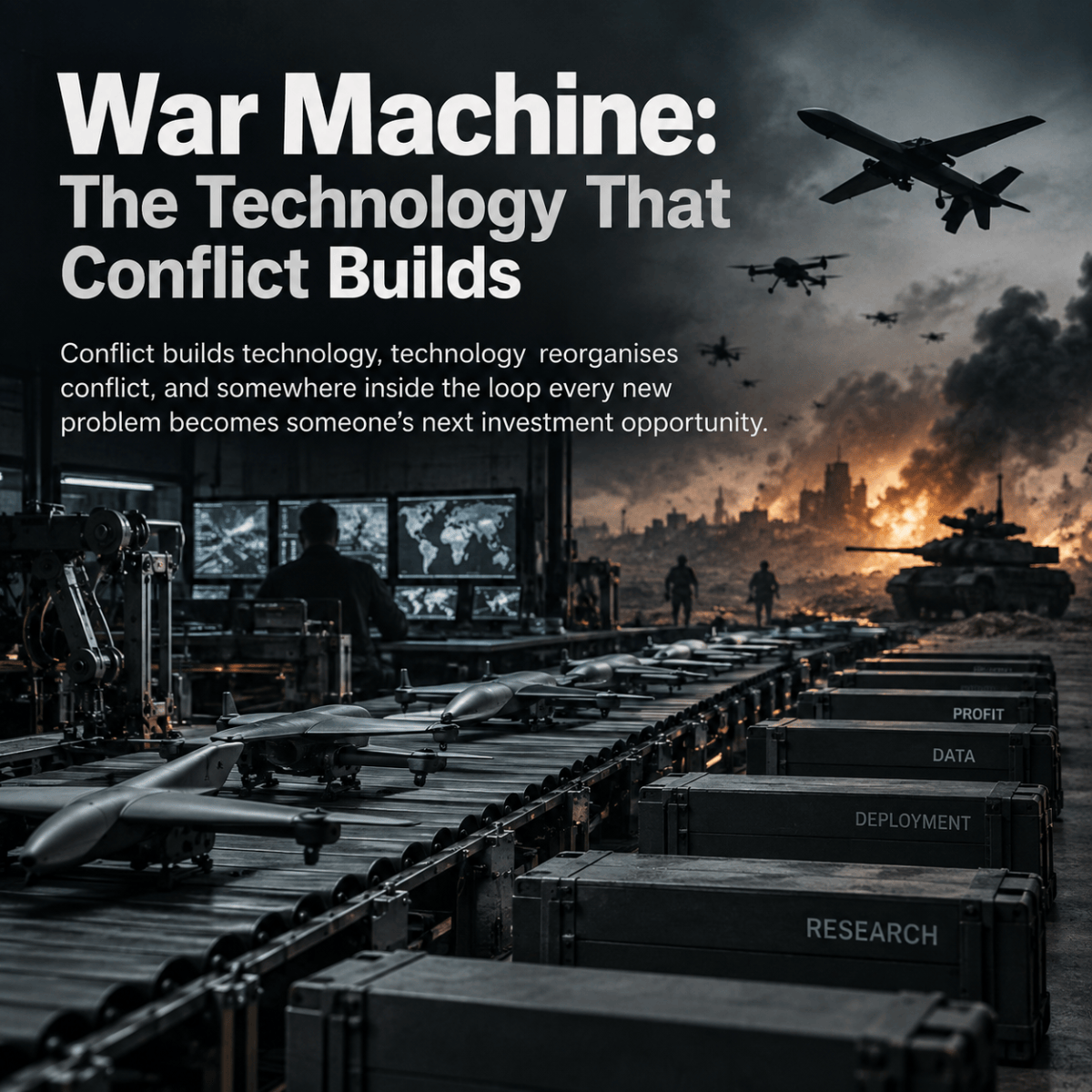
There is a remarkably efficient pipeline between technology, conflict and money. Conflict creates problems for technology to solve; technological solutions change the conditions of conflict; changed conditions create new vulnerabilities, countermeasures and strategic possibilities; these generate data, products, investment and another round of technological solutions. Artificial intelligence, autonomous systems, drones, electronic warfare and cybersecurity now circulate through this relation with extraordinary speed. The interesting thing is not simply that there is money in war. There has always been money in war. It is that technological conflict increasingly generates the conditions for further technological production. Better drones require better ways to detect and disable drones. Better surveillance creates demand for better ways to evade surveillance. Better cyberattack tools require better cybersecurity. The solution changes the problem, the changed problem requires another solution, and somewhere along the way somebody discovers that the whole sequence has a business model.
Cybersecurity makes the structure particularly easy to see because there is no final secure state waiting at the end of sufficient technological progress. A useful network must remain open enough to communicate, authenticate, exchange data, update software and interact with people. Every additional capability introduces further interfaces, dependencies and possibilities for failure or exploitation. Security reduces particular risks by changing the environment in which risk occurs. The same structure appears more broadly across technology. Local order is achieved by displacing uncertainty, dependency and complexity into the surrounding system. That displacement does not disappear. It returns through other relations, at other scales and usually somewhat later, by which time it has acquired a budget. Technology has become exceptionally good at recycling its own waste: not merely the material waste piled somewhere beyond the factory fence, but the uncertainty and vulnerability generated by technological intervention itself. Yesterday’s solution becomes part of the environment producing tomorrow’s problem. Tomorrow’s problem arrives with another solution, another dependency and another market attached.
This is what makes the enthusiasm surrounding technological conflict so disturbing. Conflict drives deployment; deployment produces testing and data; data improves systems, demonstrates capability and attracts investment; improved systems alter the strategic environment and generate new problems for everyone interacting with them. Volatility becomes economically and informationally productive. Nobody involved needs to be especially wicked. Engineers optimise capabilities, companies pursue markets, investors pursue returns, governments pursue strategic advantage and researchers pursue whatever fascinating problem has just appeared in front of them. Each action can be locally rational while the collective trajectory is spectacularly stupid. Every participant acts inside conditions partly produced by everyone else’s actions. Nobody controls the whole process, yet each response changes what everyone else must respond to next. The pattern persists not by repeating the same events but by reorganising the differences, dependencies and incentives through which another turn becomes likely. Conflict feeds technology; technology reorganises conflict; reorganised conflict produces new problems; new problems feed information, investment and further technology. Around we go.
The frightening part is that recognising the pattern does not place us outside it. Our default response to a technological problem is now more technology. More technology changes the problem. The changed problem prepares the ground for still more technology. Institutions, professions, markets, infrastructure and ordinary expectations become organised around successive turns until solutions become dependencies and dependencies become necessities. Simply describing the machinery does not provide a position outside it. There is no external engineer standing beside the system with access to the master switch. We are components of the process attempting to understand a process partly constituted by our attempts to manage it. The system does not need to intend its destination, believe in it or even recognise that it has one. It only needs to keep reproducing the relations that make the next response locally sensible. Conflict creates the problem. Technology changes the problem. The changed problem demands more technology. There is no someone else’s problem here. What we keep calling technological progress is becoming extremely proficient at generating the conditions under which still more technological progress appears indispensable.
Categories
War Machine: The Technology That Conflict Builds
Conflict builds technology, technology reorganises conflict, and somewhere inside the loop every new problem becomes someone’s next investment opportunity.