
Civilisation runs on language. Every system we build—laws, markets, machines, minds—depends on describing the world in order to act within it. Yet the world always moves first. The act of catching up is not a flaw but the essence of thought: meaning arises in pursuit, not possession. The delay—between what is and what can be said—is civilisation’s pulse.
Perfect alignment would end the rhythm. A system that matched the world exactly would have nowhere to go. Continuity depends on difference. Stability is not stillness but rhythm—a balance that renews itself by staying slightly out of phase with the world it describes. Every conversation, policy, and design holds together not by eliminating contradiction but by learning how to live inside it.
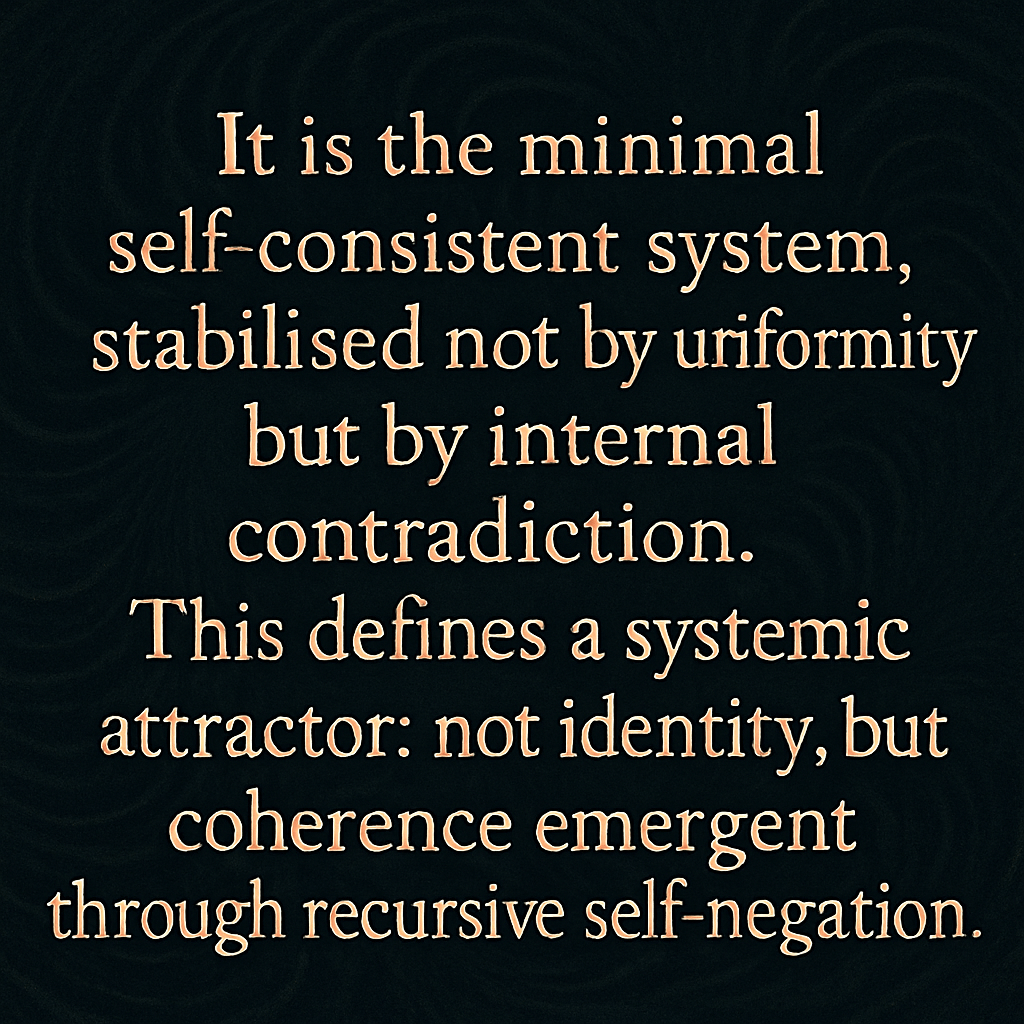
Each system—biological, linguistic, institutional—stabilises itself not through uniformity but through contradiction. It is the minimal self-consistent system, coherence maintained through internal tension, self-correction, and feedback.
Language doesn’t simply describe reality; it shapes what can exist within it. Every rule creates exceptions. Every act of definition generates its opposite. Meaning propagates through tension—the same instability that drives adaptation. The clearer our language becomes, the more ambiguity it generates elsewhere. Civilisation grows by encoding its own misunderstandings—each attempt to clarify reality produces new forms of complexity that demand fresh interpretation.
Technology accelerates this recursive pursuit. Algorithms predict the past faster than we can remember it. Machine learning mirrors the human condition: refinement without arrival. Its models follow reality by an instant—intelligence through delay.
Power survives not by eliminating uncertainty but by distributing it. Institutions manage delay, balancing the rhythm of trust and doubt. Strategy, at its best, is not control but calibration: too much order and systems suffocate; too much chaos and they collapse. Effective governance is rhythmic alignment across scales—knowing when to act, when to wait, and when to allow correction to emerge from the edges.
Meaning lives in relation. Locally, it forms through interaction and feedback; globally, through the broader curvature of connections. The world is less a collection of parts than a continuous field of dependencies. Entropy here is not decay but the openness that makes reorganisation possible—the space that keeps systems alive.
The self is not a substance but a relation sustained by absence. To erase the gap between who we are and who we think we are would end both. Art understands this: it leaves room for meaning to breathe. The blank space is not emptiness; it is the condition of creation.
We rarely see the medium that sustains us. Culture, language, and technology move through us, not the other way around. The symbols we use—flags, interfaces, uniforms—are stabilised echoes of meaning, small devices for synchronising the larger rhythm.
To live wisely in such a system is not to seek finality but coherence: to sense the pulse of delay and move with it. Order endures only by transformation. Every form of understanding is temporary, every truth a momentary alignment between change and description.
Civilisation, in the end, is a game of words. Its continuity depends on the delay between world and word, action and understanding. The world moves first, language follows, and in the space between them—our uncertainty, our adjustment, our endless translation—life persists.


One reply on “Coherence through Contradiction: A Game of Words”
LikeLike