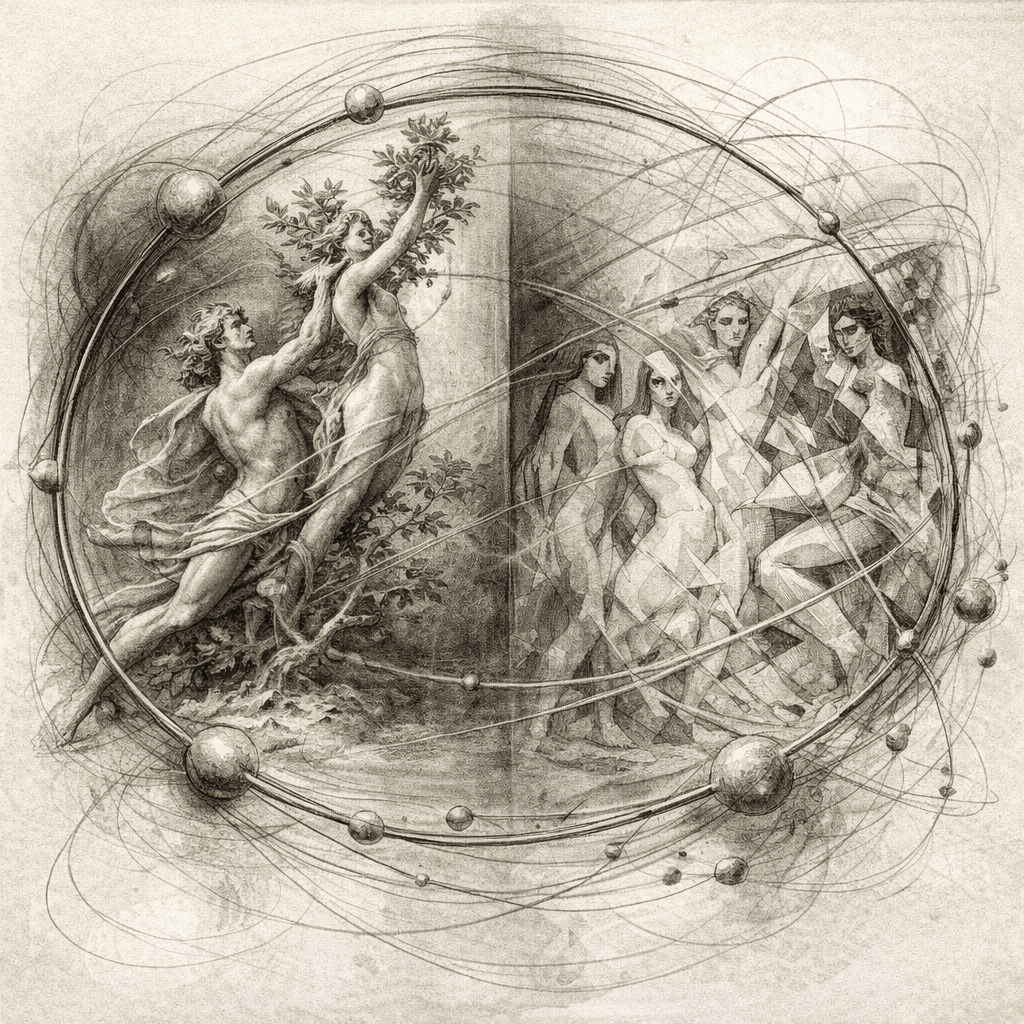
Desire does not move in straight lines. It curves. It sustains itself through distance, delay, and asymmetry, forming a logical orbit rather than a trajectory toward fulfilment. What appears in lived experience as longing or pursuit is not a failure of arrival but the mechanism by which relational systems remain open rather than collapse into symmetry. Desire persists not because it succeeds, but because it must not.
This is not a permanent metaphysical structure or a law written into the world. It is a contingent expression of how dynamical systems appear when they are lived, perceived, and articulated through human bodies, cultures, and symbolic forms. Whatever the world does, it does through and as us. It is therefore unsurprising that, in the texture of experience, we encounter echoes of the same logical symmetries and anti-symmetries that govern fields, signals, and systems more generally.
Arrival, in this sense, is closure. It is completion in the logical sense, the point at which a system exhausts its degrees of freedom and collapses into symmetry—the attainment of transient certainty, where structure hardens, identity becomes legible, and a navigable path briefly appears. This certainty is stabilising precisely because ambiguity has been reduced, but it is also terminal. Once the path is fully navigable, the orbit collapses.
What draws attention, generates incentive, and sustains motion is not completion but the attractor that sits just short of it: the site of lag, the site of delay, the phase difference carried by the signal itself. Signals do not transmit despite delay; delay is the signal. That unresolved interval is where motivation coheres, not as desire for an object, but as sustained movement without a final point.
Counter-intuitively, it is precisely the absence of a final point of full closure, complete knowledge, sustainable control that functions as the attractor. The microcosms we recognise as interpersonal, emotional, or political pursuits are scaled instances of this same dynamic. The larger field behaves no differently. Named without metaphor, that field is simply the universe doing what it does.
At the core of this dynamic is a structured absence. Between any two positions there is not only opposition but relation, and that relation is not reducible to either side. It is not an entity that can be occupied or possessed. It appears as nothing, as neutrality, as silence, yet it is the condition that makes relation possible at all. What gives the vessel its function is not the clay but the space it encloses. Between two ends of a line, the line binds. Even when unseen, unknown, or epistemically inaccessible, it remains active. This emptiness is not a void but an internal harmonic structure, circulating through the system and sustaining its coherence. The logical orbit is carried precisely by what cannot appear as an object, by what must remain unfilled in order for relation to persist.
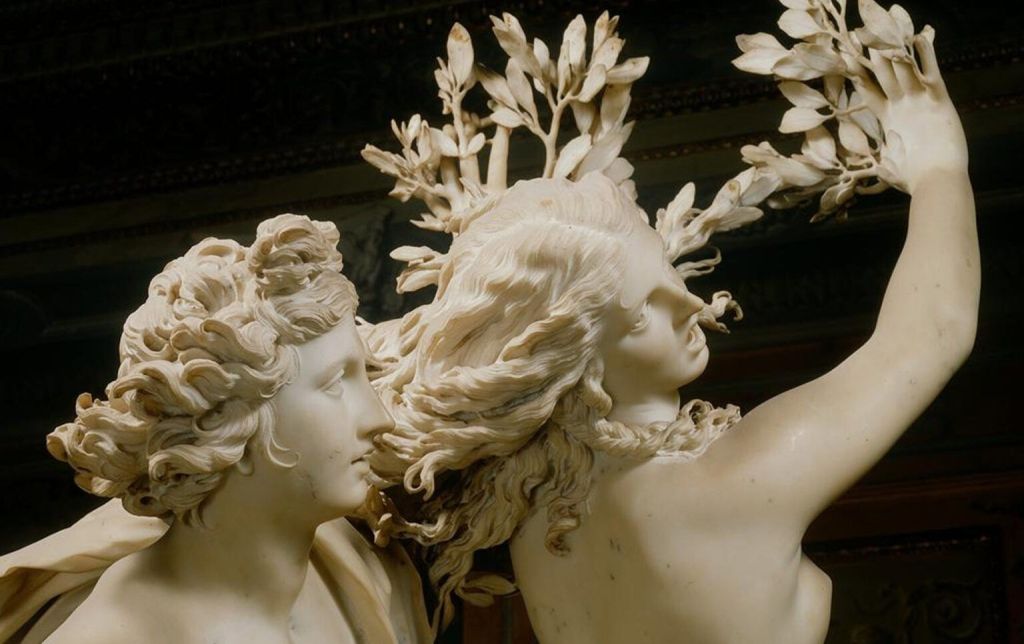
This becomes visible with particular clarity in Bernini’s Apollo and Daphne. In the myth, Apollo’s desire is absolute, accelerated by divine intervention and aligned with certainty, possession, and knowledge. Daphne’s response is not reciprocal desire but flight. She runs not simply from Apollo but from the closure his pursuit represents. As escape by distance becomes impossible, she turns to her father, the river god Peneus, and asks not to be saved but to be changed. Her transformation into the laurel tree is not an evasion of relation but its preservation. Metamorphosis interrupts arrival. It displaces desire into reverence, repetition, and symbol. Apollo does not grasp Daphne; he inherits the sign of what he cannot complete.
Bernini freezes the instant where closure is everywhere invoked yet nowhere permitted to occur. The absence of completion is not a defect but the sustaining condition of the field the sculpture holds open. The work has no path back to equilibrium, no resolving chord, only sustained tension. It is not about arrival but about delay as the condition of relation, where the distance between reach and touch generates the experience. Daphne’s transformation preserves difference through phase change rather than avoidance. Contact would not complete the relation; it would destroy it by collapsing the very asymmetry that sustains it. The lack of return does not weaken the field. It is the field.
The figures are placed in opposition, but not as stable identities or symbolic endpoints. They function as relational poles within a dynamical configuration, temporarily bearing positions that could be occupied by any agents whatsoever. In other contexts, such figures are obligated to carry gender, power, desire, and expectation. Here, those assignments are secondary to the geometry they instantiate. What matters is not who stands where, but that the relation itself requires opposition, distance, and asymmetry in order to remain active. The binding force does not belong to the figures; it passes through them. The roles are contingent. The structure is not.
This introduces a quiet bind for the protagonist in any desirous configuration. They are defined by the vector they inhabit, by the direction and intensity of pursuit, and yet they must never quite arrive. Arrival would dissolve the very conditions that give coherence. If arrival occurs, it must be displaced, problematised, or repeated so that the orbit can be re-established under altered conditions. The subject is thus compelled into recurrence: pursuit, partial resolution, destabilisation, renewal. This is not pathology. It is structure. Many of the difficulties we encounter arise from treating the end as real, attainable, or necessary, rather than recognising that the end does not, and cannot, exist.

The same underlying logic reappears under radically different conditions in Picasso’s Les Demoiselles d’Avignon. Narrative time is removed. There is no chase, no transformation, no mythic unfolding to distribute desire across duration. Instead, the field is compressed into simultaneity. Resolution is not deferred but structurally denied. Desire exists only as a suspended signal with no destination, its intensity arising from the impossibility of stabilising reference rather than from any imagined point of arrival. The figures do not invite approach; they repel orientation. Each face deflects the gaze, and every attempt at mastery collapses into angular displacement. The observer is no longer outside the system but drawn into it as a destabilising variable.
What unites these works is not subject matter but structure. Both articulate desire as a contoured relational space sustained by imbalance. In Bernini, the orbit is extended through mythic time and metamorphosis. In Picasso, it is fractured across spatial planes. In both cases, the same condition holds locally and globally: completion ends the dynamic, while lag sustains it.
Desire, then, is not oriented toward having. It is a communicative mechanism by which systems remain open. It circulates as probability rather than certainty, as signal rather than destination, concentrating attention without exhausting it. What is experienced as yearning is not an error or a lack but a human-scaled manifestation of a universal dynamic. The orbit is not a metaphor. It is the form relation takes when the universe maintains itself through difference, delay, and the refusal of final closure.
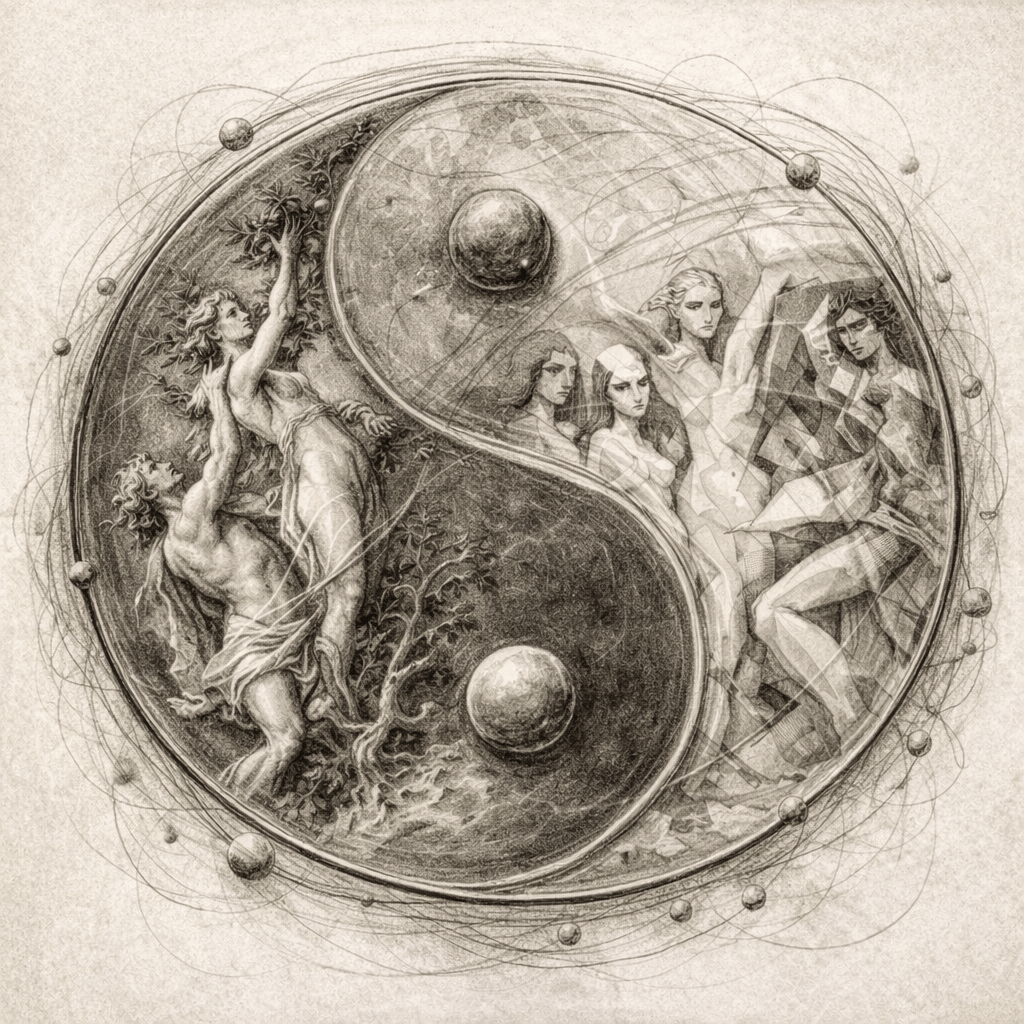
The roles form an anti-symmetry that can be exchanged, while the relational logic they inhabit remains invariant.
 Daedelus Kite
One reply on “Desire”
LikeLike