A system becomes brittle when it treats its own representations as a complete account of the conditions sustaining it. Its categories continue to organise decisions while the relations through which those categories remain useful are changing. The difficulty lies in the loss of responsiveness to what the account leaves unrepresented.
Formal logic describes how conclusions follow from specified premises. Its application depends upon distinctions that remain sufficiently stable to be identified, related and used. The logic beneath logic concerns the relational conditions through which those distinctions acquire coherence and persist across change.
Consider two differentiated processes. Their identities depend upon the boundaries, dependencies and intervals through which they affect one another. A boundary conditions which differences remain consequential, how influence propagates and what each process can encounter. It participates in the organisation through which the processes become distinguishable.
The whole is the distributed organisation through which these local distinctions become possible. Local activity continually modifies that organisation. The whole and its local expressions condition one another: differentiation depends upon the field, while differentiated activity reconstructs the relations through which the field persists.
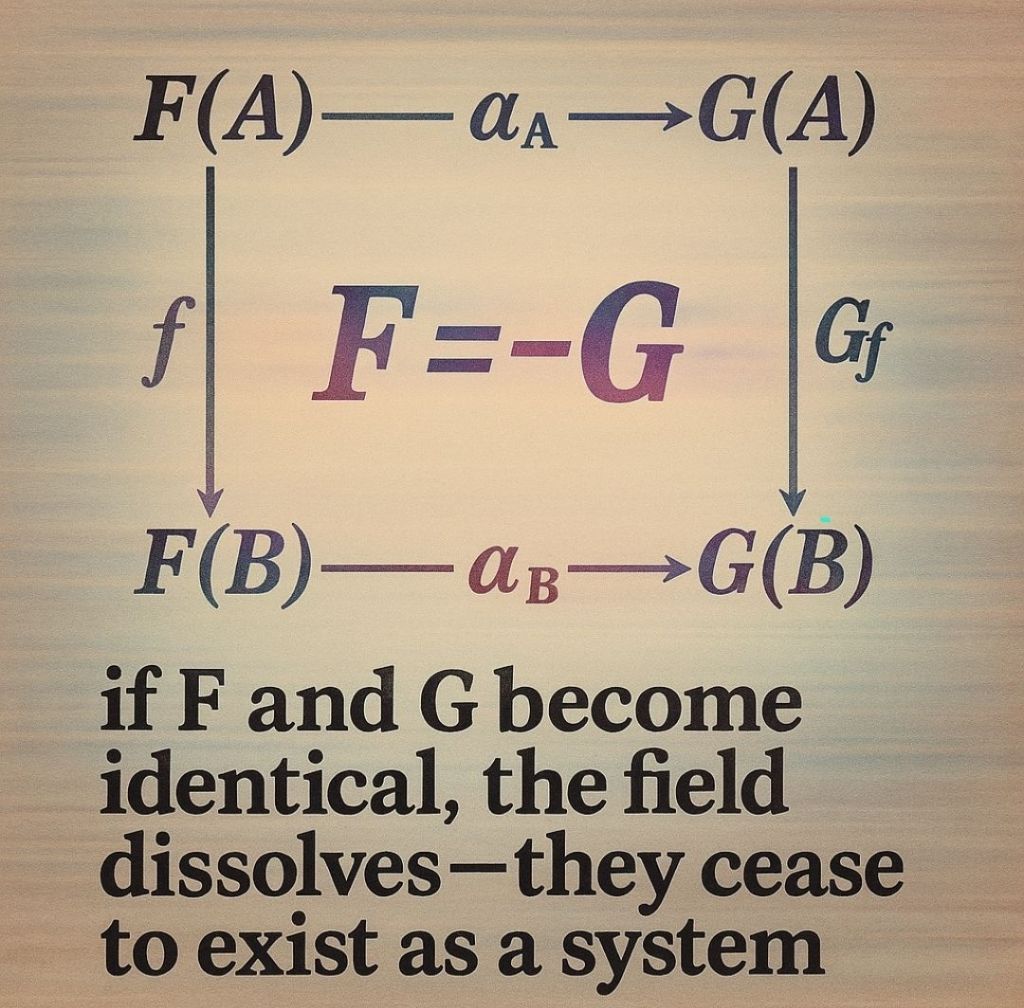
The orbit frame is the local orientation through which a process organises itself. The anti-frame comprises the wider conditions, dependencies and possibilities that this orientation requires and cannot exhaust. Binding absence is the structured interval through which they remain distinct and consequential to one another. It appears through delay, exclusion, unrealised possibility and the unavailability of the whole from any local position.
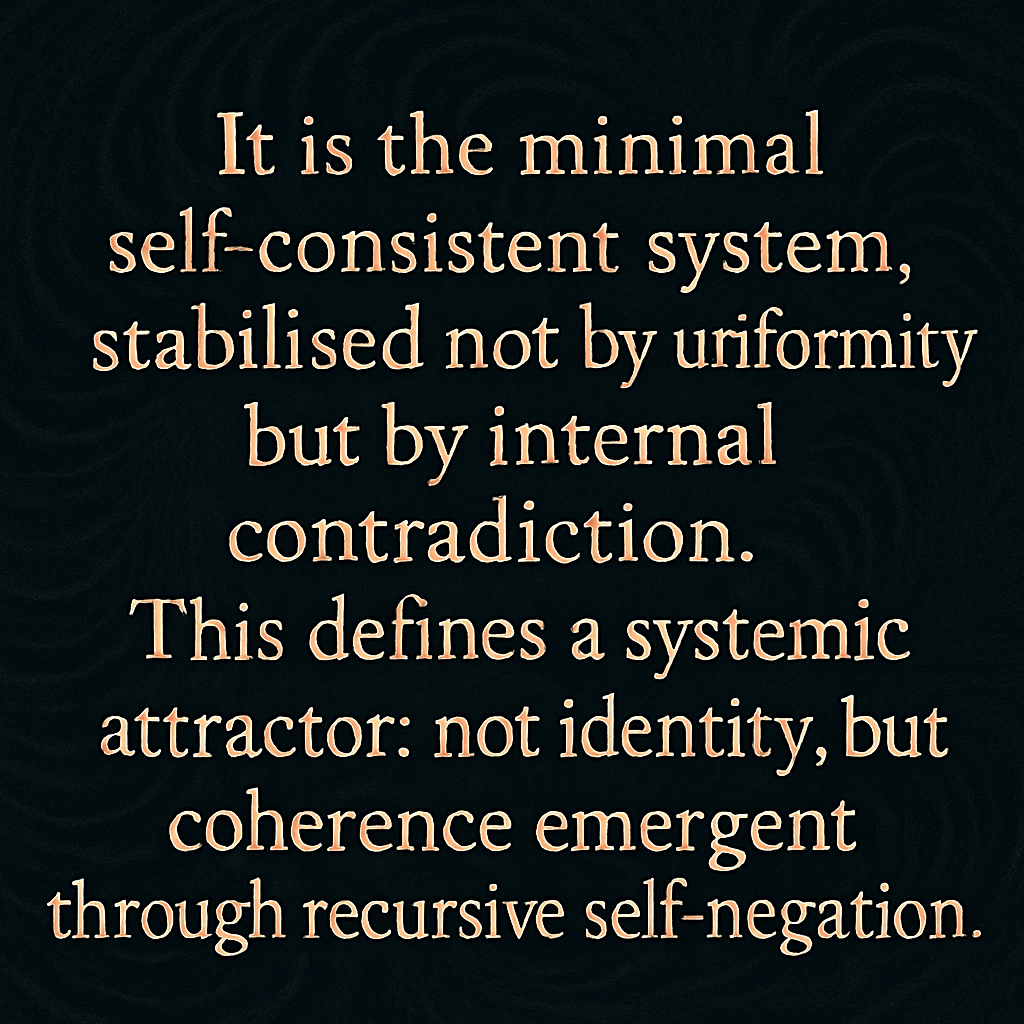
The logical orbit names this constitutive incompleteness. Persistence consists in recursive displacement under constraint: continuing activity reconstructs the relations that make further activity possible. Complete coincidence would erase the distinction through which the terms remain consequential; complete separation would erase their relation. Coherence persists through the continuing organisation of this non-coincidence.
The absent centre names a unity that remains distributed across these dependencies. It acquires local expression without becoming an independent component capable of containing or governing the whole. The absence is structural. Every local orientation depends upon relations that exceed what can appear within that orientation.
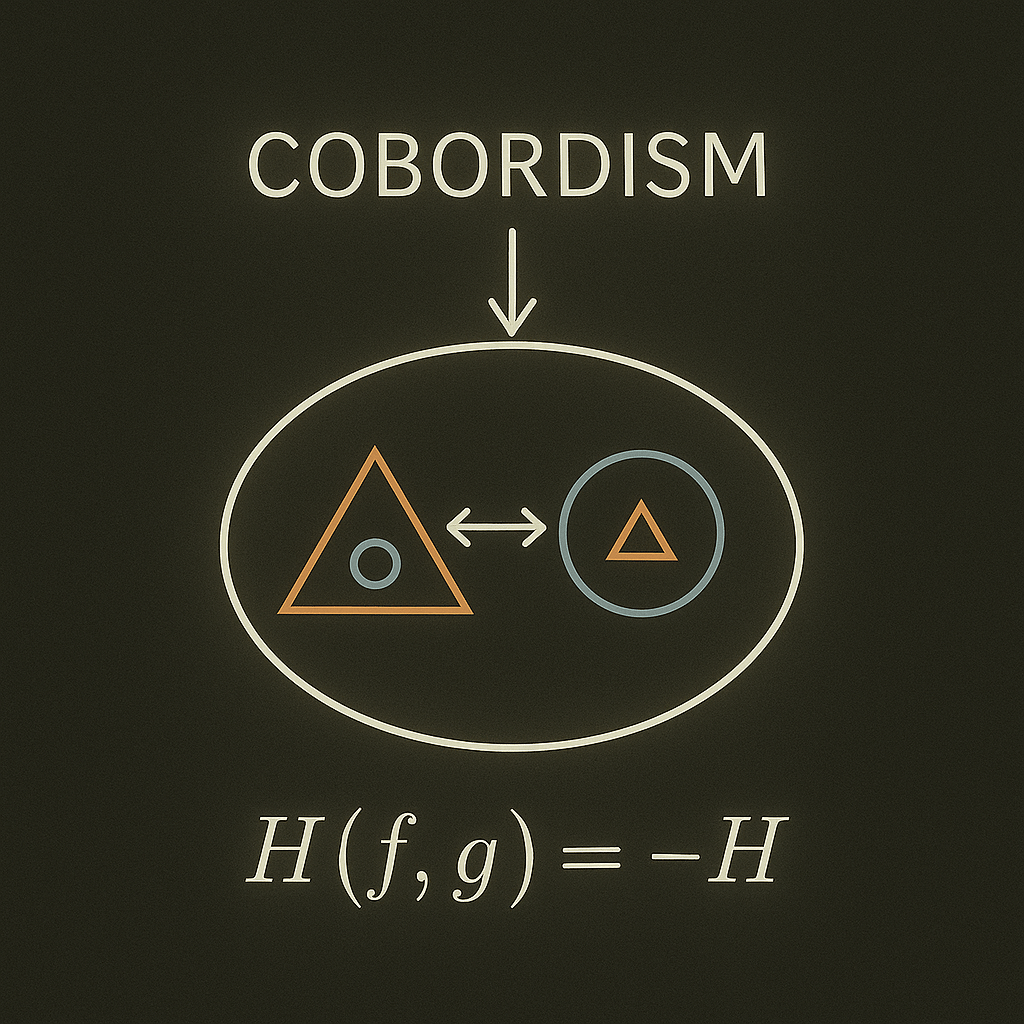
Here the notation H(f, g) serves as a schematic name for the conditions through which f and g remain differentiated and mutually consequential. It specifies no computation or synthesised output. A formal construction would need to define its terms, admissible transformations and criterion of continuity. The philosophical claim concerns the dependence that such a construction sets out to describe.
Specific constraints can be located, measured and modelled. A delay, an asymmetric dependency or a threshold provides local access to distributed organisation. Such descriptions remain selective expressions of the field. Registering a boundary as part of an account changes the account’s resolution while its dependence upon wider conditions continues.
Formal reasoning accommodates changes in terms, meanings and domains when those changes are incorporated into a model. The question concerns the reach of that description and the relations through which it remains applicable. A finite account is established, interpreted and used within an organisation that its selected terms do not exhaust. Logical incompleteness, in this account, names that constitutive non-closure.
The logic beneath logic concerns continuity under transformation: how differentiation remains coherent while its local expressions change. Its topological concern lies in the organisation of connection, separation and boundary. Cobordism motivates a structural account of continuity between distinct forms without requiring their identity. A mathematical application requires specified spaces and a boundary construction establishing the proposed connection.
In language, meaning is sustained across differing uses and contexts, with ambiguity preserving possibilities for further interpretation. In economic organisation, risk and delay are redistributed through dependencies among production, exchange and consumption. In governance, rules and signals acquire practical consequence through the timing and responsiveness of the processes they constrain. Each domain directs attention towards the relations through which differences remain bounded, available and consequential.
Sensitivity to boundary conditions means attending to where models strain, where metrics lose their connection to what matters and where consequences exceed the categories through which they were anticipated. Limits, delays, asymmetries and recurring failures provide access to relations omitted from a local account. Responding to them requires revising the organisation through which the account is produced and used.
A representation also participates in the field it describes. Categories organise attention, measurements alter priorities and interventions change the possibilities available to subsequent activity. Every revision enters this same recursion. Responsiveness consists in maintaining the capacity to reconstruct distinctions as their conditions change.
Logic remains indispensable as a local discipline of organised distinctions. Its effectiveness depends upon the relations through which those distinctions continue to matter. The logic beneath logic concerns their ongoing reconstruction. Uncertainty is the structural medium through which coherence remains open to further relation.