The Coalition’s recent turn on immigration should not be read only as a
policy announcement. I read it as a communication event built around one of the oldest political instruments available: the conversion of broad social anxiety into a visible outsider.
In its own language, the Coalition’s Australian Values Migration Plan promises to strengthen “Australian values,” “shut the door” to people said to abuse the immigration system, and show a “red light to radicals” (Liberal Party of Australia, 2026a).
The clear takeaway is not simply that the Coalition has adopted a harder migration line. My criticism is that this public framing offers a reactive and intellectually thin account of complex pressures. It concentrates on the visible surface of disorder while leaving its distributed causes less visible. It performs control over a simplified image of the system.
This is not a failure confined to conservatives. It is a broader pathology of contemporary politics: the political selection system rewards visibility more readily than demonstrated operational understanding of complexity, even though complexity is the first thing government must deal with.
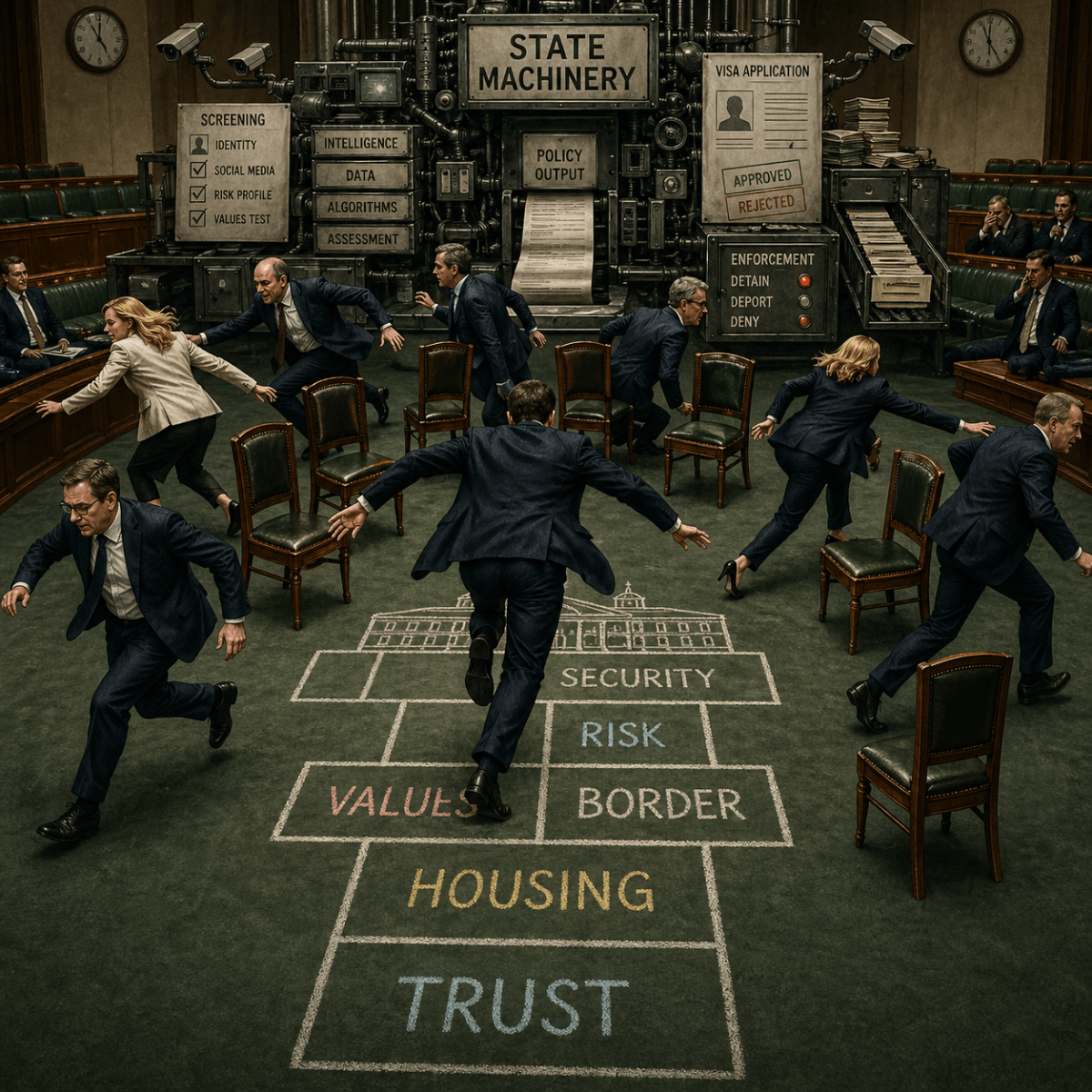
Governments inherit systems shaped by delay, feedback, scarcity, institutional memory, infrastructure, media pressure, economic constraint, and public emotion. Yet when political success is measured through slogans, announcements, punishments, and positional moves, government becomes a sequence of those performances. Electoral politics becomes a strange mixture of hopscotch and musical chairs: everyone jumping between marked squares, everyone listening for the music to stop, movement within the game passing for governance.
The Coalition’s immigration turn matters because, in my reading, its values-and-threats framing illustrates that broader failure. A difficult system becomes a theatrical object. The question is how pressure moves through housing, labour, infrastructure, social cohesion, security assessment, media incentives, and public trust. A message built around an object of suspicion cannot, by itself, answer that question.
This does not mean migration policy is simple, or that states have no right to manage borders, security, housing pressure, integration, labour markets, and public confidence. They do. The problem begins when those distinct pressures are folded into a single political object: the suspicious migrant, the risky country, the radical, the person who does not share “our values.” Once that object is created, it starts doing work that policy itself cannot easily control.
Angus Taylor’s Menzies Research Centre speech connected migration to “protecting our way of life,” restoring living standards, and the Coalition’s Australian Values Migration Plan. It also discussed economic pressures and acknowledged that the vast majority of migrants come with patriotic and contributory intent (Liberal Party of Australia, 2026b). Those qualifications matter. My criticism concerns the weight carried by the threat framing: it invites the public to read immigration as the surface on which national decline, cultural anxiety, economic pressure, and political resentment can all be made visible at once.
That is what I mean by the familiar populist move. It takes dispersed difficulty and gives it a face. Cost of living becomes border pressure. Housing stress becomes immigration failure. Social fragmentation becomes cultural threat. Administrative overload becomes moral weakness. A complex system, full of delayed causes and distributed responsibilities, is compressed into a simpler story: something has entered from outside, and order can be restored by keeping it out.
The short-term attraction is obvious. Such messages travel well. They are emotionally clear, morally charged, and easy to repeat. They produce enemies, slogans, interviews, arguments, clips, and counter-clips. They do not need to solve the underlying problem to succeed in the attention system. They only need to replicate.
That is where the deeper danger sits. Populism is often described as anti-technocratic, but in practice the two can couple neatly. The public language speaks of values, threats, radicals, bad countries, national cohesion, and the protection of a way of life. The administrative layer can then translate that language into screening, surveillance, risk-weighting, visa cancellation, social media review, enforcement, detention, and deportation pathways.
ABC reported that the Coalition proposal included expanded social media screening of visa applicants and deportation consequences for visa holders who breach Australian values. ABC’s AM interview also discussed Taylor’s description of some migrants as a “net drain” on Australia (ABC, 2026a; ABC, 2026b). These were proposed measures, not an account of reforms already implemented.
So the rhetoric does not merely float above the machinery of government. It recruits it. The symbolic outsider becomes a data object. The moral panic becomes a workflow. The gesture becomes a system.
This is how the tail begins to wag the dog. The communication system rewards whatever can be intensified, repeated, polarised, and made legible at speed. Political actors adapt themselves to an environment in which nuance performs poorly while accusation travels, fear binds faster than explanation, and identity has more energy than policy.
But this adaptation is not free. Borrowing the language of the populist fringe can validate the terrain on which the fringe is strongest. It teaches voters to organise difficulty around cultural threat, national betrayal, suspect outsiders, and insufficient force. Once that lesson is taught, the moderate imitator is structurally disadvantaged. The harder actor can always say it earlier, louder, and with less embarrassment.
The surrounding political context matters. Taylor claimed a higher risk of “bad people” coming from “bad countries,” naming Iran. He also acknowledged the contributions of migrants from such countries and said screening should assess individuals (ABC, 2026c). Taylor defended preferencing One Nation ahead of Farrer’s independent candidate (Dhanji, 2026).
AAP also reported Matt Canavan’s address to a Canberra anti-immigration rally attended by Pauline Hanson, with both arguing for tighter migration settings (Brown, 2026).
Whatever label is used, my reading of the communicative direction is clear enough. The Coalition is moving onto terrain where One Nation already knows the road.
The centre then finds itself pulled outward by the signal it amplified. Using the message becomes dependence on the message. The message begins to use the centre.
This is the failure hidden inside the apparent tactic. The immediate benefit may be real. A harder migration line may generate media heat, discipline internal factions, pressure opponents, and recover some voters drifting toward more extreme parties. But the long-term cost is a degraded political sense-making system. The public becomes trained to read systemic stress through identity threat. Policy becomes less able to describe the world accurately because its language has been bent toward mobilisation.
That matters because bad description produces bad control. If housing pressure is described primarily as an immigration problem, then planning failure, infrastructure lag, tax settings, speculative investment, labour shortages, and federal-state coordination all recede from view. If social fragmentation is described primarily as a values problem, then wage insecurity, media architecture, platform incentives, loneliness, inequality, and institutional distrust become secondary.
If national cohesion is framed around exclusion, the country may become less cohesive while claiming to defend cohesion.
This is how a system starts manufacturing the evidence for its own story. Suspicion produces alienation. Alienation produces tension. Tension produces footage, anecdotes, conflict, and political proof. The cycle tightens. What began as rhetoric becomes atmosphere. What began as strategy becomes dependency.
The United States is the warning here, in my reading of its conservative political spectacle. The concern is growing dependence on outrage as a binding medium. When distrust organises people more efficiently than policy, and spectacle becomes a substitute for demonstrated competence, movements built around resentment become harder to contain through institutional management.
The warning for Australia is the direction of travel. When mainstream parties adopt the emotional grammar of the fringe, they do not simply harvest its energy. They alter the whole political field. They make crude explanations more plausible. They make cruel solutions more thinkable. They make administrative overreach feel like common sense.
The issue is not left versus right in any simple way. All political identities can become traps when they harden into self-protective stories. The deeper problem is a culture learning to process complexity through antagonism. Once that happens, every disturbance seeks a culprit, every uncertainty becomes a loyalty test, and every policy failure is converted into proof that the enemy was there all along.
Migration then becomes more than migration. It becomes the surface on which a society rehearses its fear of disorder.
A serious country would resist that temptation. It would separate border management from symbolic theatre. It would tell the truth about housing, infrastructure, wages, planning, security, integration, and institutional capacity without bundling them into a single object of suspicion. It would refuse the false comfort of blaming complexity on the stranger.
That is the larger failure. A reactive politics can always find someone to blame. An intellectually serious politics has to understand the machinery producing the pressure. My objection to the Coalition’s framing is that the promise of control runs ahead of that explanation. It borrows the machinery of the state to perform control over a simplified image of disorder, and calls that strength.
But enforcement does not repair the explanation. It is explanatory poverty with an enforcement layer.
Populist immigration politics converts systemic failure into suspicion of the outsider, then uses the machinery of the state to validate that suspicion. It creates a closed loop in which political failure, described through a frame that leaves its own structural causes out of view, becomes a reason for escalation. Escalation is mistaken for competence.
And when politics forgets that, it does not become strong. It becomes easier to steer by its weakest impulses.
References
ABC (2026a), “‘Coalition immigration policy includes social media checks and binding values commitment’” (https://www.abc.net.au/news/2026-04-13/coalition-immigration-policy-angus-taylor-announcement/106559472), ABC News, 13 April.
ABC (2026b), “‘Some migrants a “net drain”: Angus Taylor’” (https://www.abc.net.au/listen/programs/am/some-migrants-a-net-drain-angus-taylor/106561452), AM, 14 April.
ABC (2026c), “‘Angus Taylor avoids backing ASIO amid moves by ISIS-linked families to return to Australia’” (https://www.abc.net.au/news/2026-04-26/angus-taylor-migration-isis-families-syria/106607520), ABC News, 26 April.
Brown, A. (2026), “‘Right-wing leaders tout migrant crackdowns before poll’” (https://aapnews.aap.com.au/news/coalition-targets-bad-country-migrants-in-values-test), Australian Associated Press, 26 April.
Dhanji, K. (2026), “‘Taylor says higher risk …’” (https://www.theguardian.com/australia-news/2026/apr/26/angus-taylor-higher-risk-bad-people-coming-from-bad-countries-singles-out-iran), Guardian, 26 April.
Liberal Party of Australia (2026a), “‘Coalition launches first wave of Australian values migration plan’” (https://www.liberal.org.au/2026/04/14/coalition-launches-first-wave-of-australian-values-migration-plan), 14 April.
Liberal Party of Australia (2026b), “‘Leader of the Opposition’s address to the Menzies Research Centre’” (https://www.liberal.org.au/2026/04/14/leader-of-the-oppositions-address-to-the-menzies-research-centre), 14 April.

