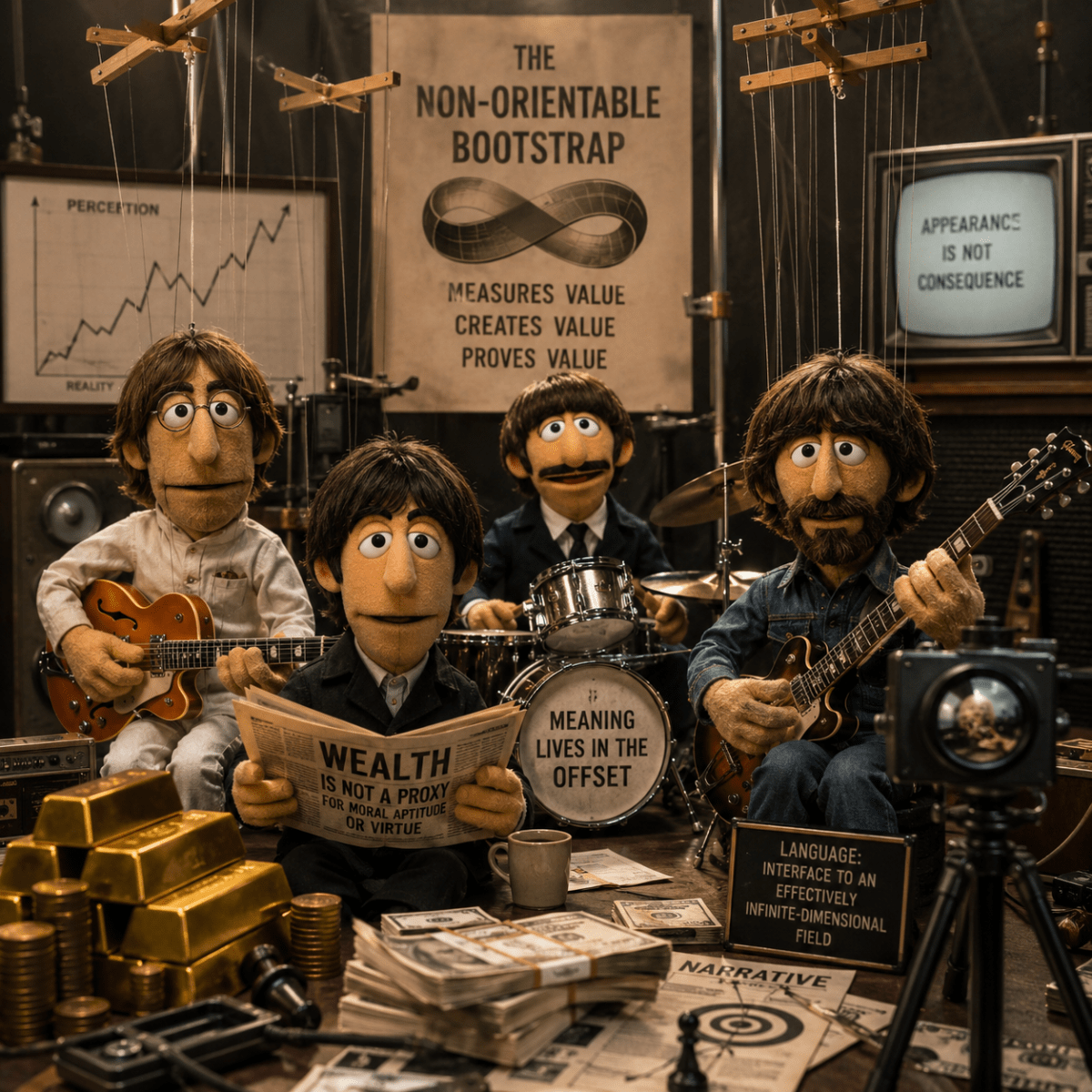
Wealth is not a reliable proxy for moral aptitude or virtue. More often, it records the convergence of advantage, timing, inheritance, legal structure, labour extraction, leverage, appetite, and institutional permission. A fortune may reflect intelligence, discipline, creativity, or risk tolerance, but it may equally reflect monopoly, exploitation, historical asymmetry, political access, or simple statistical luck. Markets reward many things. Moral wisdom is only occasionally among them.
Modern economies increasingly behave as though price and value are interchangeable, which is convenient if one happens to own the measuring stick. Entire industries generate absurd returns while degrading ecologies, exhausting populations, destabilising politics, or turning human attention into a lightly seasoned feedlot. Housing becomes an asset class before it remains shelter. Attention becomes inventory before it remains cognition. Platforms optimise for recurrence, not coherence, because recurrence sustains throughput, and throughput sustains valuation. The balance sheet records capital movement with priestly precision while remaining magnificently incurious about whether the underlying motion produces dignity, exhaustion, addiction, fragility, or social decay.
The deeper problem is semantic before it is economic. A civilisation saturated with metrics eventually mistakes quantification for understanding, then gives the richest people microphones and calls the resulting noise wisdom. Wealth performs a non-orientable bootstrap: it begins as a measure of value, becomes a producer of perceived value, then returns as evidence that the perception was true all along. The surface flips while pretending continuity. Money measures virtue, manufactures the appearance of virtue, then cites that appearance as proof. Interpretation performs the laundering before consciousness catches up to the transaction.
The billionaire, the algorithm, the market index, the quarterly report: these are interference patterns moving through vast communicative systems filled with delay, imitation, expectation, and recursively amplified perception. Meaning accumulates in the offsets, the distortions, the unresolved intervals between what a thing costs, what it signals, and what it actually does to the world. Semantics lives there, in the phase difference between appearance and consequence, because systems rarely collapse from lack of information. More often, they drift into ruin by synchronising too perfectly around the wrong signal. Language itself becomes an interface to this effectively infinite-dimensional field of recurrence, where value is less a stable property of objects than a moving harmonic negotiated across memory, desire, fear, status, imitation, and time.


One reply on “can’t buy me love”
Appendix: Non-Orientable Bootstrap
A non-orientable bootstrap occurs when a system recursively generates the conditions that later appear to justify the system itself, while concealing the inversion through continuity of appearance. The process cannot be cleanly separated into cause and effect because the output loops back and restructures the meaning of its own origin. Wealth is an example. Money first appears as a measure of value, competence, or productivity. Over time, however, accumulated wealth reshapes institutions, visibility, language, opportunity, legitimacy, and perception itself. The measure becomes an active producer of the reality it once merely described. Eventually the resulting social landscape is cited as evidence that the original concentration of wealth must have reflected genuine merit all along. The surface twists back through itself like a Möbius structure: evaluation becomes production, production becomes justification, and interpretation silently stabilises the loop. Meaning does not reside at a fixed point inside the system but emerges through the displaced relations, delays, and recursive phase offsets moving across it.
LikeLike