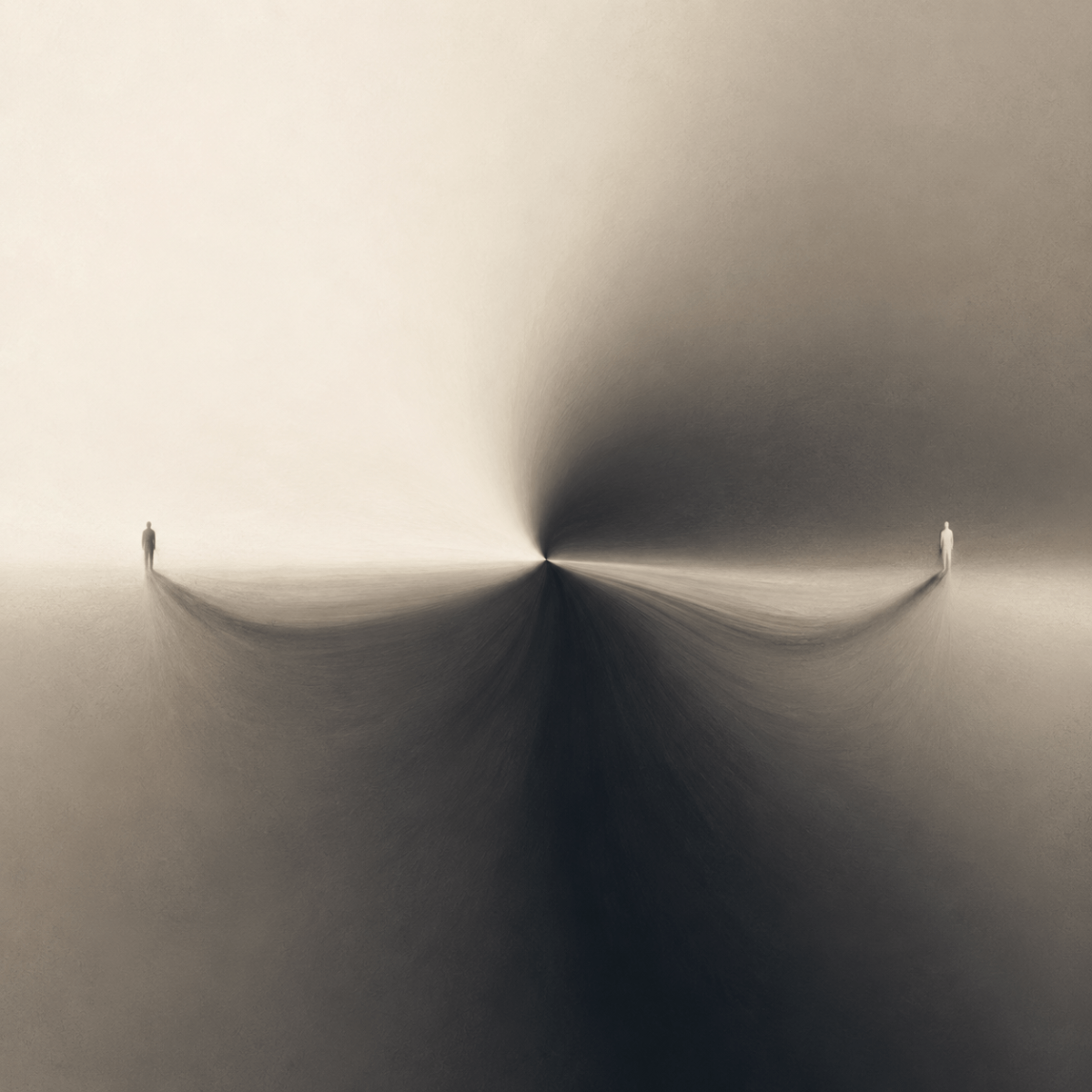
Life and death are not opposites. They are names we give to different aspects of a process far larger than either. The habit of thought is to begin with things: bodies, minds, organisms, identities. We then ask which things are alive and what happens when they die. But perhaps this begins in the wrong place. Perhaps life does not belong to things. Perhaps things belong to life.
A living organism is not a container into which life has been poured. It is a temporary coherence within a deeper continuity of relation, awareness, memory, and becoming. Everything that appears stable is already composed of processes. Cells are replaced. Matter flows through the body. Thoughts arise and vanish. Yet something persists. Not because the substance remains the same, but because the organisation does. Life is not a thing. Life is recurrence maintaining itself through change.
This is why death is so difficult to understand. We experience the loss of a person as the disappearance of a unique centre of experience, affection, memory, and meaning. That loss is real. Nothing in philosophy should attempt to explain it away. Yet death may not be the opposite of life any more than silence is the opposite of music. A song ends, but the possibility of music does not. What disappears is a particular coherence, a particular expression of something deeper. Life gathers relation into form. Death releases form back into relation.
The strange possibility is that life may be more fundamental than we imagine. Not biological life, but the deeper principle from which awareness, relation, adaptation, and organisation emerge. We usually ask how consciousness appears in a universe of objects. Perhaps the more interesting question is how objects appear within a universe of experience. We search for awareness as though it were hidden somewhere inside things, while overlooking the possibility that awareness, relation, and distinction are the conditions under which things appear in the first place.
Seen this way, the great mystery is no longer death. The great mystery is persistence. Why should anything endure? Why should any pattern hold together long enough to become a self, a memory, a civilisation, or a world? Why should there be coherence rather than immediate dissolution? Life and death become local expressions of a deeper generative asymmetry: a universe continually organising itself around an absence it can never completely resolve. We are not things briefly animated before returning to nothingness. We are temporary expressions of a process whose depth exceeds every form through which it becomes visible.
Categories
continuum: if unity, then…
Life does not belong to things. Things belong to life. Consciousness, relation, memory, recurrence, and form are not exceptions within reality. They are what reality does.