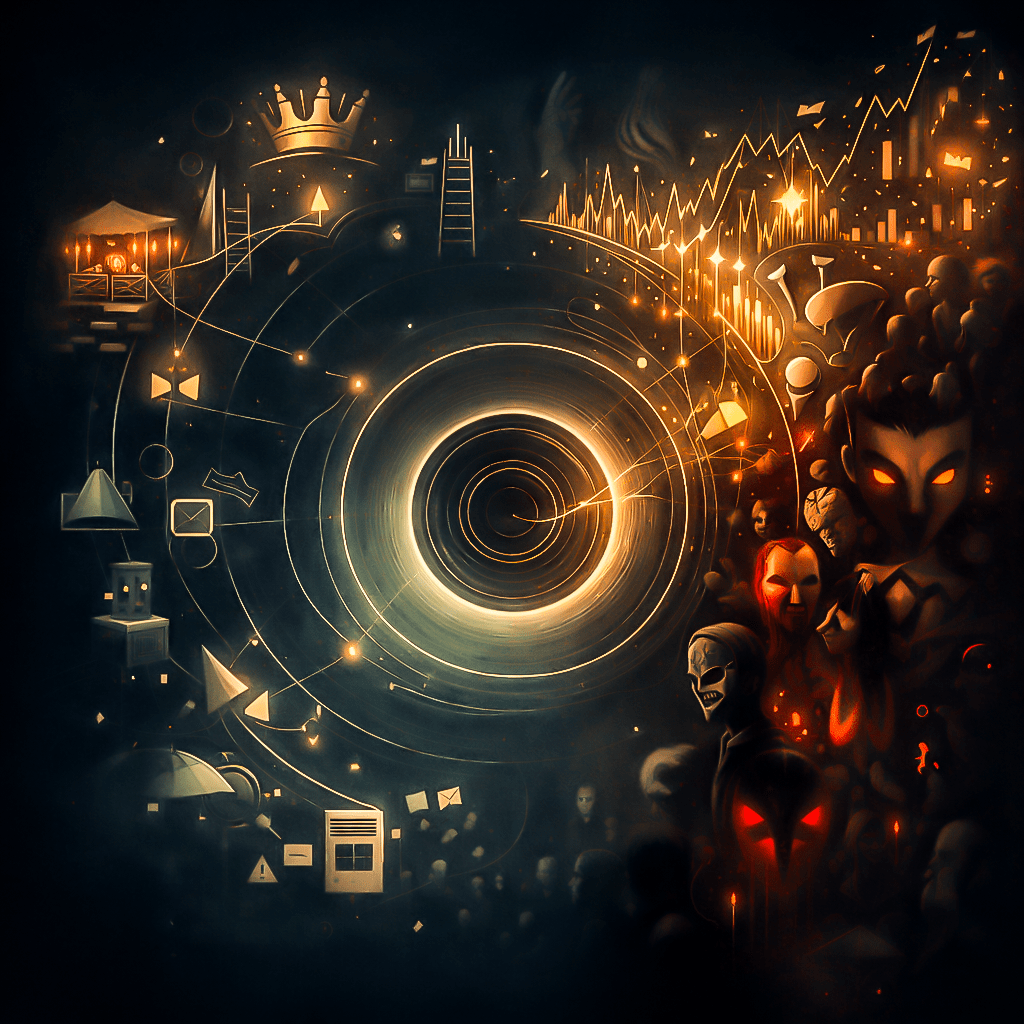
It has become remarkably difficult to distinguish what is genuinely meaningful from what merely demands attention. Every day we are presented with crisis, outrage, celebrity, wealth, political theatre, ideological conflict, institutional failure, and an unending torrent of information, each insisting upon its own importance. Much of it succeeds simply because it is repeated often enough to dominate public consciousness. We increasingly confuse visibility with significance, frequency with meaning, and attention with value. The consequence is a civilisation that often mistakes what is loudest for what matters most, while the relationships that actually sustain meaningful lives quietly disappear beneath the noise.
We have been asking the wrong question. Meaning is not something contained within words, objects, people, institutions, or even lives themselves. It is a second-order property of organised relational systems. Wherever significance becomes sufficiently organised to generate continuity, consequence, expectation, memory, and possibility, meaning emerges. A constitution, a scientific paper, an engineering drawing, a religious text, a family photograph, or a wedding ring does not literally contain its own meaning. Each becomes meaningful only through the networks of language, history, practice, memory, and consequence to which it belongs. Remove those relationships and the artefact survives. The meaning does not.
Meaning does not emerge despite separation. It emerges because of it. Every act through which reality becomes knowable contains an irreducible absence, because reality is never identical to its representation. The event and the account of the event are not the same thing. A measurement is not the phenomenon measured. A memory is not the moment remembered. A map is not the territory. A scientific model is not the system it describes. Even the most faithful representation arrives through propagation, selection, delay, interpretation, and form. Something is always carried forward, and something is always left behind. That interval cannot be eliminated without collapsing representation into the thing itself, at which point representation ceases to exist. Observation requires time. Communication requires propagation. Memory requires persistence. Understanding requires interpretation. Every meaningful structure therefore exists across constitutive phase differences through which coherence must continually be maintained. Those differences are not imperfections of reality. They are among its most fundamental organising conditions.
The implications extend even to identity itself. Whatever a thing may be in itself, every determination of identity is necessarily mediated. To identify is to observe, distinguish, measure, remember, represent, think, communicate, or describe. None of these is immediate. Each requires organisation across relation and propagation across time. The world may be perfectly identical to itself. Our access to that identity never is. Every act of knowing already incorporates absence, because what is known has always arrived through representation. Meaning therefore belongs neither to the thing nor to its representation alone, but to the organised continuity that persists across the interval separating them. In this sense, meaning is transcendental: not because it exists beyond reality, but because it belongs to the relational conditions through which reality becomes intelligible at all. It cannot be isolated as an object because it is a property of the organised field through which objects acquire significance. Meaning is the persistent organisation of absence across time.
This also explains why meaning itself now appears unstable. The communication systems through which civilisation understands itself are changing more rapidly than civilisation can reorganise around them. Every representation arrives with delay. Every delay alters the field into which the next representation propagates. Billions of asynchronous observations, interpretations, memories, predictions, and responses now interfere, reinforce, attenuate, and amplify one another across a planetary communication environment. Human beings are not standing outside this transformation, observing it from a safe distance. We are participants within it. As the field changes, so too do perception, identity, attention, memory, and the very conditions under which significance becomes possible. We are not simply experiencing technological change. We are undergoing a reorganisation of the relational architecture from which meaning itself emerges.
This is why the question matters. A civilisation that mistakes repetition for significance, accumulation for value, or attention for understanding gradually reorganises itself around increasingly empty attractors. Wealth, status, outrage, ideology, and spectacle become mistaken for meaning because they propagate efficiently, not because they necessarily deepen the continuity of human life. The challenge before us is therefore not simply to recover meaning, but to recover the capacity to organise it. If meaning is the persistent organisation of absence across time, then the measure of a life has never been what it possessed, but the continuity of care, consequence, memory, and possibility it leaves behind.
Categories
where meaning is not
Meaning is not hidden inside things. It emerges through the relationships, delays, absences, and consequences that allow anything to matter at all.


One reply on “where meaning is not”
One final observation. If this perspective is even approximately correct, then it (also) applies to itself. No theory can stand outside the conditions it describes. Every framework is another organised representation, another attempt to maintain coherence across absence, delay, interpretation, and change. It is not exempt from the very dynamics it seeks to explain.
That is not a weakness. It is where this line of inquiry began for me more than three decades ago. Any theory that claims to be complete, final, or immune to revision has already placed itself beyond the world it is attempting to understand. A living framework should remain part of the field it describes, continually reshaped by new relationships, new evidence, new consequences, and new forms of organisation. If meaning itself emerges through organised continuity across time, then so too must every serious attempt to understand it.
LikeLike