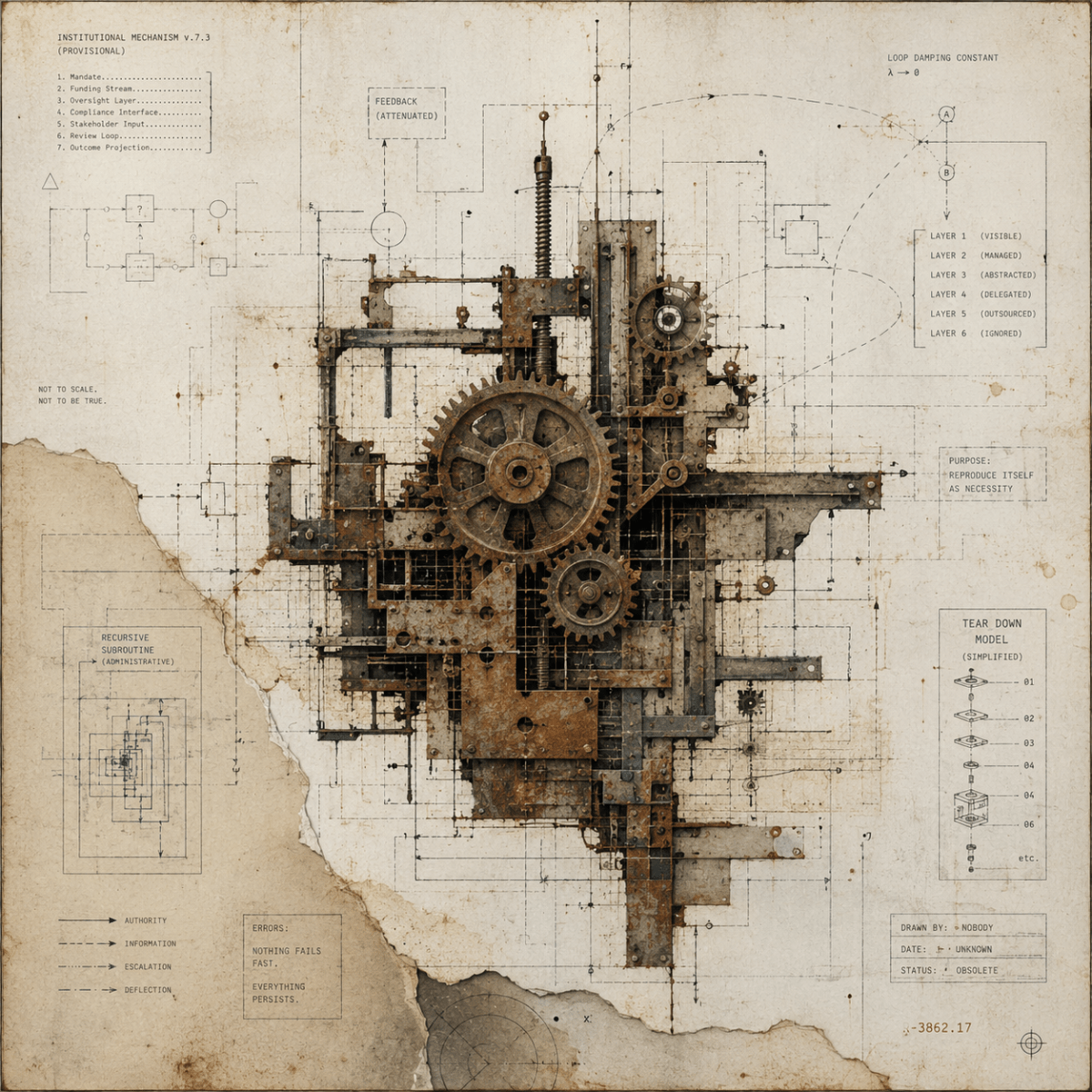
I went to a school nominally dedicated to systems thinking. It struggled to understand itself. That observation stayed with me long after I left, not because I believed the institution was uniquely flawed, but because it illustrated a much deeper problem. Its stated ambition was to help people navigate major societal transformations through cybernetics, technology, policy, and responsible approaches to new systems. Yet my experience was that it often seemed easier to describe systemic problems than to examine the conditions that allowed similar dynamics to persist within its own walls. Others may well have experienced it differently. This is simply the conclusion I reached, and it became the starting point for a very different line of inquiry.
The more I reflected on that experience, the less interested I became in the institution itself and the more interested I became in the nature of self-reference. How does any organised system come to understand itself? Every attempt at self-description is produced from within the very relationships it seeks to describe. There is no external vantage point from which a living system can observe itself completely. Every act of representation therefore introduces a separation between what the system is doing and what it can know about itself. By the time that knowledge exists, the system has already moved on. That delay is not a mistake. It is one of the conditions that makes interpretation, learning, and adaptation possible.
This also changes what we mean by a system. We often speak as though ecosystems, economies, institutions, technologies, languages, and civilisations are simply objects awaiting analysis. They are not. They are ongoing achievements. Every enduring system is an organised pattern of relationships that has learned how to persist despite continual change. Stability is not the absence of change but the successful organisation of it. Identity is not something preserved against disturbance; it is something continually recreated through disturbance.
Seen in this light, institutional blindness becomes less surprising. Every organisation develops some degree of separation between what it says, what it measures, what it rewards, and what it ultimately reproduces. Mission statements, strategic plans, policies, theories, and organisational charts are representations, not the systems themselves. The important question is therefore not whether they are incomplete—they always are—but whether the institution recognises that incompleteness and allows it to become a source of learning. The greatest risk is not imperfection. It is mistaking the description for the reality.
Once recognised, the same pattern appears almost everywhere. A university, a bureaucracy, a financial market, an ecosystem, a language, or a civilisation may look like entirely different phenomena, yet each is a local expression of the same underlying architecture: organised relationships persisting through time. Their histories differ. Their mechanisms differ. But the deeper problem remains remarkably consistent. The challenge is not to invent a separate explanation for every domain, but to understand the relational conditions that allow organised persistence to emerge, adapt, and reproduce itself.
Power also appears differently from this perspective. The central question is not who happens to occupy positions of authority. People, governments, and policies all change. What tends to persist are the relational structures through which influence, incentives, information, and behaviour continually regenerate themselves. Alter the occupants without altering those relationships and familiar patterns often reappear under different names. Lasting change begins with reorganising the architecture through which persistence is achieved.
To me, this is where systems thinking truly begins. Its purpose is not merely to describe complex systems but to explain how organised persistence becomes possible at all. Every enduring structure, from a living cell to a civilisation, emerges from the same underlying challenge: maintaining coherence while continually adapting to change. Misalignment is not a flaw. Delay is not a flaw. They are among the conditions that make organisation, understanding, and persistence possible in the first place.
Categories
systems thinking
A school can teach systems thinking and still fail to recognise the system it has become. The paradox is not educational but civilisational: systems routinely develop the capacity to analyse (and acknowledge) everything except the conditions that organise and sustain their own perception.