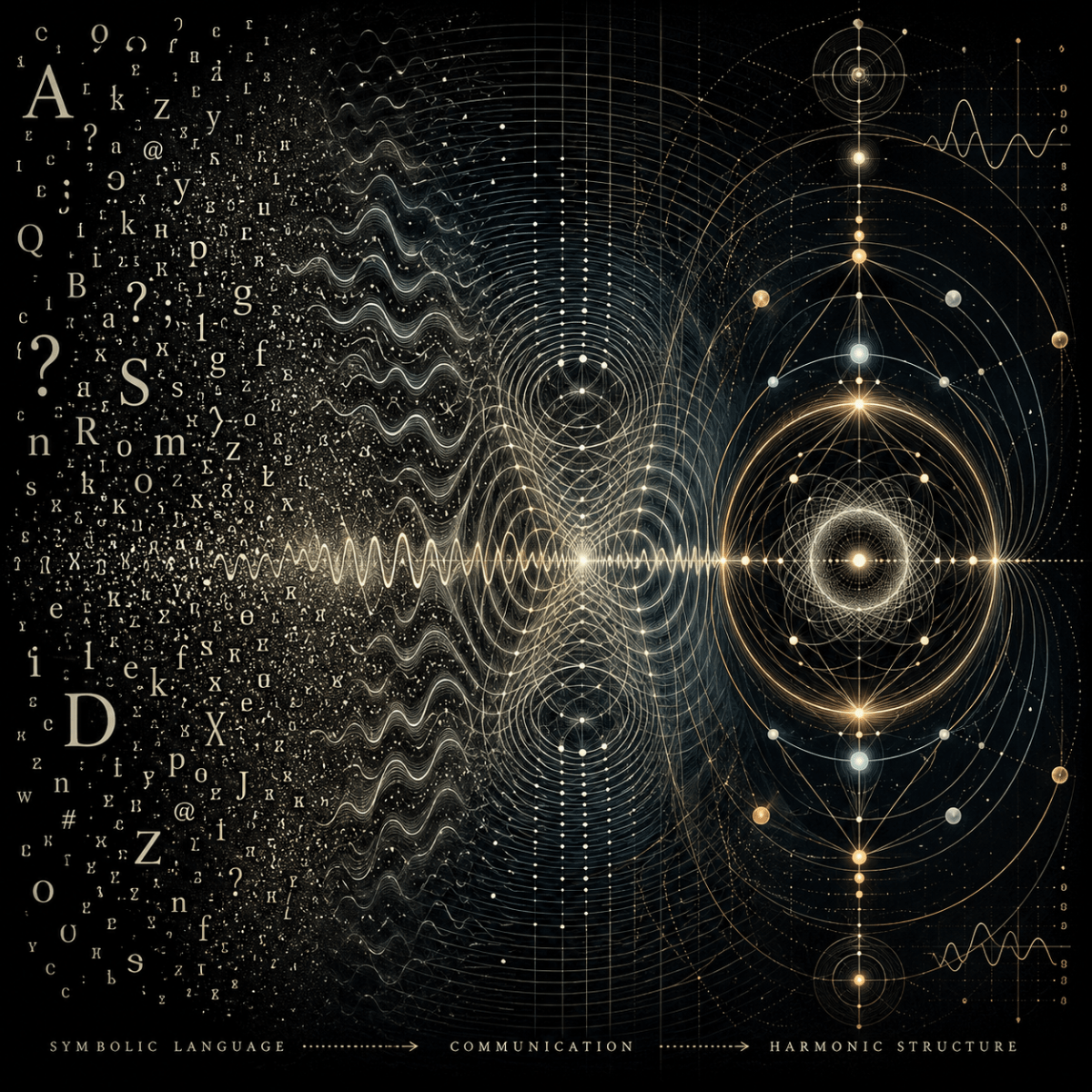
Every finite communication and control system draws its distinctions within a relational field that exceeds its local expression. A signal acquires significance through differences, expectations, dependencies and absences that no single signal contains. An intervention changes the conditions through which further intervention becomes possible. Finite organisation remains oriented by an inexhaustible relational horizon.
Relation generates the terms through which communication proceeds. Sender, receiver, signal and context become distinguishable through their participation in an organised field. Their identities depend upon the differences that connect them, the delays through which responses become possible and the absent alternatives against which a particular expression acquires significance.
Logical orbit names this constitutive logical incompleteness. A local organisation depends upon relational conditions that it cannot fully contain. Additional information changes what is locally available, while each enlarged description continues to depend upon the relations through which it becomes intelligible.
Recursive displacement is the dynamical expression of this incompleteness. Each response reconstructs the relational situation from which another response proceeds. The field changes through the activity it makes possible, and the organisation of subsequent possibilities changes with it.
A conversation makes this process accessible. An utterance changes what can meaningfully follow. A reply reorganises the significance of what has already been said, the expectations of the participants and the positions from which they speak. Roles, context and meaning develop through these relations. The conversation’s continuity depends upon their recurrent reconstruction.
Delay is constitutive of this organisation. An expression, its registration and the response to it occupy different positions within propagation. Earlier activity remains consequential through expectations, memories and constraints, while subsequent activity modifies how those consequences are carried forward. Communication continually reorganises the temporal relations through which its participants remain available to one another.
Control selectively stabilises this organisation across time. A controller participates in the relational field it regulates. Its observations, decisions and interventions enter the conditions encountered by later activity. Effective control requires a criterion of what is to continue, a horizon over which continuation is assessed and attention to how intervention changes the conditions of further regulation.
A finite model can specify every state and transition within its chosen domain. Its completeness is relative to the boundaries, inputs and observation rules through which that domain is defined. Applied Field Logic follows the relational conditions through which such definitions become possible and remain consequential. The constitutive incompleteness of local organisation concerns those dependencies.
Distributed control proceeds through recursive partiality. Each participant acts from locally available relations, while its activity alters conditions encountered elsewhere. Coordination arises when these interactions reproduce enough of the dependencies required for an organisation to continue. Shared rules, records and expectations participate in that reproduction; their significance depends upon how they are maintained and enacted.
Topology offers a precise way to distinguish local description from global organisation. On a Möbius band, an orientation can be chosen in a small patch, while carrying that orientation once around its central loop reverses it. The connections between local regions determine whether their orientations can be made globally consistent. The relevant feature is the organisation of those connections.
In Applied Field Logic, construction begins with relation. Geometry records an organisation of neighbourhoods, connections, separations and transformations. Its mathematical structures make selected relational features explicit. A geometry of communication and control must specify how local distinctions connect, how their relations change and which features remain recognisable across those changes.
In mathematics, transfinite refers to infinite ordinals and cardinals: structures used to describe order beyond finite stages and the sizes of infinite sets. Here, the title directs inquiry towards a mathematical account of the dependence of finite organisation upon an inexhaustible relational horizon. A transfinite construction requires its infinite structures and their connection to communication and control to be specified.
For example, a finite state model that admits histories of unbounded length has an infinite family of possible finite histories. The state set, admissible transitions and rule for extending a history determine that family. An account using transfinite stages must also define what happens at successor and limit stages. These specifications give a mathematical construction its content.
The relational inquiry follows how activity changes the conditions of continuation. Relations reinforce, weaken, disappear, redirect and constrain one another. An interaction can maintain one organisation while disrupting another. Global order is continually reconstructed through these consequences, and its continuity depends upon the dependencies that remain sufficiently reproduced.
A probabilistic description expresses how this activity redistributes possibilities. To assess whether control favours persistence, it must specify the organisation being maintained, the criterion of continuity, the time horizon and the alternatives against which improvement is measured. An increased probability of continuation remains compatible with failure.
Communication is the continual reorganisation of relational possibility, while control is the selective stabilisation of that organisation across time. Their geometry develops through the relations they reconstruct. A system persists by renewing the conditions through which further organisation becomes possible.

