The argument can be made quite cleanly without reducing racism or fascism to “mere language.” People enact these beliefs and their consequences are material, but the forms through which those beliefs become available, coherent and collectively reproducible are communicative. Under conditions of high communicative entropy, volatility and institutional uncertainty, some configurations propagate more readily than others. Simplification has an advantage. Binary categories have an advantage. Anger, accusation, repetition, slogans, enemies and apparently simple solutions to complex problems all possess unusually efficient reproductive characteristics. Their semantic content matters enormously to us, but their ascendancy may depend upon dynamics operating beneath semantics: repetition, entrainment, amplification, compression and recursive reinforcement.
This changes how we understand ideological extremity. A person experiences a racist or authoritarian proposition as a belief they possess, perhaps even as an insight they have independently reached. Yet the available concepts, distinctions, emotional associations and patterns of inference have already been organised by a communicative field extending vastly beyond them. People inhabit this organisation and recursively reproduce it. What appears from inside the individual as conviction can, from the perspective of the communication system, be understood as an active and adaptive interpretation of the field’s present state. This does not absolve anyone of responsibility. It relocates part of the causal explanation. The individual is simultaneously an agent within the system and a temporary site through which its patterns persist and propagate.
The uglier implication is that communicative success bears no necessary relationship to truth, intelligence, morality or long-term viability. Under sufficiently volatile conditions, ideological garbage may spread precisely because it is cheap to reproduce. Hatred compresses extraordinarily well. “Those people are the problem” requires almost no explanatory machinery, while an adequate account of housing, migration, inequality, technological disruption or institutional decline may require pages. Extremism exploits this asymmetry whether anyone consciously designs it to do so or not. Fascism can consequently become locally coherent and affectively rewarding while remaining structurally catastrophic. Its temporary ascendancy demonstrates neither its truth nor its sustainability. It demonstrates only that, under particular conditions, its communicative forms have acquired a reproductive advantage.
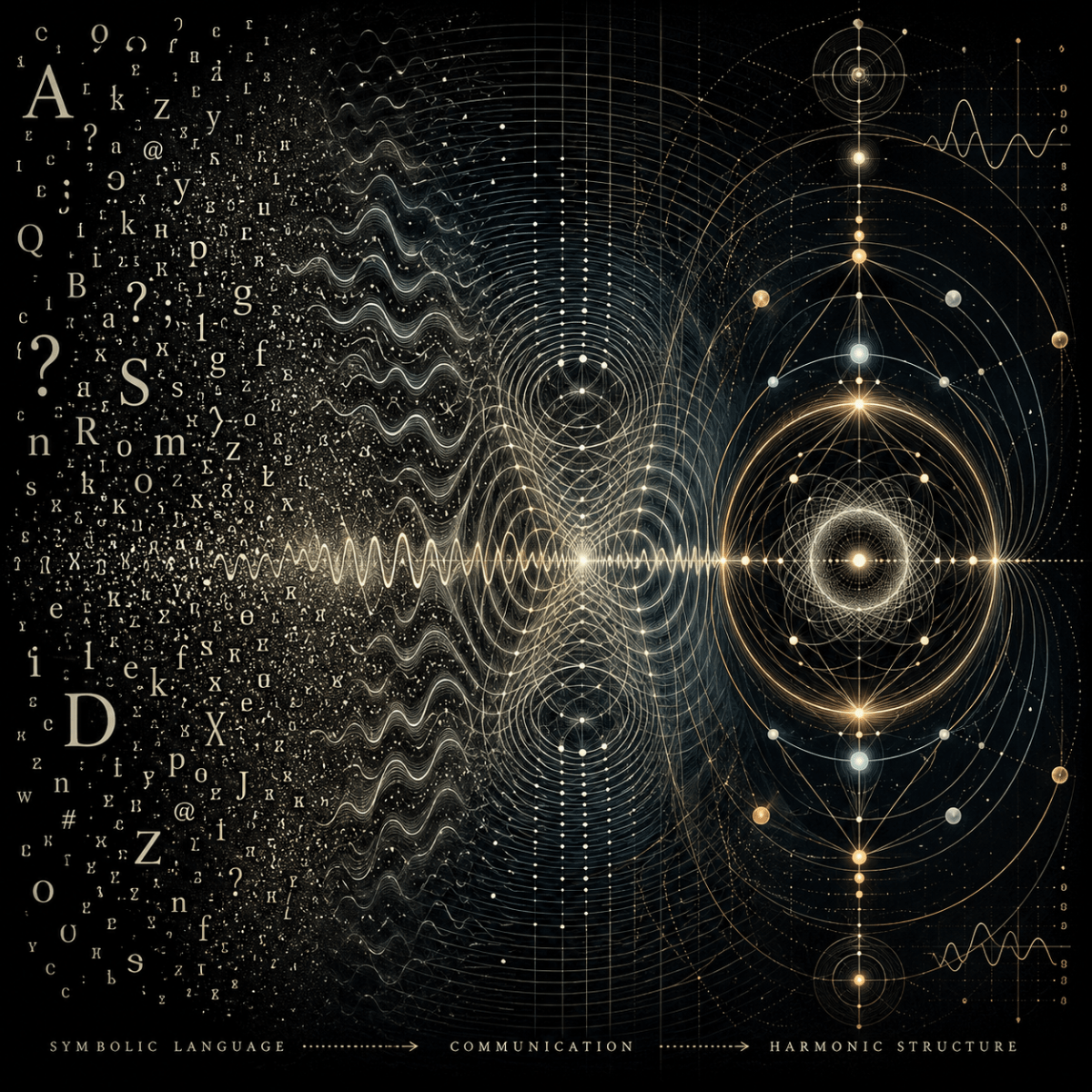
This returns to the larger error we repeatedly make about language. We behave as though language contains the world because virtually everything we explicitly believe about the world arrives in consciousness already organised through distinctions, concepts, symbols and words. But language does not contain the world. The world contains language. The communicative field is itself a physical, temporal and dynamical process occurring within a vastly larger reality. Its temporary harmonic structures, including nations, ideologies, identities, enemies and convictions, can feel permanent from within because we ourselves are entrained by them. They are not permanent. The present rise of vitriolic ideological forms may be understood, at least in part, as an entropic phenomenon: not the revelation of some final political truth, but a transient configuration in which the cheapest messages have become exceptionally good at making more of themselves.


One reply on “the good, the bad and the ugly of political communication”
There is an obvious Darwinian thread running beneath this argument, although I would be reluctant to make Darwinism its final explanation. The resemblance is structural. Communicative forms vary, encounter different environments, reproduce with different degrees of success and disappear, mutate or persist as those environments change. What succeeds at one moment need not succeed at another, and reproductive success tells us nothing by itself about moral value, intelligence or permanence.
There is a curious recursion here. The theory of evolution is itself a communicative form, and an extraordinarily successful one. Part of the reason it has reproduced so successfully is that it describes something about the world with extraordinary accuracy. It travels not merely because it is communicatively effective, but because its organisation resonates remarkably well with processes that continue to be observed independently of the language used to describe them. This matters because communicative fitness and correspondence with reality are not mutually exclusive. Garbage can reproduce exceptionally well, but so can an idea whose persistence derives partly from repeatedly surviving contact with the world.
The deeper question, then, is not whether communication is Darwinian. That would simply replace one explanatory vocabulary with another. It is whether biological evolution, language, knowledge, ideology and perhaps many other apparently different phenomena express more general principles of persistence within changing relational environments. Variation, recurrence, selection, entrainment, adaptation and differential persistence may be recognisable manifestations of something more fundamental: patterns reproducing through time by reorganising their relations to the conditions in which their continued existence becomes possible.
Seen this way, the previous argument about political communication becomes one local instance of a much larger problem. Racist or fascist messaging may temporarily acquire a reproductive advantage in the strictly communicative sense: it can become easier to repeat, transmit, reinforce and propagate through a population. This is not a claim about biological reproduction, fertility or any reproductive advantage of the people who hold such beliefs. Evolutionary theory may likewise acquire communicative advantage, but partly because it describes the world exceptionally well. Both persist through communication, but not for the same reasons. The task is not to confuse persistence with truth, but to understand the deeper dynamics through which some forms persist, others vanish, and still others transform the field in which whatever comes next must find a way to continue.
LikeLike