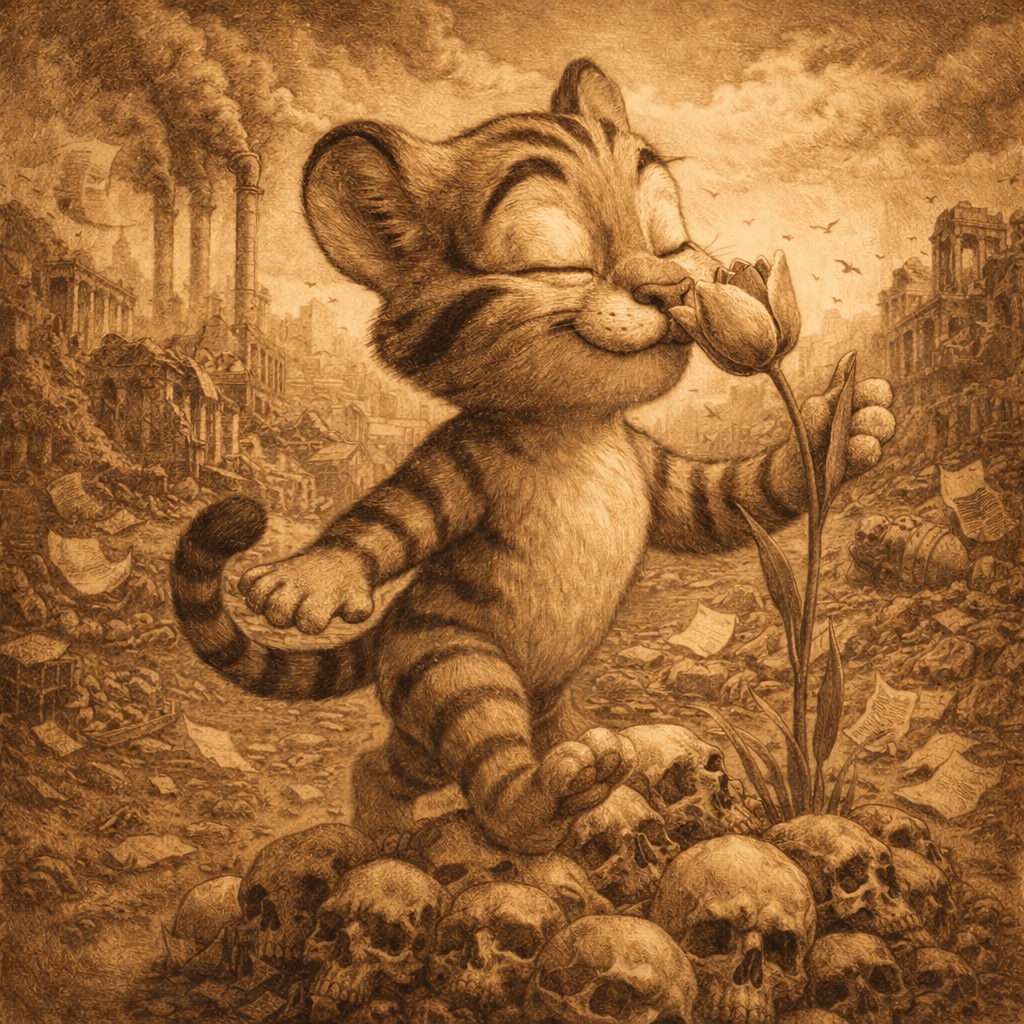
The deepest problem with the human world is not simply corruption, greed or incompetence. It is that too many people make too much money from things remaining confused, inefficient and broken. Entire industries, professions and institutions often prosper not by resolving problems, but by managing, prolonging or adapting to them. The legal system, healthcare, housing, finance, lobbying, consultancy, conflict and even disaster all contain incentives that reward persistence as much as resolution. This has become so normal that the pursuit of wealth regardless of systemic consequence is treated as economic common sense rather than a structural pathology.
A civilisation cannot indefinitely reward the reproduction of its own failures without eventually confronting them at scale. Climate change may prove to be that confrontation. The adjustment is unlikely to be gentle, because those who benefit from the present arrangement have every reason to preserve it, while those who bear its costs have the least capacity to reshape it. Even then, fortunes will be made from the transition itself. The tragedy is not that people profit from solving problems. It is that our incentives so often reward the continuation of the conditions that created them.
The deeper difficulty is that complex societies do not merely preserve problems. They metabolise the disorder they inherit and the further disorder generated by their own attempts at resolution. Law provides an obvious example. Prohibition may be introduced to suppress a harmful activity, yet it can also produce illicit markets, enforcement industries, administrative expansion and new forms of organised violence. The response becomes entangled with the problem until both are reproduced through the same institutional machinery. What begins as an attempt at repair becomes a durable network of procedures, careers, investments and dependencies, making meaningful change increasingly difficult.
The same pattern exists within us. Human attention is organised by attachment. Every fear, desire, ambition, grievance and possession becomes another point around which thought, emotion and behaviour repeatedly orbit. The more numerous and demanding those attachments become, the more fragmented our inner organisation becomes, and the more readily it can be coupled to the incentives of institutions, markets and technologies built to capture and direct it. Civilisations do not simply construct external systems. They progressively internalise them, until many of the structures governing society are reproduced within the ordinary patterns of everyday thought and behaviour.
Conflict is the clearest and most consequential expression of this pattern. The dependency upon conflict becomes first metabolic, then normative, embedded in institutions, economies and cultures that continually organise fear, aggression, desire, attachment and the identification of enemies. Culture develops through human neurophysiology, amplifying and directing ancient emotional tendencies through increasingly sophisticated symbolic and technological systems. Fear, attachment and othering are among the most valuable commodities in the world because they reliably organise attention, affiliation and behaviour. Escaping the resulting institutional, bureaucratic and corporate intransigence will require more than solving isolated problems. It will require changing the systems that have learned to survive by absorbing, reproducing and profiting from them.
Categories
the profitable persistence of a broken world
The world is not merely broken. Too many people are paid to keep it that way.