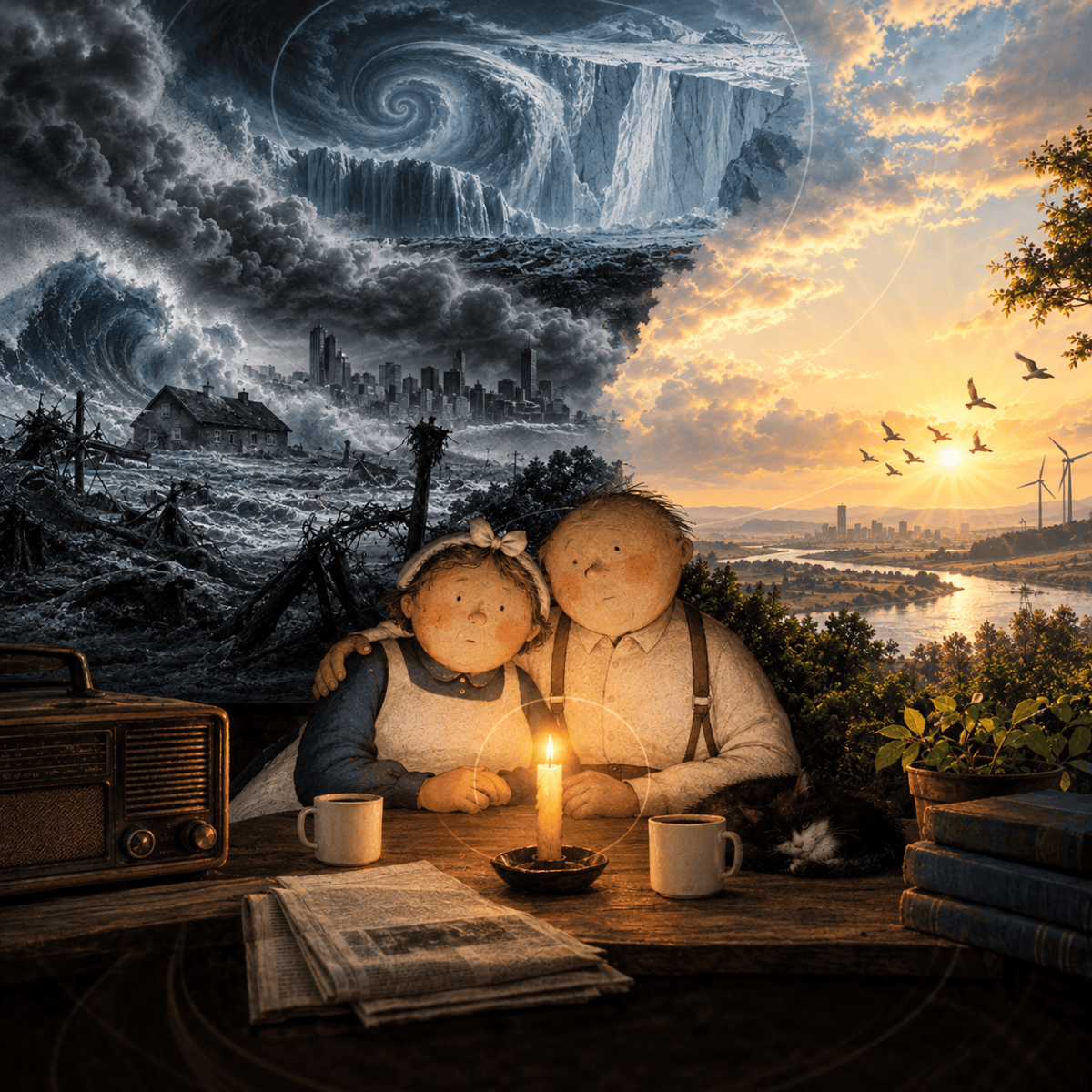
Humanity has always lived at the mercy of the weather, but we have developed an extraordinary capacity to mistake temporary stability for permanence. In When the Wind Blows, Raymond Briggs depicts nuclear catastrophe through the ordinary domestic lives of Jim and Hilda Bloggs, whose faith in familiar routines and official instructions survives long after the world that sustained them has ceased to exist. Their tragedy is not simply that they misunderstand the danger. It is that their understanding belongs to a world that no longer exists.
There is something uncomfortably familiar in this. We continue to build, consume, compete and plan for tomorrow as though the environmental conditions that made yesterday possible were guaranteed to persist. Shakespeare’s Macbeth offers a more economical assessment: “Out, out, brief candle!” The flame does not negotiate with the wind.
The Younger Dryas, beginning approximately 12,900 years ago, provides a geological reminder of how abruptly the conditions of existence can change. As the planet emerged from the last ice age, warming was interrupted by a rapid return to colder conditions across much of the Northern Hemisphere. Greenland experienced a dramatic temperature decline, forests retreated across parts of Europe, rainfall patterns shifted and ecosystems were reorganised. The disruption persisted for approximately 1,200 years, transforming the landscapes and resources upon which human populations depended. It was not a global extinction event, but a profound climatic upheaval that altered the conditions of survival across generations.
The Younger Dryas was not caused by industrial emissions, nor does it predict an identical event today. Its precise causes remain debated, although disruption of North Atlantic ocean circulation is a leading explanation. Its significance lies in demonstrating that the climate can reorganise rapidly, with consequences extending across oceans, continents and ecological systems. The relatively stable conditions under which agriculture and civilisation subsequently developed are neither guaranteed nor permanent. Stability is a condition of persistence, not a promise of its continuation.
We are now disturbing those conditions ourselves. A warmer atmosphere can hold approximately seven per cent more water vapour per degree Celsius, increasing the potential for extreme rainfall. The strongest tropical cyclones are projected to become more intense, even as their total global frequency is not expected to increase. Rising seas compound the damage from storm surges, while droughts, floods and heatwaves place interconnected systems under mounting pressure. No single storm will extinguish humanity, but civilisation depends upon the continuity of food production, infrastructure, energy, communication and the ecological systems that sustain them. These systems need not fail simultaneously to bring one another down. Disruption propagates through dependency, and recovery itself depends upon the persistence of what remains.
Like Jim and Hilda, we remain preoccupied with preserving the routines of a world whose underlying conditions we are actively dismantling. Yet unlike them, we possess considerable knowledge of the danger, the means to reduce it, and the capacity to reorganise our collective response. We cannot prevent every storm, but we can reduce the forces driving further warming, strengthen the systems upon which survival depends, and recognise that adaptation requires more than rebuilding what has already failed. The danger is not that the wind will suddenly blow out every candle. It is that we will exhaust the means of relighting them, one by one, while insisting that the lights are still on. Another future remains possible, but keeping the flame alive requires considerably more than sheltering it from the wind.
Briggs, R. (1982) When the Wind Blows. London: Hamish Hamilton.
An illustrated account of an elderly couple confronting nuclear catastrophe, clinging to familiar routines and official instructions as the conditions sustaining their lives disappear.
Xia, L. et al. (2022) ‘Global food insecurity and famine from reduced crop, marine fishery and livestock production due to climate disruption from nuclear war soot injection’, Nature Food, 3, pp. 586–596.
Models the global consequences of nuclear war, including atmospheric disruption, agricultural collapse and famine. Under a large-scale US–Russia nuclear war scenario, more than five billion people could die from hunger.
National Research Council (2002) Abrupt Climate Change: Inevitable Surprises. Washington, DC: National Academies Press.
Examines the Younger Dryas and other evidence that Earth’s climate can undergo dramatic reorganisation within decades. Establishes that climatic stability is neither guaranteed nor permanent.
IPCC (2021) ‘Climate change information for regional impact and for risk assessment’, in Climate Change 2021: The Physical Science Basis. Cambridge: Cambridge University Press, Chapter 12.
Assesses abrupt climate change, tipping points and potentially irreversible transitions. Provides the contemporary scientific basis for understanding how human-driven warming can destabilise interconnected climatic systems.


One reply on “When the Wind Blows: Climate, Catastrophe and the Brief Candle”
There is a peculiar absurdity in funding universities to investigate existential risks while allowing the research itself to become entangled in the political machinery of academic careers. Climate forecasting, modelling and long-term projections demand intellectual independence, continuity and the capacity to question established assumptions. Yet postgraduate research and the institutional hierarchies beyond it operate within competing interests, disciplinary orthodoxies, reputational economies and career structures. The problem is not that researchers lack integrity, but that the organisation of research often rewards conformity, visibility and institutional survival over sustained inquiry. When public funding intended to help civilisation understand its existential risks is consumed by reproducing the status hierarchies of the institutions conducting that research, the waste extends well beyond a few expensive academic careers. We are paying to understand catastrophe while reproducing organisational conditions that obstruct our capacity to respond to it.
The deeper irony is that institutional, political and socioeconomic systems are themselves subject to sudden and catastrophic reorganisation. What appears to be a tightly controlled political matrix is a dynamic organisation of competing interests, dependencies, delays and accumulated tensions. Tight control is critically fragile precisely because it restricts the capacity of a system to accommodate difference, adapt to changing circumstances and reorganise without threatening its established order. The more rigidly an institution maintains its existing relationships, the more consequential their disruption becomes. A political order can appear immovable until the relationships sustaining it fracture, just as an apparently stable climate can cross a threshold into another regime. Forecasting environmental catastrophe does not exempt the institutions conducting that research from the dynamics they seek to understand. Institutional authority is not evidence of organisational stability. The weather is not the only thing capable of changing rather suddenly.
LikeLike