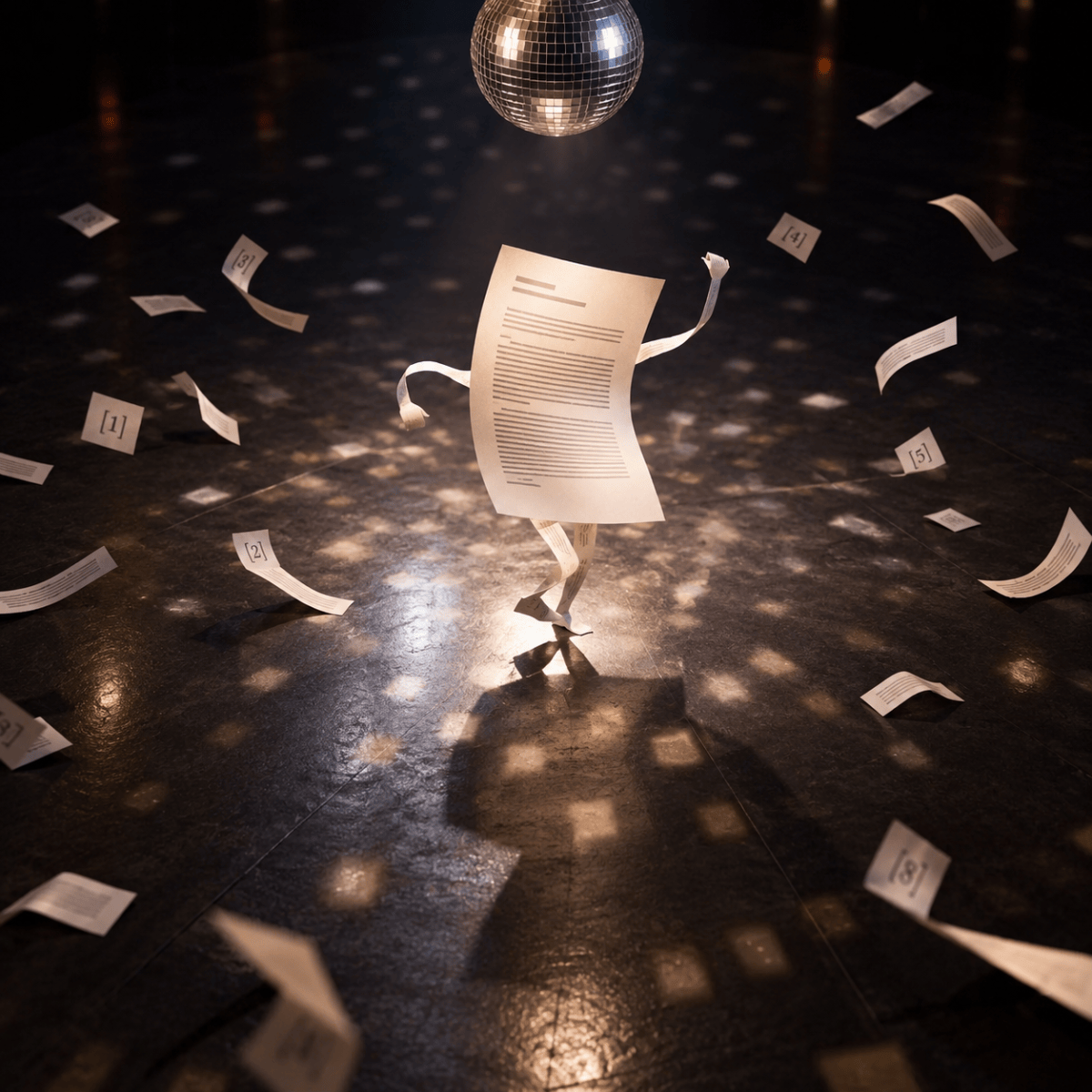
Writing seriously with generative language models produces a peculiar ritual. The prose arrives quickly. Arguments can be reorganised, compressed and extended almost instantly. Then you ask for references and the disco begins. Papers need checking. Authors have apparently said things they never said. Citations point vaguely towards the right intellectual suburb while occasionally failing to locate the house.
It is tempting to call this an AI problem. Language models generate plausible continuities rather than preserve perfect documentary provenance, so sometimes the references wander off and start their own careers. Better retrieval will help. But there is a more interesting problem.
These systems were trained on us.
Our documentary culture already consists of ideas repeatedly detached from their origins. Claims are copied because somebody else cited them. Secondary interpretations become accepted descriptions of primary texts. Quotations migrate between famous people. Institutional authority frequently saves everyone the tiresome business of following an argument back through the chain of things that supposedly justify it. We had citation disco long before anyone installed a transformer.
Citation works against this drift. It attempts to preserve the path by which something became known: this claim, this document, these observations, this method. It is not simply academic courtesy. It is a small piece of machinery for preventing knowledge from becoming completely detached from its history.
Generative systems make the problem harder to ignore because they radically alter the economics. Producing plausible claims is now almost free. Establishing provenance remains expensive. A machine can produce a hundred scholarly-looking statements while you are still discovering that reference number four does not exist.
That asymmetry matters. The scarce resource is no longer information. We are drowning in the stuff. What becomes valuable is confidence in the relations connecting claims to documents, documents to evidence, and evidence to whatever actually happened.
Perhaps citation failure is not an embarrassing defect sitting at the edge of artificial intelligence. It may be structurally consistent with the civilisation from which these systems emerged: extraordinarily good at reproducing knowledge, considerably less enthusiastic about remembering exactly how it knows anything.
The machines did not invent citation disco.
We taught them the steps.
Categories
Citation Disco: AI, References and the Loss of Provenance
AI citation failures reveal something larger than a technical flaw: a civilisation increasingly efficient at reproducing knowledge while losing track of how it became known.