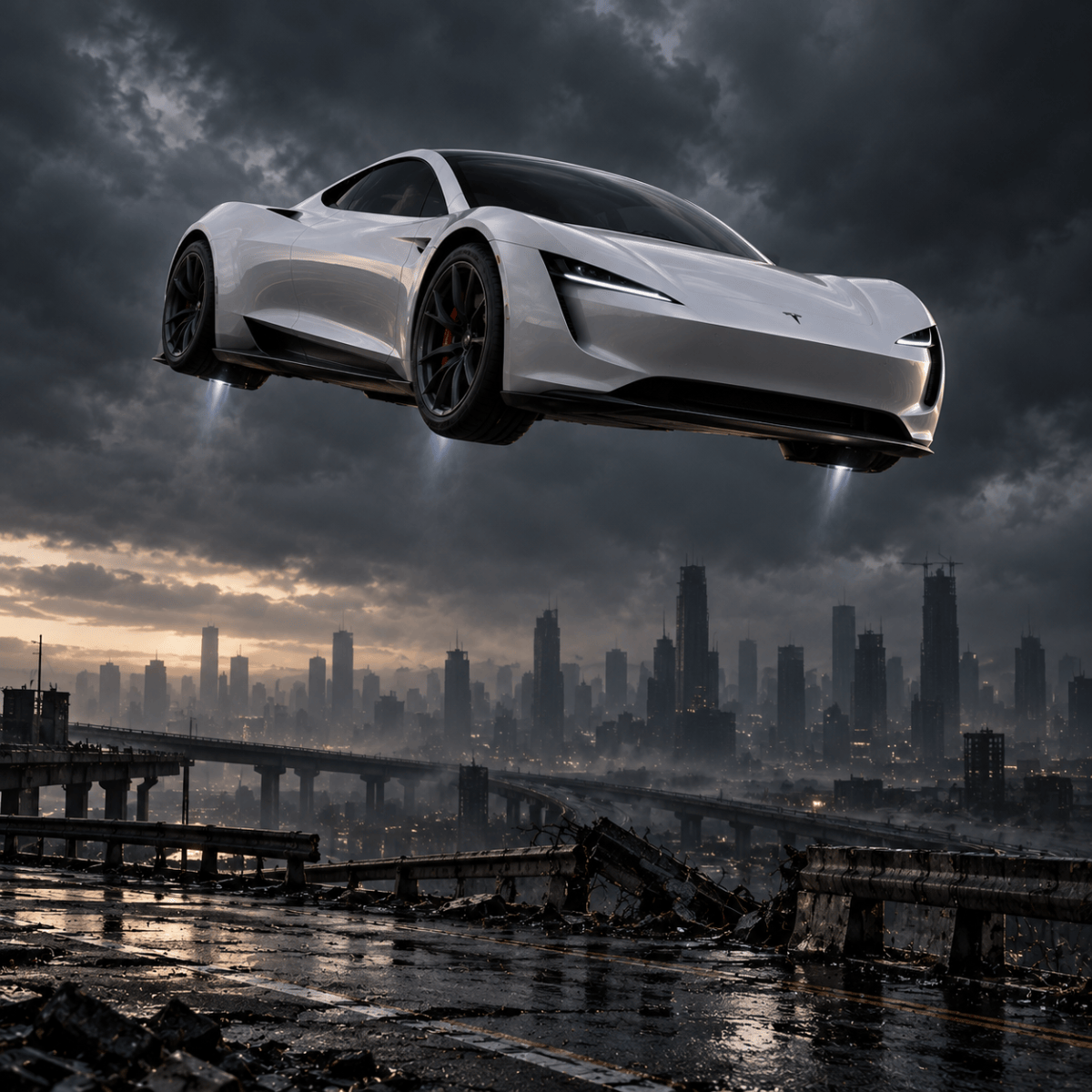
The flying car is almost a perfect metaphor for technological civilisation’s predicament. We have become extraordinarily capable of inventing new ways to move through the world while systematically dismantling the conditions that make the world worth moving through. Elon Musk’s latest spectacle is impressive, certainly. But it raises a rather awkward question: what exactly is the point? We have apparently reached the stage of civilisational development where escaping traffic is an engineering priority while preventing collective self-destruction remains an administrative inconvenience. Technological sophistication is not the same as civilisational competence, although the distinction seems to have escaped some of our wealthier enthusiasts.
Of course, the vehicle does not yet achieve sustained flight, and overcoming that limitation presents serious engineering challenges. Gravity, irritatingly, remains unimpressed by personal wealth. But the greater problem is not aerodynamic. Extraordinary technical achievements are emerging from economic and institutional arrangements increasingly characterised by concentrated wealth, ecological deterioration, political volatility and systemic fragility. We celebrate each invention as evidence of progress while paying remarkably little attention to whether the societies expected to benefit from it are becoming more capable of sustaining themselves. The flying car illustrates the peculiar absurdity of developing increasingly sophisticated means of getting somewhere while losing collective control over where we are going.
Civilisation does not persist through the accumulation of sophisticated objects, but through the organised relationships that make their existence possible. Wealth, technology, institutions and human activity are mutually dependent, and none can remain viable independently of the conditions sustaining the others. When these relationships increasingly reward extraction, concentration and short-term advantage, the system progressively consumes the foundations of its own persistence. Each technological triumph reinforces the arrangements producing it, even as those arrangements undermine the wider organisation upon which they depend. The billionaires can keep inventing their magnificent toys, but their fortunes, factories and flying machines are no less dependent on a functioning civilisation than the rest of us. This is not simply a failure to anticipate consequences. It is a recursive contradiction in which the mechanisms generating progress simultaneously accelerate disintegration. We are not running out of ingenuity. We are progressively, procedurally and programmatically organising it against ourselves.
Categories
Elon Musk’s Flying Car: Going Nowhere, Faster
The flying car illustrates the peculiar absurdity of developing increasingly sophisticated means of getting somewhere while losing collective control over where we are going.