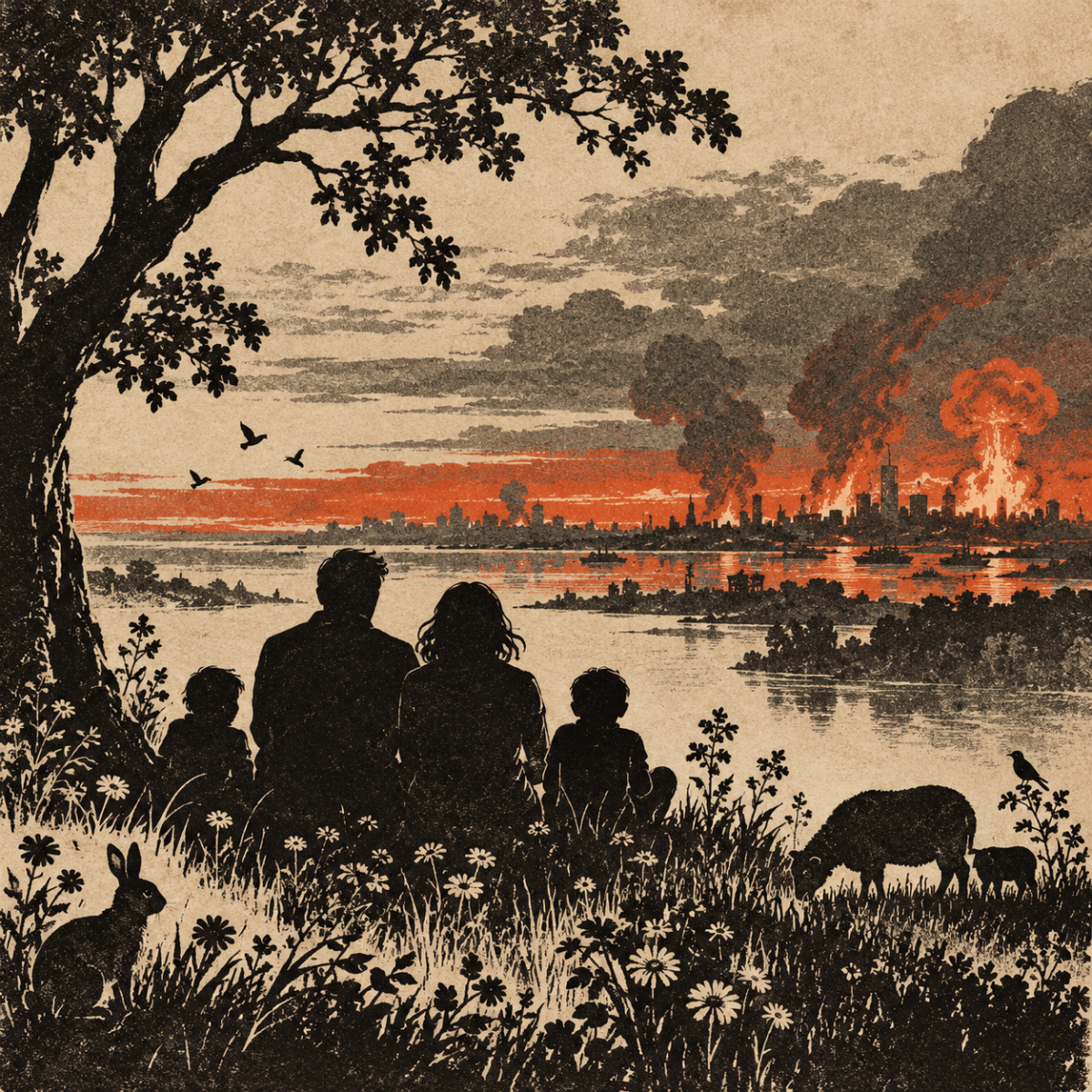
I have spent more than four decades studying systems, philosophy, communication, complexity and consequence, trying to understand what it means to be alive in a universe, and how the extraordinary arrangements we call civilisation emerge, persist and eventually come apart. It has been a remarkably broad intellectual journey, and frequently a lonely one. When I tried discussing these things with people, perhaps one in fifty possessed the vocabulary necessary to follow what I was saying, not because the ideas were absurd or inaccessible, but because most people had never encountered the conceptual foundations necessary to understand them. There was no preparation, no shared language, and often no apparent curiosity about what lay beyond the familiar. I was not trying to be clever or difficult. I was trying to understand how things fit together, what makes their existence possible, and what happens when the relationships sustaining them begin to fail. The more I learned, the more extraordinary the existence of life itself became, and the more troubling our apparent inability to appreciate what we have inherited.
From that perspective, the present condition of the world is profoundly disturbing. We have organised political, economic and technological systems that reward behaviour increasingly destructive to the conditions upon which their own persistence depends. Governments flatter wealth, corporations exploit dependency, political movements manufacture insecurity, and religious identities are sometimes recruited to justify ambitions that bear little resemblance to the moral principles they ostensibly represent. The United States has become an especially conspicuous example of this deterioration, although the underlying dynamics are planetary. Political opposition becomes part of the machinery it opposes, public outrage supplies another profitable source of attention, and the resulting confusion is continuously recycled into the arrangements producing it. None of this requires extraordinary intelligence to exploit. It requires incentives, opportunities and enough people willing to mistake personal advantage for collective necessity. The technical sophistication is impressive; the collective judgement is appalling. We have become remarkably proficient at extracting value from arrangements whose destruction would render that value meaningless.
What saddens me most is how unnecessary so much of this is. We possess sufficient knowledge of human psychology, communication, conflict and complex systems to recognise many of these destructive processes and interrupt their reproduction. Yet enormous fortunes and political careers depend upon keeping them alive, while the people responsible appear incapable of comprehending the larger consequences of their own success. They are not necessarily unintelligent people, but intelligence devoted to exploiting a system is no guarantee of understanding what that exploitation is doing to the whole. I have no particular interest in railing against them, because outrage itself has become another commodity in this grotesque economy of attention. Every living existence has its own value, but the extraordinary, interconnected organisation of planetary life is beyond any calculation of worth. We have inherited something that took billions of years to emerge, something none of us created and none of us can replace. What we stand to lose is not simply civilisation, but the living relationships that make existence possible, including our own. And I find it profoundly sad that we have come so far, learned so much, and still seem determined to make such a miserable, unnecessary ending of it all.
Categories
What We Stand to Lose: Civilisation, Power and the Value of Life
We have spent billions of years becoming what we are, yet our political and economic systems increasingly reward the destruction of the complex relationships that sustain us. What we stand to lose is beyond calculation, and the tragedy is how unnecessary so much of it is.