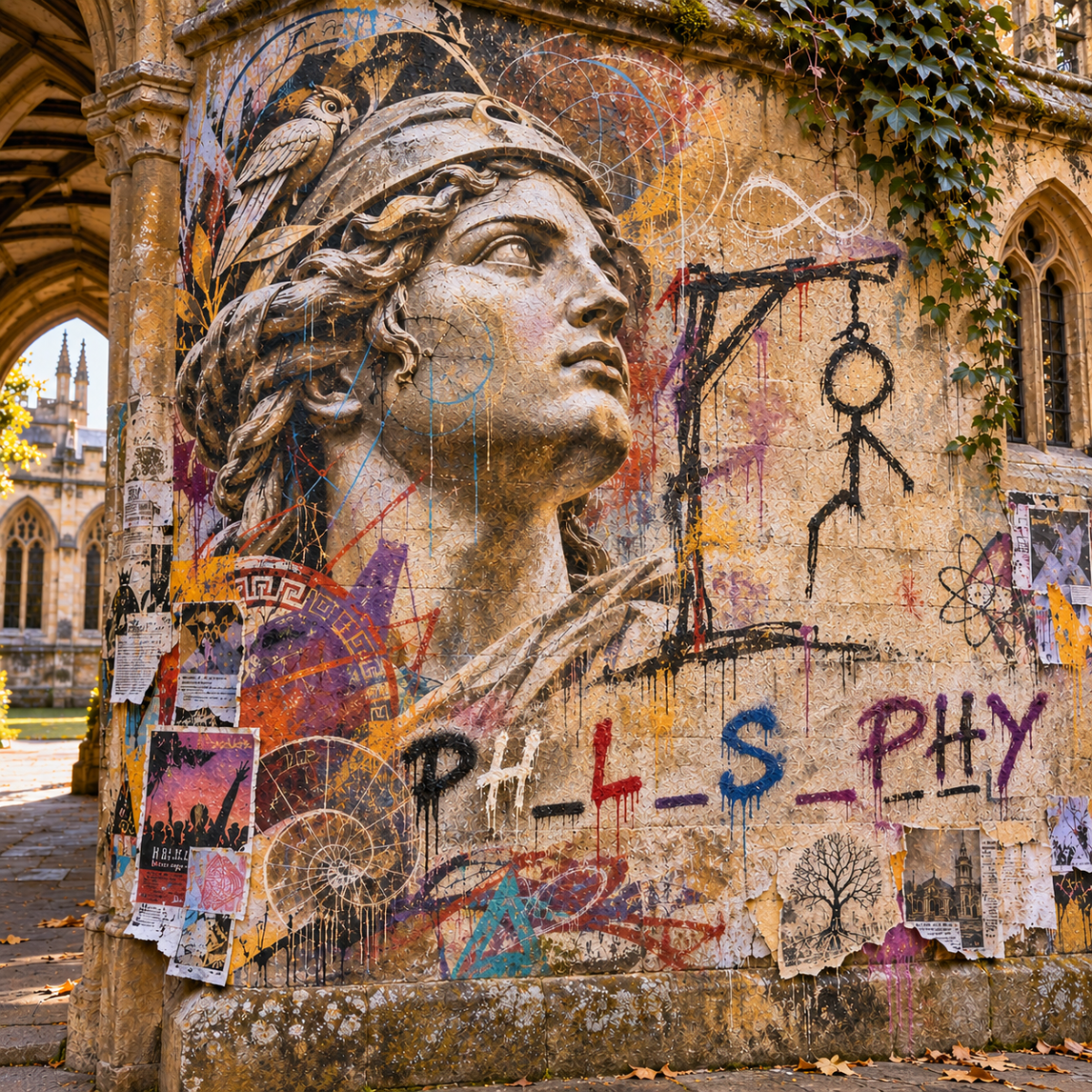
“The aim of philosophy, abstractly formulated, is to understand how things in the broadest possible sense of the term hang together in the broadest possible sense of the term.”
— Wilfrid Sellars, Philosophy and the Scientific Image of Man (1962)
For thousands of years, people have been trying to understand what sort of world they have found themselves in. They have approached it through observation, mathematics, poetry, contemplation, experiment, argument and the occasional inspired act of intellectual vandalism. Their questions have crossed cultures and centuries, producing ideas as diverse as the lives and circumstances from which they emerged. Some were mistaken, some remarkably perceptive, and many were both. What matters is that they changed what could be understood. The reception was not always enthusiastic. People who disturb established explanations have a long history of being ridiculed, marginalised, punished or celebrated, sometimes in that order. We now honour many of them as intellectual giants, having first made certain they are safely dead. Their achievements become subjects to study, their arguments become traditions, and the unfamiliar possibilities they opened gradually become familiar boundaries. It is a peculiar way to celebrate thinking.
Philosophy, however, is not the history of philosophy, any more than music is the history of musicians. Both histories matter, but neither can substitute for the activity itself. Philosophy begins with the ordinary astonishment of being here, surrounded by things that somehow make sense, things that plainly don’t, and things we have become so accustomed to that we no longer notice how strange they are. A sound becomes a word, a word becomes an idea, and an idea changes what we hear. A question about language leads to biology; a question about biology leads to mathematics; a question about mathematics leads back to the experience of being alive. Understanding does not respect the neat divisions we construct to organise it. It moves, returns, changes shape. Sometimes an explanation survives that movement, revealing something recognisable across otherwise different experiences. Sometimes it breaks, and what seemed obvious becomes a question again. Neither outcome is a failure. The pleasure lies partly in discovering how things hang together, and partly in discovering that they might hang together differently.
There is a reason familiar explanations are difficult to abandon. We could scarcely communicate without shared meanings, established expectations and the accumulated experience of those who came before us. Language, culture, knowledge and institutions allow us to cooperate across distances and generations. They give our understanding continuity, and without them we would spend most of our lives rediscovering fire and arguing about whose turn it was to invent the wheel. Yet every useful arrangement also establishes habits. What begins as a means of understanding can become a measure of what is permitted to count as understanding. An unfamiliar question is dismissed because it does not fit an established answer; an unexpected observation is treated as an inconvenience because nobody has a suitable category for it. Institutions are indispensable, although there is often a considerable difference between how important they are and how important they think they are. The difficulty is not that they preserve knowledge. It is that preservation can quietly become protection against the very activity that produced it. Once an explanation becomes part of someone’s livelihood, reputation or authority, reconsidering it can seem an unnecessarily expensive hobby.
The consequences extend well beyond philosophy. We inhabit a world in which communication has become almost instantaneous, while understanding remains constrained by the habits through which information is produced, circulated and recognised. Familiar arguments return in new language. Old conflicts acquire new technologies. We become more efficient at reproducing circumstances we claim to want to change. None of this means that established knowledge is worthless, or that every unfamiliar idea deserves acceptance. Most ideas are mistaken in some respect, including our own, and the capacity to recognise error is among the more useful things we have developed. But a civilisation facing ecological disruption, conflict and increasingly consequential technologies cannot afford to confuse the familiarity of its explanations with their adequacy. Reality has no obligation to accommodate a consensus, however impressive the qualifications of those who assembled it. Things hold together until they don’t. And when they don’t, repeating the instructions more loudly is unlikely to repair them.
Perhaps thinking otherwise is simply the willingness to notice that something does not quite fit. A hesitation, an unexpected connection, a contradiction that refuses to disappear. These are not necessarily obstacles to understanding; sometimes they are where understanding begins. There is no need to turn that recognition into a doctrine, a profession or another grand campaign to improve humanity. We can only begin with the explanations available to us, examine what they make possible, and remain willing to reconsider what they leave out. Philosophy is beautiful because it permits that movement without promising a final destination. We encounter a world, make something of it, act within it, and discover that our actions have changed the circumstances we were trying to understand. The process begins again, whether we approve or not. And given how much now depends upon our capacity to respond to what we have made of the world, being able to think a little differently may be the most practical thing we can do.
Key Takeaways
- Philosophy is something we do, not merely something we inherit. Its history is an extraordinary resource, but understanding the world requires more than remembering what others thought about it.
- Uncertainty is not the enemy of understanding. An unexpected connection, a stubborn contradiction or a question that refuses to go away may be precisely where something interesting begins.
- What holds us together can also hold us back. Language, culture and institutions make collective understanding possible, but their familiar arrangements can become boundaries we mistake for reality.
- Familiarity is a poor substitute for understanding. An explanation does not become more accurate through repetition, institutional approval or the impressive qualifications of those repeating it.
- Thinking differently may be a condition of survival. When the world no longer behaves as our explanations predict, defending those explanations is no substitute for reconsidering them. Reality is notoriously indifferent to our paperwork.

