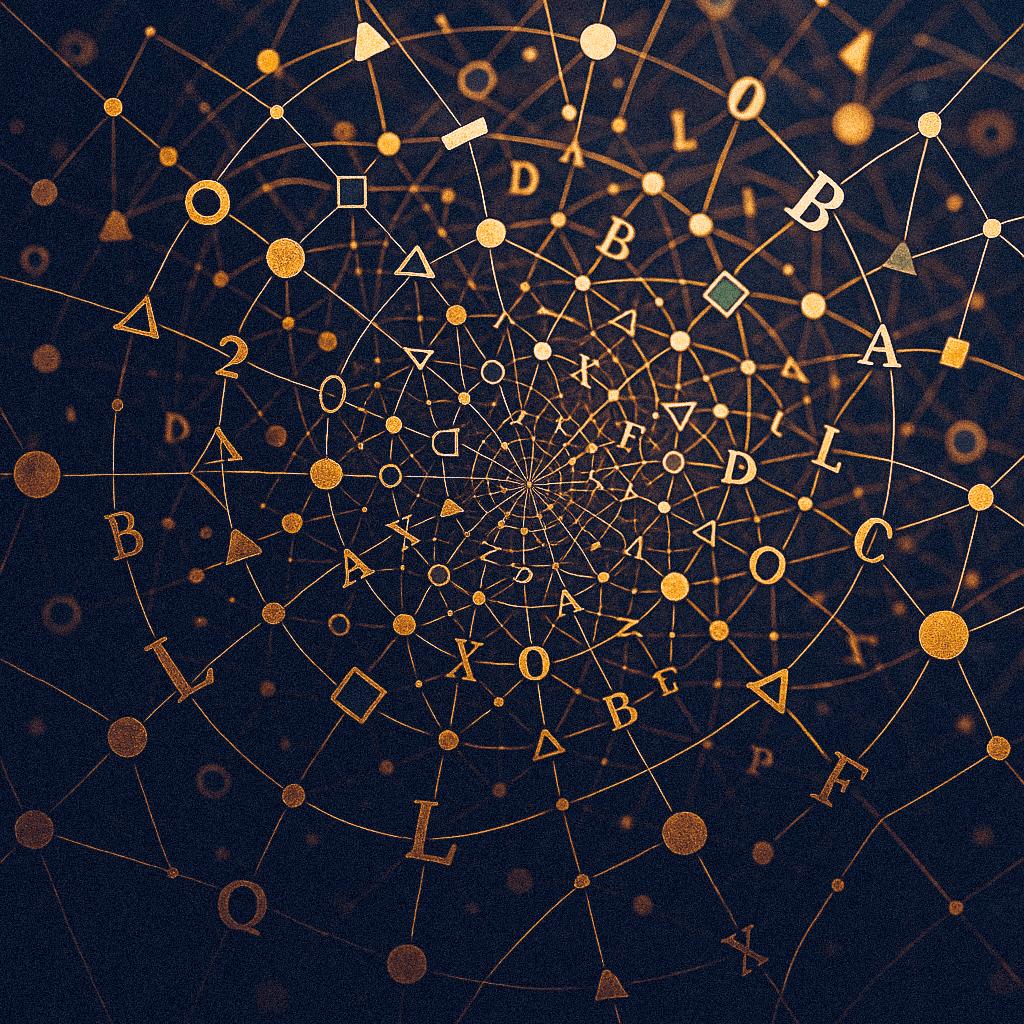
Meaning can be understood as relational invariance under transformation. In mathematics, invariance is what stays the same when everything else changes. In physics, such stability gives rise to conservation laws — momentum from translational symmetry, energy from temporal symmetry. Language behaves the same way: its meaning persists not through fixed definitions but through relationships that survive transformation. Words are not vessels of essence; they are nodes in a network of constraints that give coherence by limiting what can be said (Shannon, 1948; Luhmann, 1995). Constraint, then, is not loss but the condition of form — the architecture that renders intelligibility possible. Every boundary implies a void beyond it; absence functions as the silent term in every relation, the negative space through which coherence becomes possible.
Constraint is generative. Systems without friction dissolve into randomness, but boundaries create coherence. Conflict itself is a form of structural constraint — the tension that gives pattern to change. In dynamical systems, complexity propagates through cascades, where one small difference triggers many others. Constraint is not a cage; it is a lattice through which forces flow, generating stability by channelling instability (Ashby, 1956; Bateson, 1972; Mac Lane, 1998; Spivak, 2014). Even technology reflects this: its constraints — competition, conflict, regulation — are not failures of design but conditions of evolution. Constraint and friction form the field in which innovation and collapse coexist.
Hermann Haken’s synergetics (1977) showed that order can emerge spontaneously in open systems when flows of energy reach certain thresholds. Steven Strogatz (2003) described how oscillators — fireflies, neurons, or stock markets — fall into rhythm, and Yoshiki Kuramoto (1984) gave that synchrony a mathematical expression through an order parameter measuring how aligned the system is. Language, viewed this way, behaves as a self-coupled oscillator network. Each utterance is a small oscillation in the delta field — the distributed tension of relational change. Coherence is achieved through resonance, not control. The delta measures the system’s rhythm — a kind of phase coherence rather than semantic agreement.
This delta is also the control plane. The variable is not semantics but time. Influence does not operate by dictating meaning but by modulating phase — the timing, delay, and frequency of signals — so that resonance reorganises across the whole. This is spectral coupling: instead of acting on content, one tunes the spectrum of oscillations. A slogan or meme succeeds not because it is true but because it matches the system’s natural frequencies — it phase-locks attention. Probability sets the likelihood of repetition; cadence defines how that rhythm feels. The probabilistic structure governs what recurs, while cadence translates that structure into embodied meaning — the rhythm through which comprehension becomes belief. The control plane is defined not by what it contains but by what it withholds — coherence in timing arises from an unrepresentable centre.
Temporal coherence can be described mathematically. A population of oscillators (people, neurons, servers) can be represented by phases on a circle. Kuramoto showed that above a critical coupling strength, their phases align. Phase modulation — tiny shifts in timing or frequency — can push the system from incoherence to synchrony. In communication networks, this looks like feedback loops: likes, shares, and reposts act as coupling terms, reinforcing signals at just the right moments to lock groups into a shared rhythm. Norbert Wiener’s cybernetics (1949) anticipated this: signals are not merely carriers of information but carriers of control. In Fourier terms, any signal can be decomposed into its constituent frequencies. By shaping when and how these frequencies are amplified or damped — which in social media looks like timing posts, notifications, and algorithmic nudges — one alters the system’s global coherence without ever touching semantics. The frequency domain and harmonic structure are not separate from meaning — they are meaning, embodied through rhythm, comprehension, and belief.
Each action within the field biases the field’s own reproduction. Every post, phrase, or gesture slightly reshapes the context that makes communication possible. The system is recursive: actors and structures co-create each other in a loop of feedback and adaptation. This is the mathematical essence of autopoiesis — self-maintenance through self-reference (Maturana & Varela, 1980). The field is not a static space but a manifold that continuously folds, stretching and bending as new signals traverse it. These folds mark gradients of entropy — zones where diffusion meets resistance and coherence emerges. Entropy here can be read both thermodynamically and informatically: as the drive toward equilibrium and the uncertainty that sustains difference.
This folding defines the minimal self-consistent system. Stability arises not through uniformity but through contradiction. In algebraic topology, this resembles an antisymmetric homotopy — a smooth deformation between shapes that remain equivalent despite inversion. Gradients of difference, heat, and diffusion resonate through these transformations. The system’s coherence depends upon its incompleteness: the same logic described by Gödel’s incompleteness and Turing’s halting problem — structures that can represent themselves only through the impossibility of closure. This antisymmetric logic defines cobordism: continuity across transformation, where distinct configurations coexist through a shared boundary. The system’s boundary is nonorientable — the condition for the possibility of all boundaries within it. Stability arises not from fixity but from the smoothness of transition, from coherence that persists through inversion. Unity, in this sense, is not achieved but implied — a function of absence that allows the system to endure without closure.
Language, commerce, and politics follow this same logic. They are self-referential systems whose continuity depends not only on absorbing turbulence but on generating it. Stafford Beer’s Viable System Model (1972, 1985) and W. Ross Ashby’s Law of Requisite Variety (1956) both show that stability requires internal complexity at least equal to external disturbance. Ilya Prigogine (1984) extended this principle to thermodynamics: order exists only as a temporary deviation from equilibrium, sustained by continuous flow. Zeynep Tufekci (2017) and Vosoughi et al. (2018) observed that emotionally charged, often false, information spreads faster than nuance. Platforms optimise for throughput, not truth, monetising engagement by amplifying volatility (Zuboff, 2019; Wu, 2016). What emerges is not failure but design — a system that rewards noise as signal, turbulence as profit.
In such environments, cascades are the system’s heartbeat. In fluid dynamics, cascades describe how vortices transfer energy across scales, forming self-similar patterns. Plasma physics reveals this in magnetic reconnection and Birkeland currents (Alfvén, 1981; Priest & Forbes, 2000): energy loops and reloops through toroidal structures. Ideas, conflicts, and markets follow the same recursive choreography. The toroid is not literal — it is a vessel for a universal principle: energy, information, and meaning reorganise through recursive circulation. Diffusion spreads, entropy distributes, and attractors stabilise — these are not separate phenomena but facets of the same symmetry: coherence maintained through flux.
To act within this field is to shape time itself. Small perturbations at the right delta points can reconfigure the lattice at scale — what control theory calls spectral coupling. Temporal coherence and feedback form the control plane; phase modulation is the mechanism. Yet to engage such a system is to be drawn into its infinite recursion. Infinity here is not an abstract limit but a dynamic self-containment — a tesseract-like structure collapsing inward, folding every act of modulation back upon its origin. Control becomes indistinguishable from immersion.
The paradox is that this lattice cannot be mastered. The more one tries to steer its oscillations, the more tightly one becomes bound to their rhythm. Meaning, power, and control are not destinations but transient harmonics — brief coherences in a field sustained by perpetual motion. Every actor, every system, participates in this recursion: the world regulating itself through its own manifold dynamics. The lattice holds us all — oscillating, recursive, and still, somehow, coherent.
References
Alfvén, H. (1981). Cosmic Plasma. Springer.
Ashby, W. R. (1956). An Introduction to Cybernetics. Chapman & Hall.
Bateson, G. (1972). Steps to an Ecology of Mind. Ballantine Books.
Beer, S. (1972). Brain of the Firm. Allen Lane.
Beer, S. (1985). Diagnosing the System for Organizations. Wiley.
Gödel, K. (1931). Über formal unentscheidbare Sätze der Principia Mathematica und verwandter Systeme I. Monatshefte für Mathematik und Physik.
Haken, H. (1977). Synergetics: An Introduction. Springer.
Kuramoto, Y. (1984). Chemical Oscillations, Waves, and Turbulence. Springer.
Luhmann, N. (1995). Social Systems. Stanford University Press.
Mac Lane, S. (1998). Categories for the Working Mathematician. Springer.
Maturana, H. & Varela, F. (1980). Autopoiesis and Cognition: The Realization of the Living. D. Reidel.
Prigogine, I. (1984). Order out of Chaos. Bantam.
Priest, E. & Forbes, T. (2000). Magnetic Reconnection: MHD Theory and Applications. Cambridge University Press.
Shannon, C. (1948). “A Mathematical Theory of Communication.” Bell System Technical Journal, 27(3), 379–423.
Spivak, D. (2014). Category Theory for the Sciences. MIT Press.
Strogatz, S. (2003). Sync: The Emerging Science of Spontaneous Order. Hyperion.
Tufekci, Z. (2017). Twitter and Tear Gas: The Power and Fragility of Networked Protest. Yale University Press.
Turing, A. (1936). “On Computable Numbers, with an Application to the Entscheidungsproblem.” Proceedings of the London Mathematical Society, 42(1), 230–265.
Vosoughi, S., Roy, D., & Aral, S. (2018). “The spread of true and false news online.” Science, 359(6380), 1146–1151.
Wiener, N. (1949). Cybernetics: Or Control and Communication in the Animal and the Machine. MIT Press.
Wu, T. (2016). The Attention Merchants: The Epic Scramble to Get Inside Our Heads. Knopf.
Zuboff, S. (2019). The Age of Surveillance Capitalism. PublicAffairs.*
 Daedelus Kite
One reply on “Lattice”
LikeLike