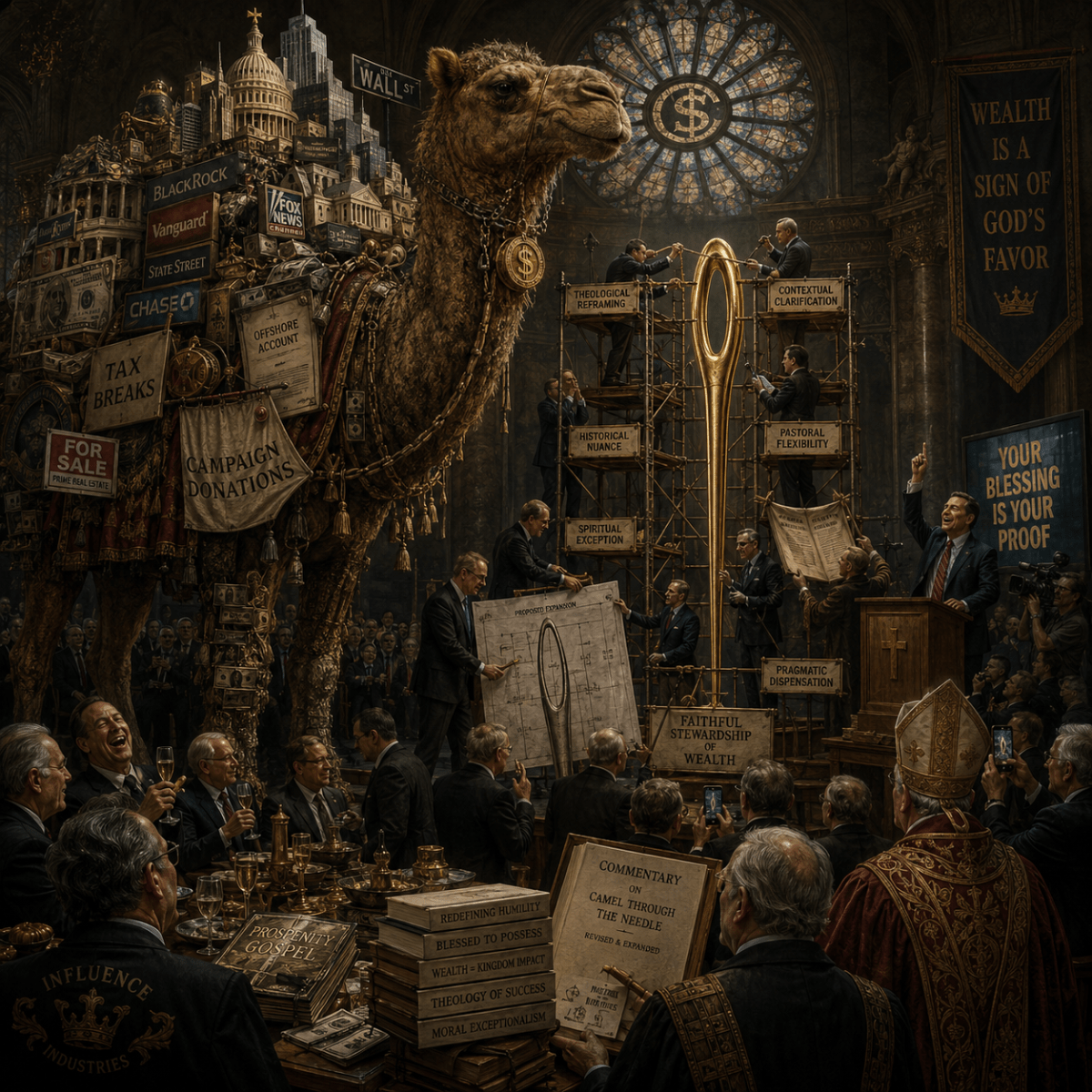
The camel has grown enormous. It arrives draped in stock portfolios, property deeds, media holdings, tax concessions, and campaign donations, while a crowd gathers around the needle insisting that the opening itself is the problem. Rather than asking whether wealth, power, and status might present a spiritual obstacle, they propose enlarging the eye, redefining the camel, reinterpreting the thread, and eventually congratulating themselves for discovering that accumulation was a sacrament all along. The miracle is not that the camel passes through. The miracle is that anyone remembers the original warning after so much industrious theological carpentry.
What emerges is not so much a contradiction as a recurring historical pattern. The warning remains intact. The needle remains where it has always been. Yet generation after generation discovers ingenious reasons why it applies to someone else. The tradition contains a persistent suspicion of wealth, but it also contains centuries of institutions, empires, patrons, kingdoms, political movements, and commercial interests seeking ways to coexist with wealth, legitimise wealth, or benefit from wealth. Nothing needs to be removed from the text. The warning survives perfectly well.
The remarkable achievement lies in constructing vast political, economic, cultural, and theological architectures around it, redirecting attention toward interpretations more compatible with power. Entire industries of commentary, identity, and ideology now orbit around explaining why the obstacle is less substantial than it appears. It resembles a man standing beneath a storm, declaring himself dry because he has successfully redefined rain. The spectacle would be comic were it not so influential: a faith whose founding texts repeatedly warn of the spiritual dangers of concentrated wealth, while its institutions continue discovering ever more sophisticated reasons for that wealth’s moral innocence. The needle remains exactly where it always was. The cathedral around it keeps getting bigger.
Categories
caravan of confusion
Power does not erase wisdom’s serial warnings about the corruption and cruelty that often accompanies extreme wealth; it orchestrates and sustains an institutional matrix to demonstrate why the warning applies to someone else.