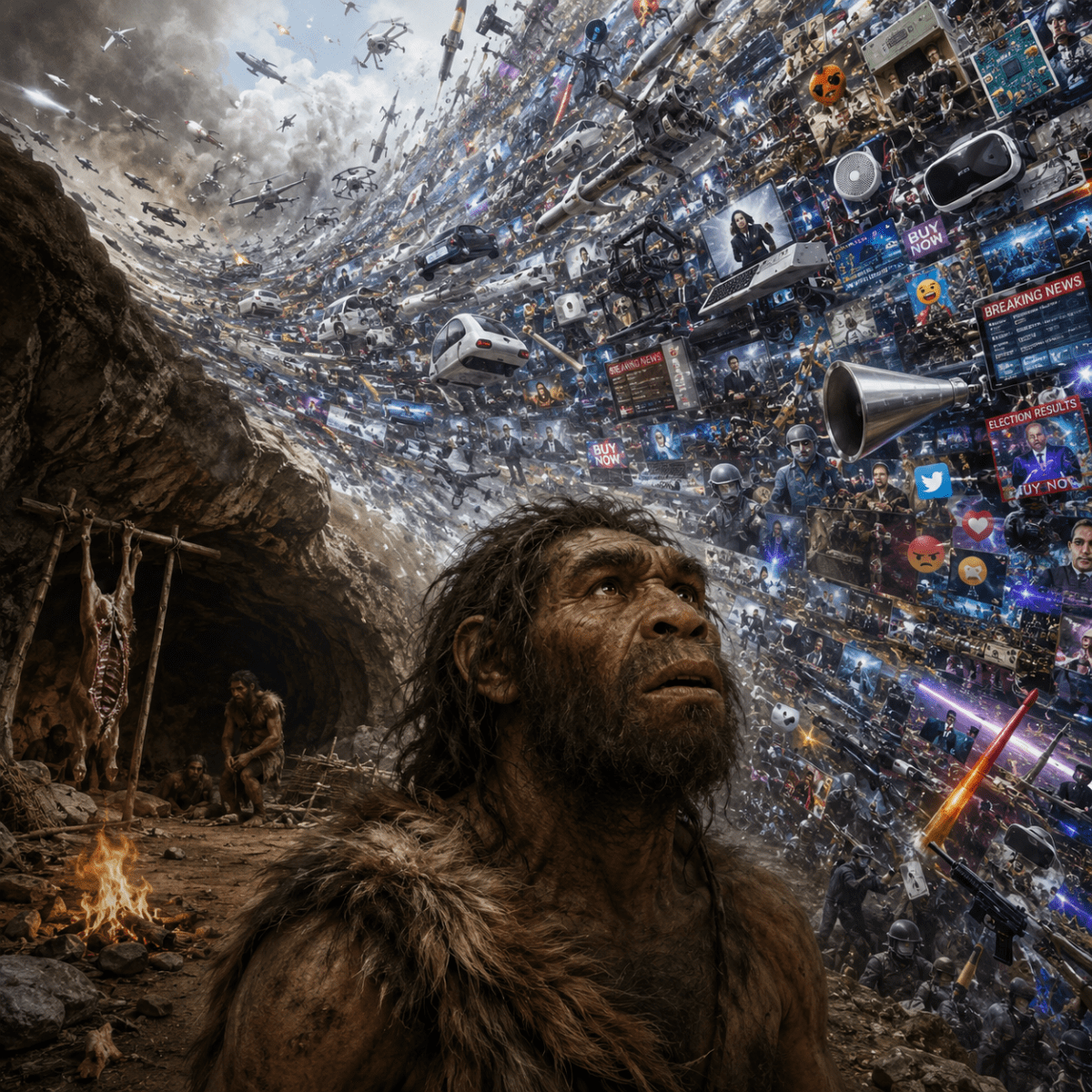
Developmental delay is usually something we attribute to individuals. Increasingly, it describes civilisation. Human cognition evolved for small groups, immediate environments, and relatively stable worlds. Our working memory comfortably holds only a handful of relationships at once. That is not a defect. It is how our intelligence was built. The problem is that the world it was built for no longer exists.
Technology has accelerated far faster than human cognition. We now navigate global finance, artificial intelligence, climate change, algorithmic media, and continuous information flows that no individual can genuinely comprehend. Our tools have become planetary while our minds remain fundamentally local. The developmental delay is not biological. It is civilisational. More importantly, it has become part of the environment itself. Our inability to keep pace is now anticipated, measured, priced, and exploited by the systems we have created.
When reality becomes too complex, people compress it into stories they can carry. That is why simplistic politics, conspiracy theories, culture wars, and commercial manipulation are so effective. They reduce overwhelming complexity to a few emotionally satisfying explanations. The relief is real. The understanding is not. Our cognitive delay has itself become a resource: attention is captured, uncertainty is monetised, outrage is amplified, and prediction increasingly depends upon modelling the limits of human understanding. These simplified narratives then regenerate the very problems they claim to explain, reinforcing the cycle from which they emerged.
This reaches far beyond politics. Housing, environmental degradation, migration, public health, artificial intelligence, financial instability, and information disorder are deeply interconnected systems. They cannot be understood through slogans, identities, or tribal loyalties. Yet those remain the forms of explanation our minds instinctively prefer under conditions of stress and overload. Complexity has become a resource to be exploited by those willing to manufacture certainty, while the widening gap between technological capability and human comprehension has itself become a source of economic, political, and strategic advantage.
The singularity is not a future event. It began the moment technological acceleration permanently outran the human capacity to understand it. The defining challenge of this century is no longer building more powerful technologies. It is developing ways of thinking that can keep pace with the world we have already created. Until then, our greatest vulnerability will not be our machines. It will be our own developmental delay.
Categories
developmental delay
The defining challenge of this century is no longer building more powerful technologies. It is developing human and institutional capacities capable of understanding, governing, and surviving the systems we have already created.