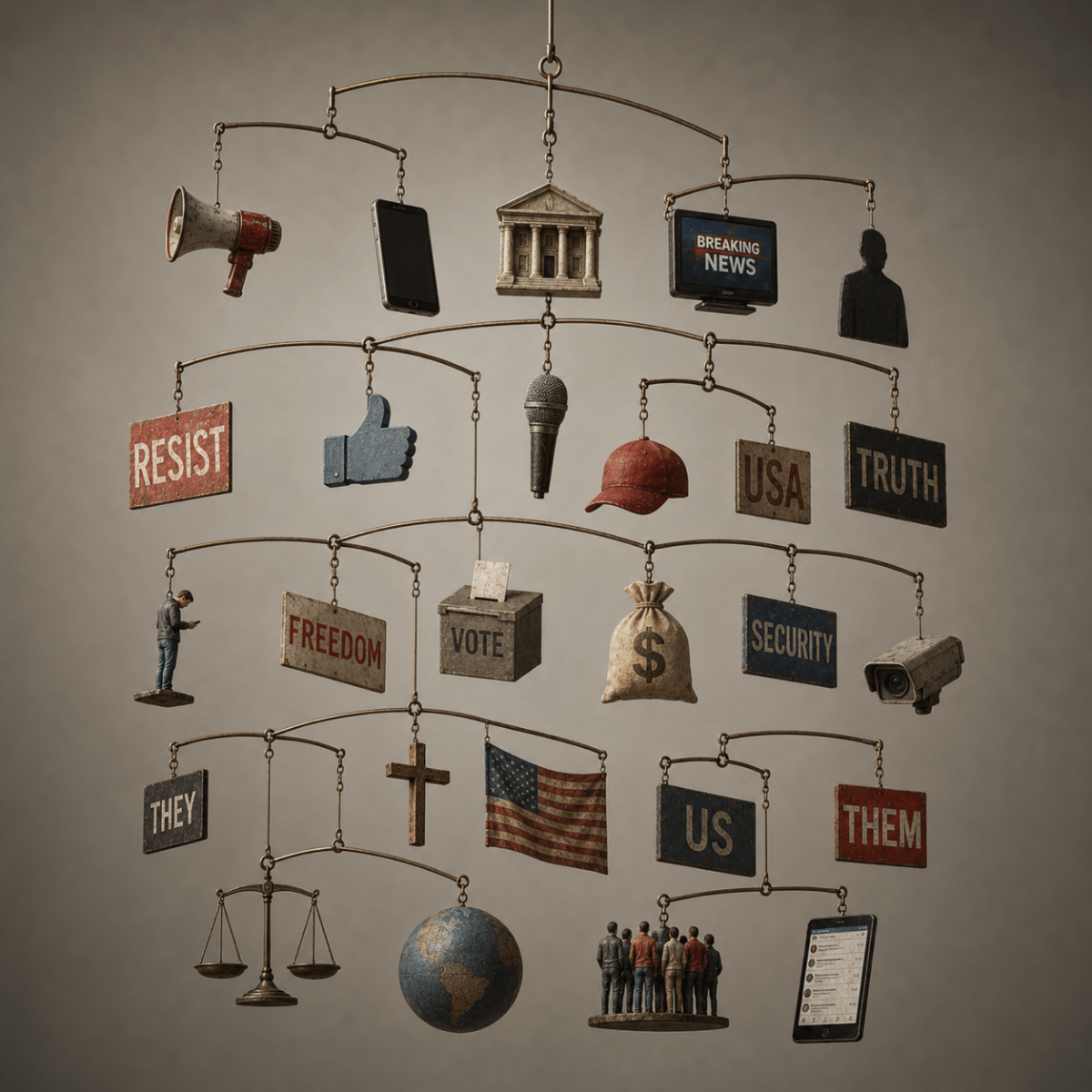
We tend to imagine political belief as something belonging to the individual. I believe this, you believe that, and politics emerges when our independently formed convictions collide. But this begins with an assumption that becomes questionable once identity itself is understood relationally. People do not stand outside political, linguistic, technological and cultural systems and then decide what to bring into them. We develop inside them. The beliefs we experience as our own are assembled from languages, histories, categories, fears, aspirations and distinctions already circulating through the world. We make them particular because no two lives occupy exactly the same position, but the materials from which political identity is constructed were moving long before any particular person arrived. Even our experience of choosing among them occurs within a landscape we did not choose.
At the larger scale, what persists may not be any particular political belief at all. Parties reverse policies, conservatives discover new things to conserve, radical positions become respectable and old orthodoxies quietly disappear. What survives these transformations more reliably is the organised difference between positions, the gradient across the political field. Left acquires meaning through right, establishment through outsider, authority through resistance, and resistance through whatever presently possesses authority. These differences are not merely abstract features of political systems. They become psychologically and socially coherent from within. The more completely someone inhabits a position, the more natural its distinctions can appear: who belongs, what matters, what threatens us, what must change. That coherence gives political identity its behavioural force, while the resulting behaviour reproduces the field from which the identity acquired its coherence in the first place.
There is a deeper recursion here. It is not simply that the parts reproduce a whole they cannot see. Their inability to see the whole is implicated in there being distinct parts at all. A political subject exists from somewhere, not everywhere. To possess a position is necessarily to encounter the political field from a limited location within it. If every participant could somehow occupy the totality of perspectives, relations, histories and consequences simultaneously, much of the differentiation through which political identity becomes possible would disappear. Our partiality is not merely an unfortunate shortage of information waiting to be corrected by a sufficiently heroic quantity of reading. It is part of the architecture. We become politically distinct through bounded positions, and those positions generate the differences through which the larger political field continues to organise itself.
Probability enters here in a consequential way. A political influence that propagates does more than transmit a message. It alters attention, expectation, language, affiliation and response, changing the conditions through which subsequent communication occurs. Successful influence differentially weights the field toward pathways through which related forms of influence are more likely to recur. Nothing needs to intend this. Millions of local and contingent acts collectively reshape what is more or less likely to be thought, repeated, resisted, institutionalised or forgotten. The political field is never neutral. It carries the accumulated effects of prior communication forward as an uneven distribution of future possibilities.
The renewed spectre of communism in contemporary American politics provides an unusually clear example. The actual prevalence of communism is almost beside the point. As a political category it already carries a century of accumulated associations: foreign threat, economic failure, atheism, state control and opposition to an idealised American freedom. Invoking it does more than identify an opponent. It reactivates an old relational structure in which free markets, religious identity, nationalism and American power can once again appear together as the natural opposite of a familiar enemy. The historical success of that distinction has already shaped the communicative field, and its renewed circulation differentially weights the field toward pathways through which the same distinction can continue to make sense. The old enemy does not even need to return in any substantial form. Sometimes the ghost is sufficient to keep the architecture standing.
None of this makes political experience imaginary. Quite the opposite. Anger is real. Fear is real. Solidarity, resentment, loyalty, hope and the experience of agency are real. So are peaceful intentions and sincere attempts to escape destructive political divisions. But something can be entirely real at the scale of human experience while performing a very different function at another scale. Feelings produce actions, actions provoke responses, responses organise affiliations, and affiliations generate further communication. Persistent political systems do not always need to crush their opponents. Often they can metabolise them. Protest becomes consultation, rebellion becomes culture, critique becomes profession, and opposition becomes another durable source of political communication. The machine does not particularly care whether you kick it or praise it if both actions keep the machinery turning.
Politics begins to look less like a contest between independently existing beliefs and more like an argument that continually generates the conditions for its own continuation. Nobody needs to want this outcome. A wildfire does not need a theory of fire. It needs gradients, fuel and somewhere else to burn. Political communication similarly persists because differentiated human experience continually regenerates the distinctions, responses and relationships from which further politics can emerge. We experience ourselves locally as choosing, believing, resisting and belonging, while those experiences participate in a relational structure no participant can occupy as a whole. The deepest political question may not simply be which side should finally win the argument, but how the experience of having a side, with all its sincerity, urgency and apparent self-evidence, helps reproduce a political field that keeps giving us sides to fight over.
Categories
unbalanced: political recursion
Politics is an abstraction that leverages human beings as an extraordinarily effective method of self-propagation.