The uncomfortable thing about contemporary identity politics is not that one side discovered propaganda while everyone else remained innocent. An entire generation grew up inside increasingly precise systems for measuring attention, sorting populations, predicting behaviour and returning statistically successful stimuli to them at industrial scale. Advertising, polling, recommendation systems, engagement metrics and social media did not need to understand anyone particularly well. They needed to discover which signals reliably produced measurable responses across sufficiently large populations. Technology made that experiment continuous. Billions of behavioural trials selected for whatever made people stop, look, click, share, fear, desire, identify and return. We built extraordinary machines for discovering which buttons people possess, then established some of the world’s largest corporations by pressing them.
Identity became particularly useful within this machinery because belonging, status and social continuity are not abstract concerns. Threaten them and attention changes. What is colloquially called an amygdala hijack is neurologically more distributed than the phrase suggests, but the useful point is simpler: perceived threat can narrow attention, intensify affect and privilege rapid defensive interpretation. Once information is attached to identity, disagreement no longer arrives merely as information. It happens to us. The particular politics scarcely matters at this level. Nationalist, progressive, reactionary, religious, secular and conspiratorial formations can occupy the same logical orbit: establish an identity, specify a threat, amplify the distinction, reward participation, repeat. Language supplies the distinctions by which the field is divided into us and them, permitted and forbidden, loyal and suspect. Eventually everyone acquires a vocabulary explaining why everyone else is the problem. Convenient.
Nobody needed to design the resulting system as a whole. Statistical selection was sufficient. Signals producing stronger measurable responses survived, travelled and generated further information about those responding to them; signals producing indifference tended to disappear. Corporate and technocratic systems then did what systems organised around measurement predictably do: they optimised what could be measured. Attention became engagement, engagement became data, data became prediction, prediction became intervention, and intervention produced more data. This is the triumphal stagnancy of technological overreach: extraordinary technical acceleration coupled to an increasingly repetitive behavioural repertoire. Vast computational infrastructures, planetary communication networks and some of the most sophisticated engineering in history have been recruited to discover ever more efficient ways of keeping frightened primates looking at rectangles.
But the mechanism that produces convergence also produces discontinuity. A system that continually sharpens differences to capture attention cannot indefinitely consolidate them into a stable identity. Every successful distinction permits finer distinctions; every boundary creates new positions from which to contest it; every language of belonging generates corresponding languages of exclusion. What appears from a distance as a coherent political mass consequently resolves, under continued amplification, into proliferating factions competing to become its authentic centre. The crystal becomes more ordered and more brittle at once. Eventually it fractures into competing shards, each carrying the same relational demand in miniature: recognise me, validate me, follow me, give me power. Everyone wants to overthrow the hierarchy and, by extraordinary coincidence, end up somewhere near the top of the replacement.
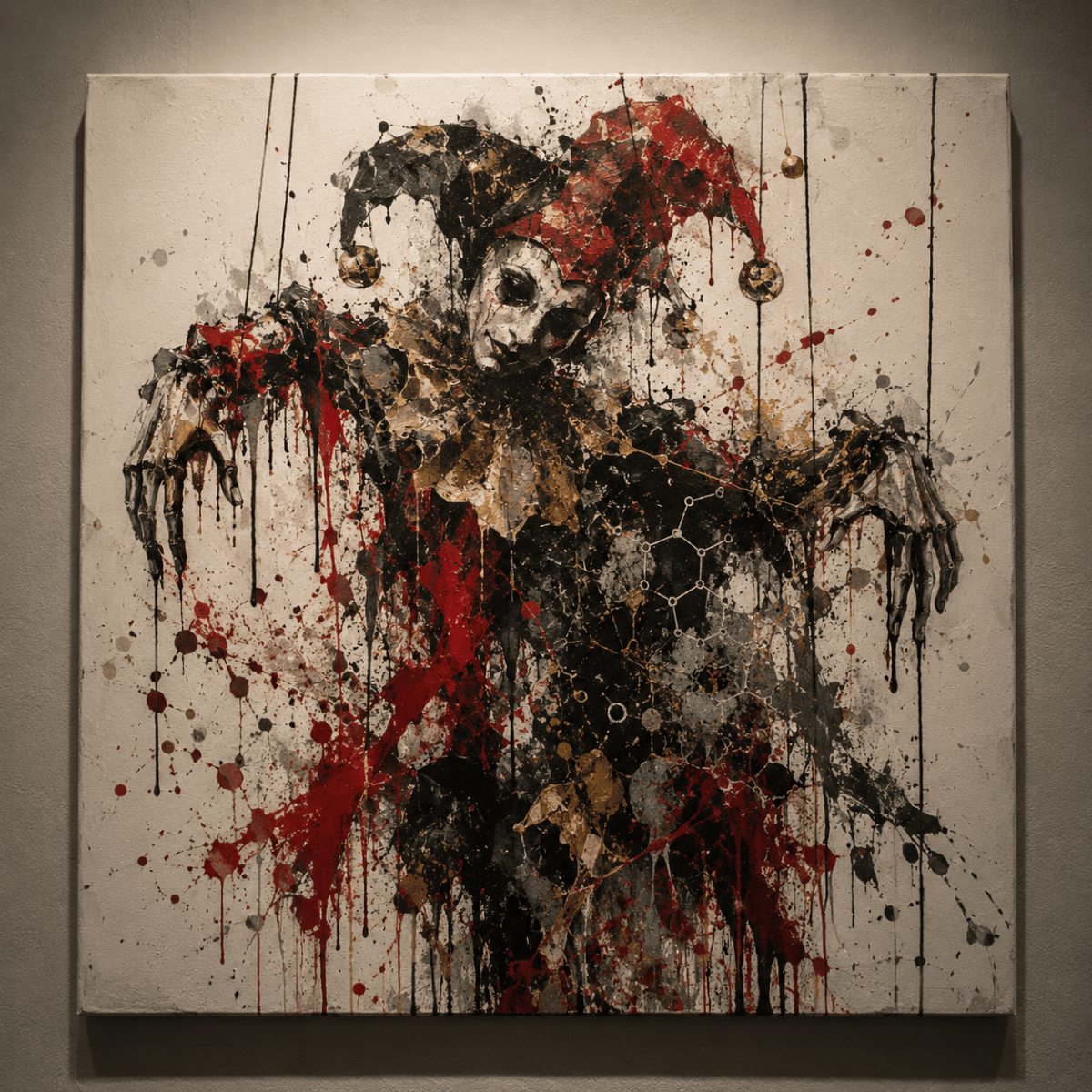
This is what “The Herd Reich” names. Not a regime, ideology or unified herd, but the industrial production of herding as a relation: a technologically mediated order in which populations are statistically sorted and affectively entrained into recurrent patterns of attention, identification, threat and response. The herd is the emergent synchrony. The Reich is the distributed infrastructure of measurement, amplification and behavioural selection through which that synchrony persists without requiring a single centre of command. People can disagree completely about what the world means while becoming remarkably similar in the rhythms through which they attend, react and return.
And here the apparent triumph begins to consume itself. Machinery built to improve prediction generates distinctions faster than it can reconcile them; attempts at stabilisation create new positions from which stability can be contested; language endlessly supplies somewhere else to stand. The architecture sought legibility and discovered something worse: that fear, grievance and belonging could be rendered as behavioural variables, tuned for recurrence, and sold back to the people generating them.

 Daedelus Kite
One reply on “The Herd Reich”
Political identity is the lowest common denominator of mass manipulation: reduce a person to an allegiance, attach that allegiance to a threat, and behaviour becomes remarkably easy to steer.
LikeLike