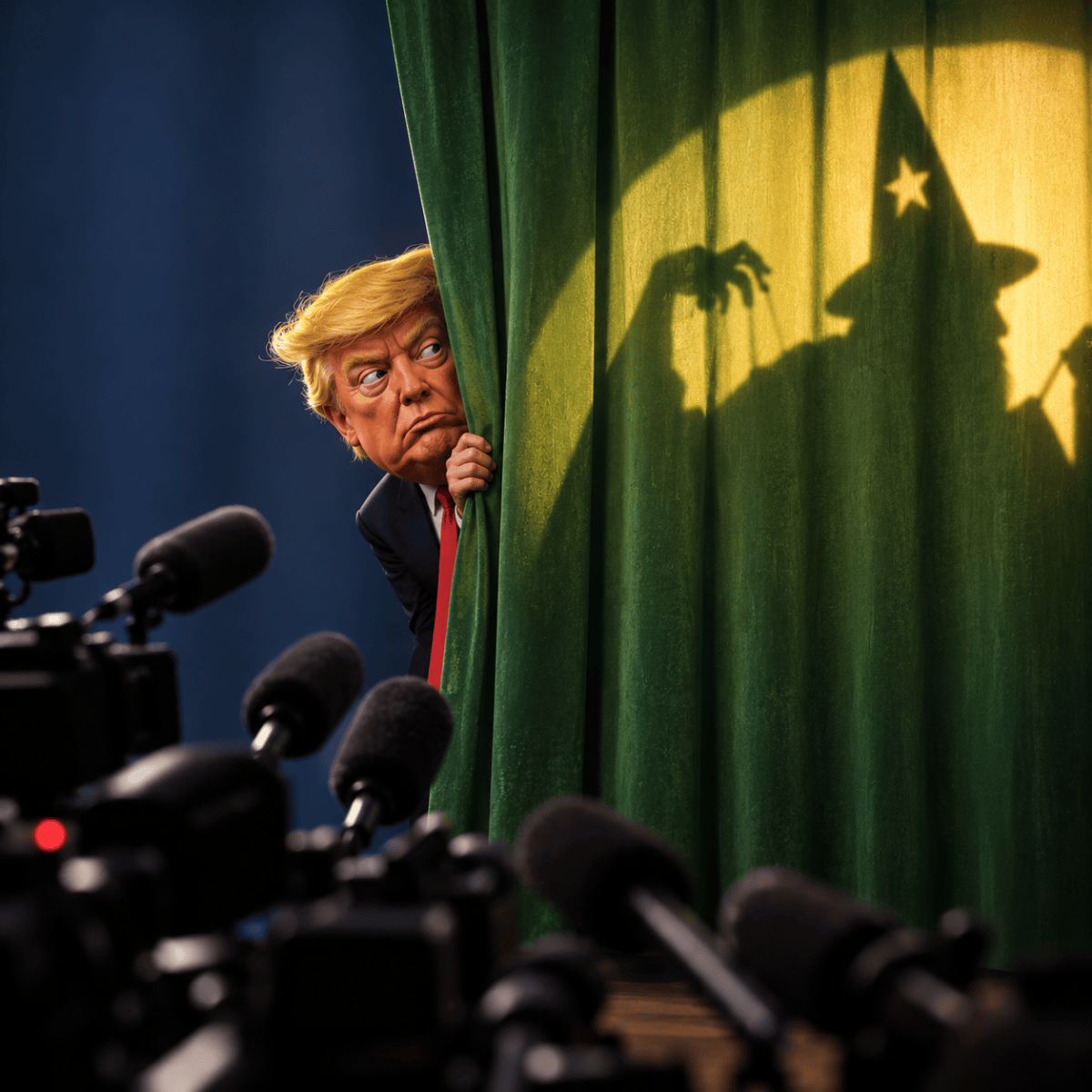
Trump depends in part upon the opposing media he seeks to exclude. Its opposition generates conflict through which his political identity acquires force. The wizard needs the curtain, but he also needs someone on the other side insisting that we look behind it.
Donald Trump has a peculiar relationship with the media. I argue that much of his political presence is, in fact and ironically, sustained by the media organisations he seeks to exclude from the White House. Every provocation generates reporting, criticism and outrage, but the significance lies in what happens between these events. Each confrontation inherits an audience already anticipating the conflict, journalists expecting another provocation, and supporters prepared to interpret the resulting hostility as confirmation of their allegiance. The opposition becomes part of what makes Trump recognisable. His supporters do not simply believe in him. For some, their loyalty is organised against those who oppose him. The wizard needs the audience to believe, but he also needs someone outside the curtain insisting that the whole performance is nonsense.
Language does not simply describe this conflict. It helps reproduce the circumstances in which the conflict becomes meaningful. Words acquire significance through their relationships with other words, previous encounters, cultural expectations and the responses they have repeatedly produced. A phrase such as “fake news” carries more than an accusation. It invokes an established division between legitimate and illegitimate authority, inviting an audience to recognise its place within that division before examining the information itself. Repeated distinctions become familiar ways of organising experience. Culture preserves them, communication renews them, and each recurrence changes the conditions under which the next message will be understood. The participants need not share an interpretation. Their incompatible interpretations can sustain the very relationship that keeps them communicating.
This is why disinformation cannot be understood simply as a collection of false statements. A claim can be disproved while the expectations that made it credible remain undisturbed. Indeed, the correction itself can be interpreted as another instance of the anticipated hostility. The contradiction is absorbed, and the familiar pattern continues. What persists is not necessarily the claim, but the relationships through which new claims become believable. Timing matters. The provocation establishes an expectation, the anticipated response confirms it, and the confirmation prepares the audience for the next disturbance. Digital technologies can reinforce these relationships by measuring and preferentially circulating communication that generates further responses. The machinery does not require a genius behind the curtain. It requires recurring differences, an audience prepared to recognise them, and sufficient opportunities for the performance to reproduce itself.
And this is where restricting journalists’ access becomes such a peculiar decision. The administration’s approach risks restricting a source of opposition that also helps sustain Trump’s political presence. The White House briefing room is one point of contact where the administration’s account of itself encounters independent questioning. The resulting differences circulate beyond the room, generating further reporting, interpretation and response. Restricting that contact changes the relationship. It does not eliminate the opposition, and the restriction itself can become another provocation, but it interferes with one of the mechanisms through which the conflict is continually renewed. The decision creates a tension between the political benefits of an adversarial press and attempts to determine the conditions under which that adversary can operate. The wizard has decided that the people asking awkward questions should leave the theatre. An interesting decision for someone whose performance depends, at least in part, upon their continued objections.
There is, however, a difference between opposition that reproduces the spectacle and investigation that changes the conditions under which it can persist. Familiar criticism can reinforce familiar loyalties. Evidence connecting statements to decisions, documented financial interests and material consequences introduces relationships that cannot be settled merely by repeating the original dispute. This is why independent observation matters. It allows information to emerge outside the administration’s preferred account of itself. Wealth and technological power can influence which information circulates, how frequently it recurs and which alternatives remain difficult to encounter. They cannot establish the truth of a claim by making it familiar. An enormous bank balance is not a certificate of intelligence, although the consequences of confusing wealth with wisdom can become remarkably expensive for everyone else.
Trump is not the entire problem. He occupies a conspicuous position within a system in which opposition can reproduce the political presence it seeks to diminish. His administration’s restrictions on press access illustrate the contradiction without necessarily resolving it. The conflict can continue elsewhere, acquiring new forms and new participants, while opportunities for independent examination become more restricted. The distinction is between reproducing the familiar opposition and changing the relationships that make it persist. The wizard needs the curtain, but he also needs the people trying to pull it aside. His difficulty is that he cannot guarantee they will keep playing their assigned parts once they discover how the machinery works.
Categories
The Wizard Needs the Curtain: Trump, Media and the Machinery of Power
Trump depends upon the opposing media he seeks to exclude. Its opposition generates the conflict through which his political identity acquires force. The wizard needs the curtain, but he also needs someone on the other side insisting that we look behind it.


One reply on “The Wizard Needs the Curtain: Trump, Media and the Machinery of Power”
And then there are the flying monkeys, those industriously pernicious guardians of irredeemable arrogance, determined to prevent anyone from interfering with the curtain. Not because it conceals the machinery, but because keeping the curtain in place preserves the arrangement, even when everyone can see what is happening behind it. The financial interests and relationships of power are increasingly visible, yet their exposure does not necessarily interrupt them. Media and institutional life are accustomed to exposing what is hidden, not confronting a system in which investigation and exposure can themselves become part of the machinery sustaining what they seek to challenge. Every revelation generates further attention, circulation and conflict, amplifying Trump’s presence while some supporters interpret the hostility as confirmation of their allegiance. The flying monkeys defend the curtain, the media keeps pulling it aside, and the wizard becomes more conspicuous with every revelation. The absurdity is that exposing the machinery has become part of its operation. Everyone keeps pulling at the curtain, everyone keeps watching, and the performance goes on. There’s no place like home.
LikeLike