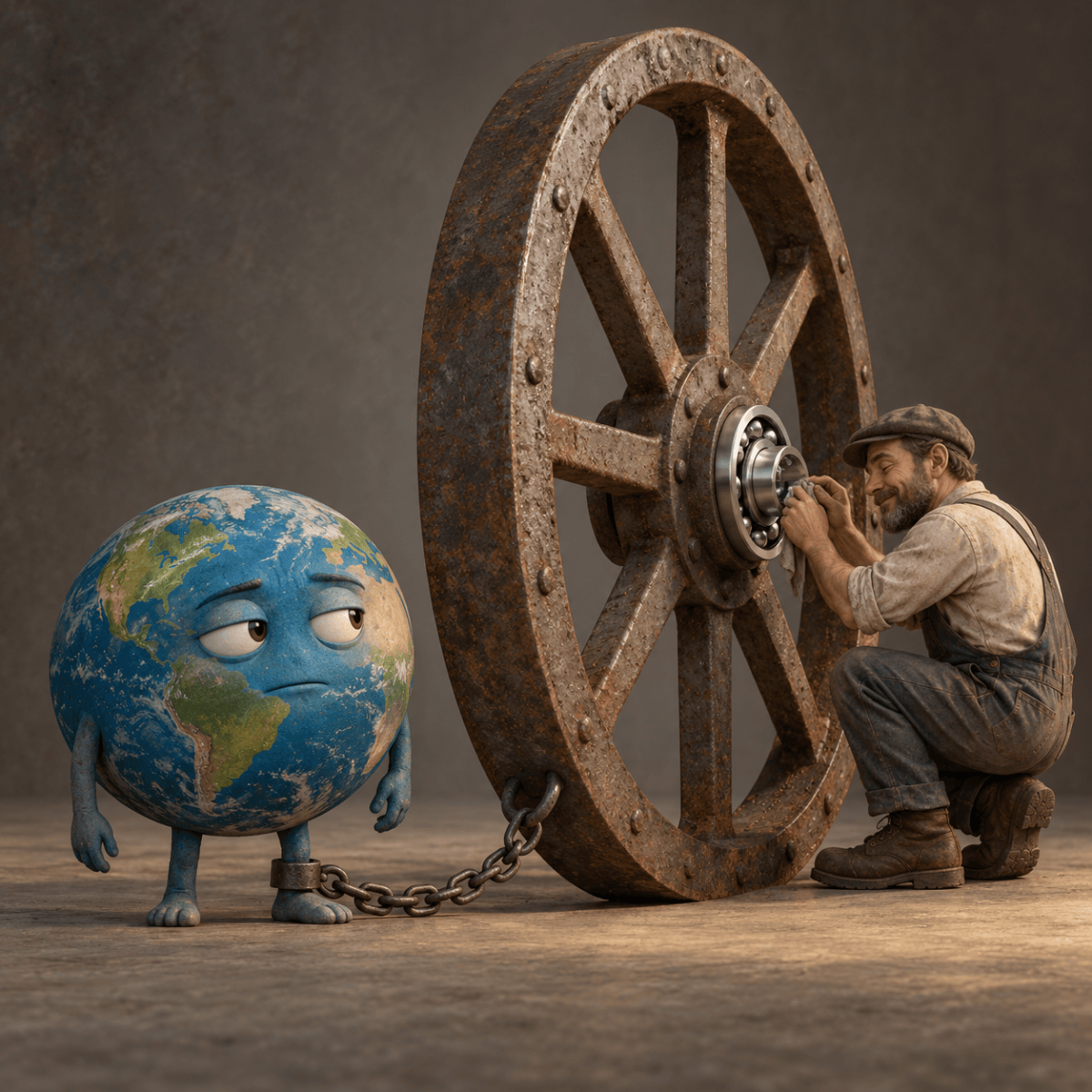
A civilisation can become exceptionally good at doing something it remains profoundly foolish to continue doing. The sophistication of a weapon, the efficiency of a military operation, or the speed of an automated response may demonstrate considerable intelligence within a particular task. The larger arrangement that makes the task necessary requires a different assessment. We have spent much of our history improving our capacity to fight wars. Each improvement can look like progress when measured against the previous instrument. Across generations, the same development can deepen our dependence on a process that destroys the conditions of our collective existence.
The distinction is between local success and the consequences of the relationships through which that success becomes possible. A government seeks security, an engineer solves a difficult problem, a company earns revenue, and a military organisation acquires an advantage. Their actions enter a shared environment, changing what others fear, expect and prepare to do. Those responses return as reasons for further investment and intervention. War becomes capable of reproducing the circumstances that sustain it. History persists through infrastructure, institutions, economic dependencies and inherited descriptions of reality. We are trapped in our past to the extent that these arrangements keep making another version of the past the most available future.
This way of understanding draws upon feedback, recurrence, historical constraint and the displacement of costs. Entropy enters as a question about how local order is maintained and what accompanies its maintenance elsewhere. The philosophical issue concerns what we choose to recognise as intelligence; the political issue concerns whose security and prosperity count when its achievements are assessed. Peace, within this account, is the continuing work of sustaining difference without making destruction the principal means of organising it. Fighting wars better can reinforce an inherited failure with extraordinary ingenuity. The more demanding achievement is learning to reorganise our relations without continually requiring war to do the reorganising.
There is nothing mysterious about a clever action contributing to a foolish outcome. An arms manufacturer can produce an excellent instrument according to its specification. A commander can use it effectively. An adversary can adapt, develop a countermeasure, or acquire another capability. Each participant then confronts circumstances partly created by the others. What appears as a sequence of separate decisions becomes a connected process through which everyone helps construct the next problem. Intelligence remains visible at every point. The damage lies in the trajectory that these intelligent acts collectively sustain.
Calling that trajectory stupid does not require dismissing the expertise of its participants. Their competence is often real, disciplined and consequential. The difficulty is that competence takes its purpose from a bounded situation. A targeting system is evaluated against targeting requirements; an operational plan is assessed against operational objectives. The question of whether fulfilling those objectives strengthens a destructive pattern belongs to a wider assessment. A civilisation may accumulate increasingly impressive answers while continuing to organise itself around a question it has never adequately reconsidered. Automating the answer leaves this difficulty intact. An artificial intelligence system can make an inherited objective easier to pursue without supplying a reason to regard that objective as intelligent at the scale of civilisation.
There are situations in which protection is urgent and force becomes a response to actual aggression. People defending their homes cannot simply step outside their circumstances because someone has described a larger system. An account of recurrence has to accommodate this fact. Immediate necessity and historical intelligence operate across different horizons. A response can be necessary within an inherited predicament while helping reproduce the predicament. Understanding that difficulty makes the problem harder. It also prevents the intelligence of an immediate response from becoming sufficient evidence for the intelligence of the whole arrangement.
The boundary around an achievement is part of its meaning. A successful operation can leave behind damaged infrastructure, displaced populations, disrupted livelihoods and grievances that outlast the campaign. These consequences may fall outside the institution’s reporting period or jurisdiction. They remain inside the world. Assessment becomes misleading when an administrative boundary functions as though it were a boundary of consequence. What looks complete from within one account can be an unfinished transfer of damage into another population, another place or another generation.
History is active in precisely this sense. The past survives as roads, borders, weapons inventories, industrial capacities, alliances, legal arrangements and trained expectations. It survives in memories of humiliation and narratives of entitlement, in the procedures through which institutions recognise danger, and in the careers through which people acquire authority. These are working components of the present. They distribute resources, make some responses easy and others difficult, and give particular futures a practical advantage before anyone explicitly chooses them. The past continues to organise the probability of what follows.
This is why recurrence need not mean that identical events repeat. A new war can involve unfamiliar weapons, different participants and changed political objectives while sustaining an old organisation of relationships. Threat produces mobilisation; mobilisation produces capability; capability changes the strategic environment; the changed environment produces further threat. Along the way, institutions grow, expertise develops and expectations harden. The pattern persists through adaptation. Its capacity to change can become the means by which it remains familiar. Novelty at the level of equipment can preserve continuity at the level of dependence.
Mathematical accounts of temporal correlation and collective timing provide useful background here. The Wiener–Khinchin theorem relates a stationary process’s autocorrelation, its statistical relationship with itself across time, to its power spectrum, the distribution of power across frequencies. Kuramoto’s model, extensively examined by Strogatz, describes how interacting oscillators with different natural frequencies can develop collective synchronisation. These results concern specified mathematical conditions. Applying ideas of persistence and coupling to historically changing societies requires a further interpretive step. The relevant suggestion is that collective patterns can arise through relationships among participants without belonging to any one participant’s intentions.
Improvement within such a pattern can strengthen its hold. A more effective capability changes what institutions invest in, which skills they reward and what they regard as a credible response. Once these arrangements acquire material depth, abandoning them carries immediate costs. Their continued development becomes easier to justify than their transformation. We re-lash ourselves to the mast with better materials. We improve the bearings on the wheel to which we are chained. The ingenuity is undeniable. Its relation to freedom remains another question.
A sufficiently intense bushfire can generate its own weather. Heat produces powerful convection; under suitable conditions, storms develop above the fire, with winds and lightning capable of intensifying its spread. The analogy with war concerns a process that changes the environment through which it propagates. Violence generates fear, displacement, emergency decisions, disrupted supplies and demands for retaliation. These consequences alter the conditions under which further violence becomes intelligible or likely. The conflict begins producing some of its own weather. Its environment is increasingly shaped by what it has already done.
Starting such a process confers no general command over its unfolding. A leader may understand a military objective and still misjudge the reactions that its pursuit releases. Markets, populations, alliances and adversaries respond according to different pressures and different timescales. Their responses intersect, amplify or obstruct one another. The initial plan becomes one influence among many. Confidence in the ability to initiate an operation is easily mistaken for confidence in the ability to govern its consequences. The distinction becomes most consequential after the world has changed enough to make reversal difficult.
Entropy brings a related question into view. In physical systems, maintaining an organised condition can require continuing energy flows, with entropy produced and transferred to the surroundings. Political insecurity and human suffering are not quantities of thermodynamic entropy. The useful connection is an attentiveness to maintenance, boundaries and displaced costs. An orderly centre may depend on arrangements whose burdens appear elsewhere. Physics does not make war necessary. It encourages us to examine the complete accounting of an apparent achievement, including the conditions that sustain it and the consequences excluded from its immediate description.
The relevant costs exceed military expenditure. Destroyed water systems change public health; interrupted food supplies alter vulnerability far from the battlefield; displacement changes families and communities; damaged environments constrain later recovery. Resources devoted to destruction are unavailable for other purposes, while reconstruction consumes further time and capacity. A balance sheet may record a profitable contract without recording these losses. A state may describe its own position as secure while exporting instability through the relations that support it. The displacement can be geographical, social or temporal. Its distance from the beneficiary makes it easier to overlook.
Profit gives this arrangement a particular durability. A relatively small number of organisations and individuals can receive concentrated benefits while losses spread through populations with little influence over the decisions. Financial returns are one part of the picture. Conflict can also yield political authority, professional status, institutional relevance and opportunities to reorganise ownership or access. These advantages can accumulate among beneficiaries while the broader costs are carried by people with no comparable share in them. The same event can improve a position inside the system while degrading the shared conditions upon which positions of every kind eventually depend.
Ordinary institutional incentives can coordinate this result. Procurement officials pursue readiness, researchers pursue solvable problems, firms pursue contracts and political leaders pursue authority. Each activity can be reasonable within its immediate setting. Their convergence can nevertheless favour the continued production of threat. Institutions become adapted to environments rich in urgency, and adaptation becomes dependence when their continuity requires those environments to persist. The problem enters the machinery of its proposed solution. Ending it then entails changing livelihoods, expectations and distributions of power, as well as negotiating the dispute itself.
Technical communities encounter an especially attractive version of this difficulty. War offers problems with urgency, funding and relatively legible measures of performance. Detect more accurately, respond more quickly, extend range, reduce exposure, defeat the countermeasure. The intellectual satisfaction can be substantial. Peace presents questions whose answers involve contested purposes, unequal costs and continuing adjustment. It is less easily enclosed by a specification. A community can become highly inventive about warfare while giving comparatively little attention to the organisation that keeps warfare necessary. What counts as a technical problem has already narrowed what counts as an intelligent contribution.
The narrowing also occurs through language. Enemy, deterrence, credibility, victory and security are categories through which people recognise situations and organise responses. Their repeated use shapes expectations; expectations inform institutions; institutions produce actions that can return as confirmation of the original categories. A population repeatedly described as an existential threat may be treated in ways that intensify its hostility. That hostility then appears to justify the description. Language participates in the relationship it claims merely to report. The apparent clarity of an inherited vocabulary can conceal the work it performs in making an inherited future recur.
War also produces people in social and psychological senses. It makes soldiers, refugees, bereaved families and communities organised around loss. Trauma enters memory, education and political identity. These consequences do not dictate every later choice, but they change the circumstances within which choices acquire meaning. A demand for protection can become attached to a demand for vengeance; remembrance can become recruitment for the next confrontation. Respect for sacrifice and the reproduction of warfare can occupy the same narrative. The sincerity of grief does not prevent it from being organised into another turn of the process that produced it.
Peace can consequently disturb an order built around crisis. An institution whose authority rests on emergency may find normality difficult to accommodate. A political identity defined through opposition may lose coherence when the adversary ceases to perform the expected role. An industry organised around urgent demand may experience diminished danger as economic uncertainty. Such dependence can develop without being anyone’s original design. A system learns how to persist under disturbance and gradually comes to require the disturbance through which its persistence has become organised.
At the scale of an interconnected civilisation, even an external enemy occupies an internal relationship. Borders remain consequential, as do national histories and political differences. Yet populations share material and ecological conditions through food, energy, trade, knowledge and the atmosphere. Damage travels through these connections. To describe all war as civil war is, in this sense, to change the scale of attention. The adversary is politically foreign and systemically entangled with us. Destroying an opponent can also damage the larger conditions within which one’s own society hopes to continue living.
Shared conditions do not imply equal responsibility. Aggression and defence remain distinguishable; coercion and resistance remain distinguishable; historical injustice does not disappear into a diagram of relationships. Structural understanding asks how those differences enter a process whose effects exceed the intentions of its participants. Responsibility includes the decision to act and the consequences carried into later decisions. An account that dissolves all responsibility into complexity would be as inadequate as one that imagines every consequence belongs exclusively to a single actor.
Peace begins to look different from this perspective. Difference itself is ordinary and necessary. People have incompatible preferences, institutions pursue distinct purposes, and societies change unevenly. These differences enable learning and correction, as well as generating tension. War is one organisation of tension among many possible organisations. Its historical prevalence does not establish that it is the highest expression of intelligence available to us. Familiarity has made an elementary and destructive method of managing difference appear both inevitable and sophisticated, particularly when its instruments become more sophisticated.
A peaceful arrangement has to preserve the capacity to disagree, revise and resist without repeatedly converting difference into an existential emergency. Uniformity can conceal unresolved pressure until the mechanisms for handling it have weakened. Peace requires institutions capable of carrying tensions that no final agreement will erase. This includes addressing injustice, sustaining avenues of participation and allowing arrangements to change before exclusion or desperation makes violence appear to be the only remaining means of influence. The achievement lies in how relationships remain workable through change.
Much of this work is continuous and comparatively inconspicuous. Maintaining channels of communication, repairing damaged trust, checking an alarming report and keeping essential services functioning can preserve possibilities that escalation would remove. Agreements need interpretation, revision and practical support. People need reasons to expect that restraint will leave them able to survive. Peacebuilding institutions are subject to the same questions as other institutions: whose experience guides their work, which costs they notice, and whether their own continuity has become more important than the relationships they exist to sustain.
Timing matters because speed changes what a situation permits. A faster warning or response can prevent immediate harm. It can also compress the interval available for verification, interpretation, consultation or retreat. When tightly connected actors treat one another’s rapid responses as fresh threats, acceleration can make escalation easier to produce than to interrupt. The technical reduction of delay is then an increase in political vulnerability. Time saved within one operation can become time lost to the wider capacity for thought. The relevant measure is what the accelerated relationship allows people to do.
Useful delay has a specific function. It allows information to arrive, ambiguity to be examined and positions to change without immediate catastrophe. Delay that abandons people to violence or allows confusion to grow performs a different function. Peace requires attention to these distinctions, rather than a general preference for slowness. Confirmation procedures, continuing contact and opportunities to revise a response can retain choices within a crisis. Their value lies partly in events that fail to happen, making their contribution harder to display than the visible performance of a weapon.
There is no position outside this shared world from which its complete future can be commanded. Better information does not remove disagreement or make every consequence predictable. Analysis itself changes expectations and decisions. The absence of total control gives particular importance to arrangements that permit correction: actions whose consequences can be assessed, commitments that can be revised, and institutions able to learn without requiring a catastrophe first. Intelligence becomes a quality of how relationships accommodate incomplete knowledge and changing circumstances. Its measure extends beyond the performance of any isolated component.
The question is whether civilisation can preserve its capacity to continue without making recurrent destruction the principal instrument of its renewal. Growth, technological novelty, military superiority and private profit are partial achievements whose significance depends on that wider capacity. We can recognise extraordinary skill in warfare while observing the poverty of the historical pattern it serves. Better wars remain wars, with costs carried by humanity within and beyond the societies that fight them. We have learned to turn the wheel with remarkable precision. Peace asks whether we can organise a future that no longer requires us to remain chained to it.
Sources for the brief technical references: Wiener–Khinchin theorem, Ohio State University; Strogatz, “From Kuramoto to Crawford” (2000); Bureau of Meteorology, “When bushfires make their own weather” (2018); Ge and Qian, “The Physical Origins of Entropy Production, Free Energy Dissipation and their Mathematical Representations” (2010).

