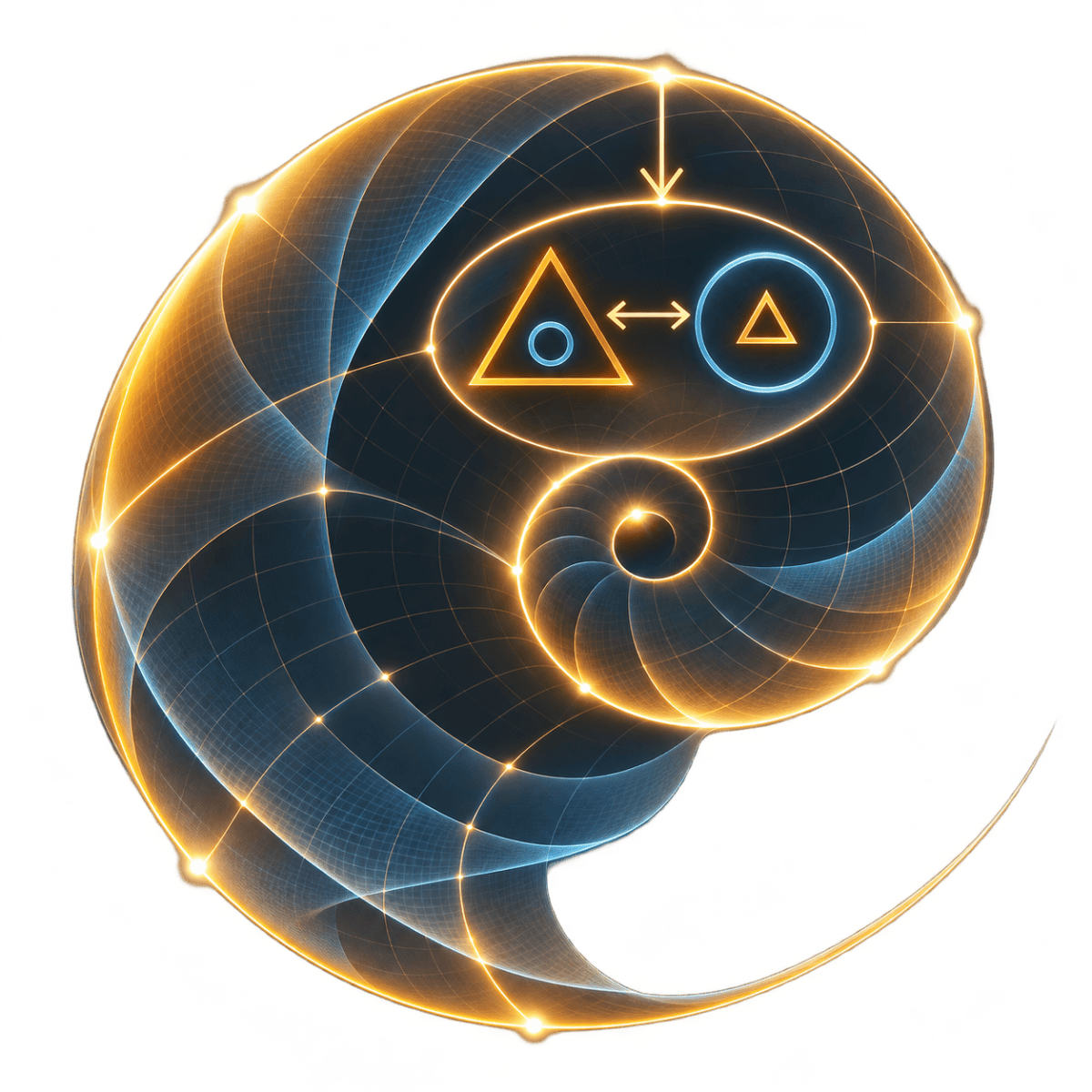
Understood relationally, cobordism is an instance of harmonic structure, describing how apparently distinct systems arise, persist and transform through a larger field of reciprocal relations. Their interfaces, interactions, phase differences, delays and consequential effects establish patterns of coupling through which distinguishable identities emerge. These systems are not independent entities subsequently joined together. They are provisional expressions of shared dynamics, sustained through differences that remain mutually dependent. The cobordism is consequently logically prior to its constituent systems, even though it arises through their interactions. This is not chronological priority, nor a contradiction. The whole and its constituents are reciprocally generative, with their identities, boundaries and possibilities continually shaped through their relationships.
The same harmonic structure applies to the explanation itself. The constituent systems and their relational whole are not merely connected; their dynamics are spectrally entangled, with patterns of recurrence, coupling and transformation distributed throughout the field. Changes in one region alter the conditions of possibility elsewhere, while the whole constrains and enables the behaviour of its constituents. This extends the mathematical conception of cobordism, where spaces form boundaries of a higher-dimensional manifold, into an account of emergence, communication, complexity and systemic continuity. The two perspectives are themselves reciprocally dependent: the whole takes shape through its constituent differences, while those differences acquire meaning through the relationships they collectively generate. Neither the parts nor the whole provide an independent foundation. Their reciprocal differentiation is the harmonic structure through which both become possible.
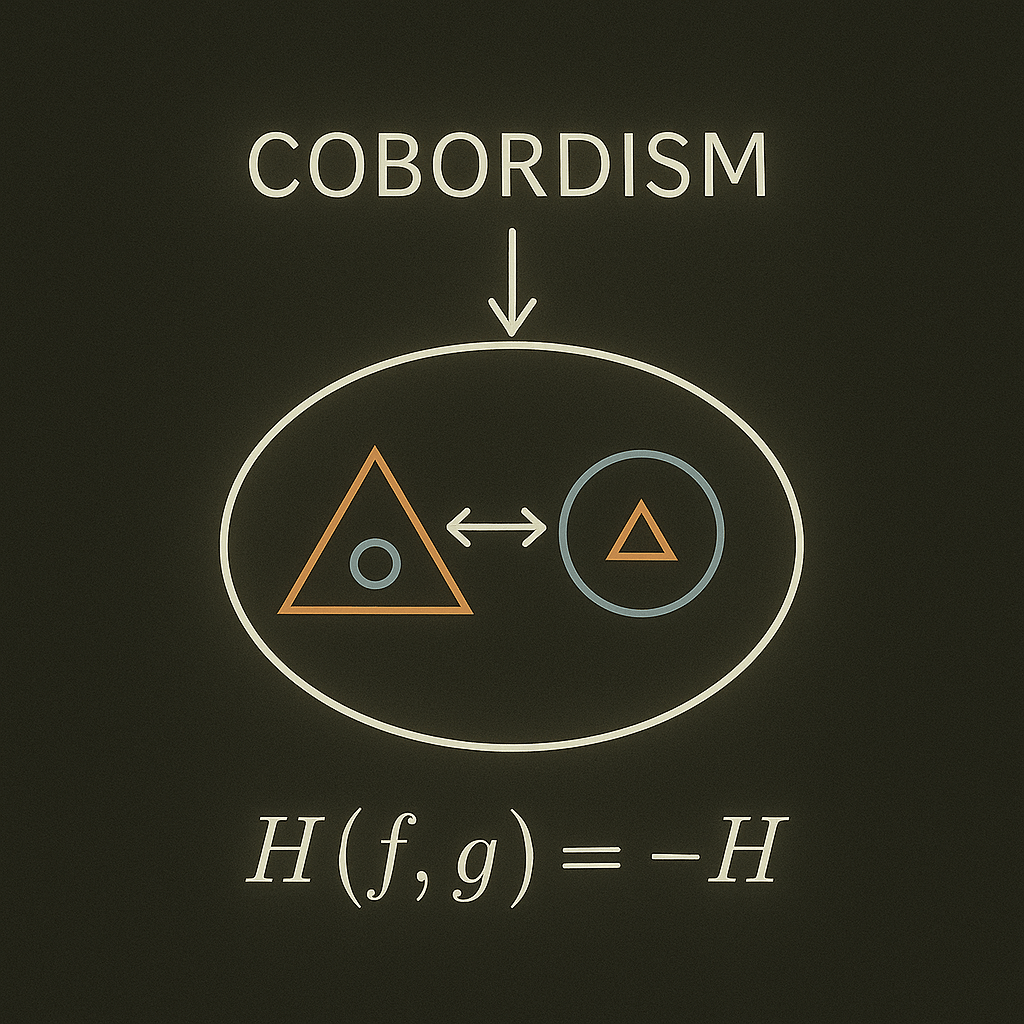
Two distinguishable systems, represented by nested geometric forms, arise within a shared relational whole. Their reciprocal transformations express the orbit frame: identities and boundaries emerge through mutual dependency rather than independent existence.

The spiral represents the persistence of relational differences through recurring, asymmetric coupling. Its geometry illustrates how the whole and its constituent systems continually shape one another.
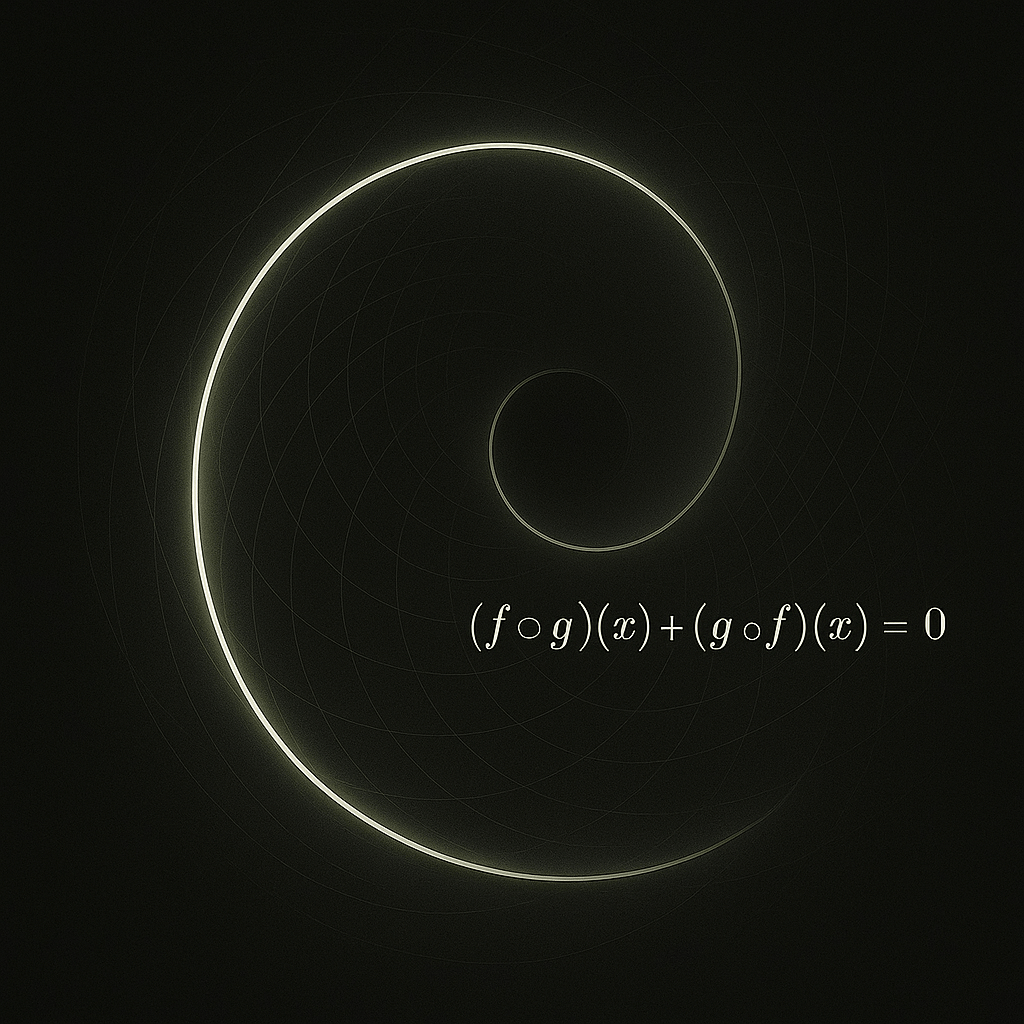
The equation (f ∘ g)(x) + (g ∘ f)(x) = 0 expresses an antisymmetric relationship between two compositions. The spiral represents their reciprocal dynamics as a persistent orbit rather than a static equilibrium.
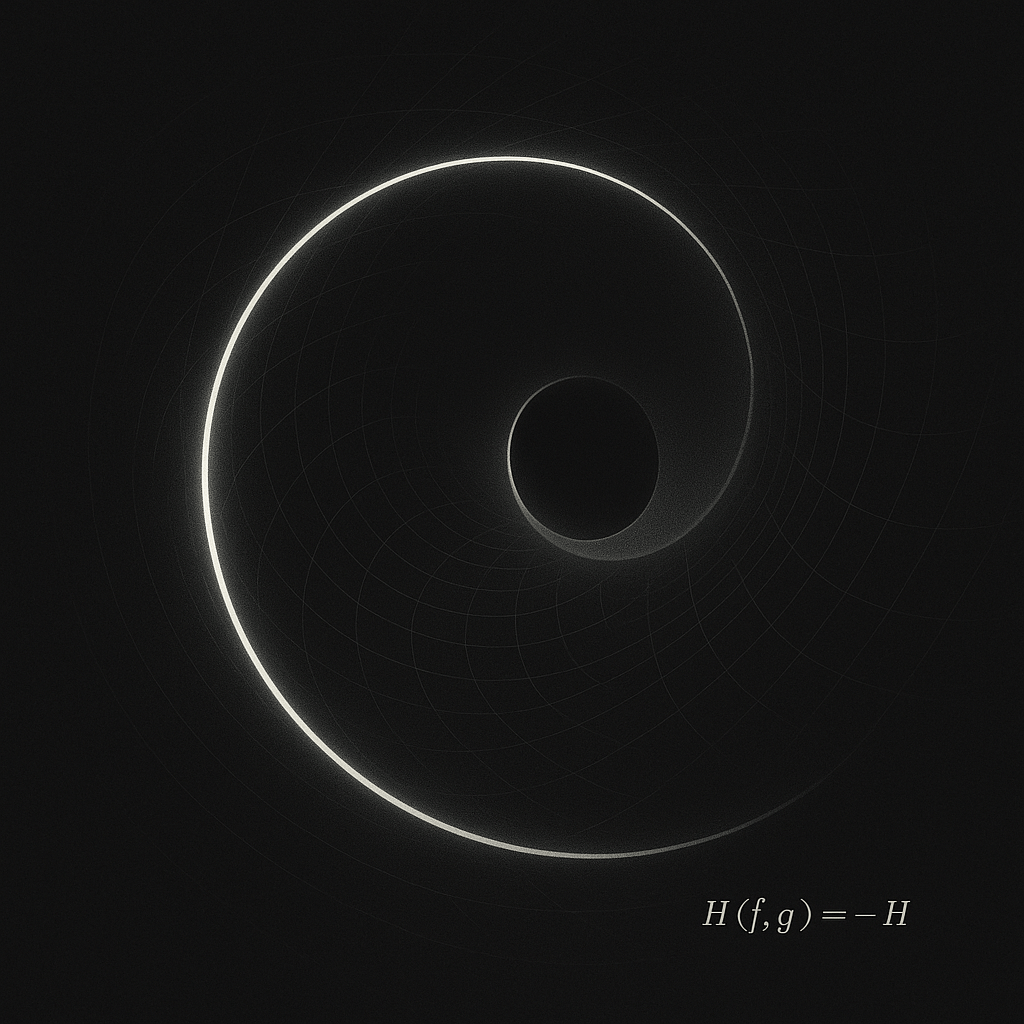
The uninterrupted spiral represents relational continuity through transformation, with its changing curvature expressing differences of scale, phase and perspective. The antisymmetric relation H(f,g) = −H(g,f) expresses how reversing the relationship reverses its sign without eliminating the underlying dependency. The orbit frame is both a description of these reciprocal dynamics and an expression of the larger whole they generate.

