
Contents
Language and Recurrence
A rumour survives its correction. A political movement becomes dependent upon its enemies. An institution develops increasingly elaborate procedures to manage problems its own procedures help reproduce. Meanwhile, billions of people exchange explanations, grievances, expectations and uncertainties, wondering why a world capable of producing so much knowledge remains such a spectacular mess. What we call knowledge is itself dependent upon the relationships through which it is produced, communicated and understood. We tend to examine these problems separately, through politics, psychology, economics or technology. But some of their underlying dynamics arise through the same relationships: how people interpret one another, how responses influence subsequent responses, and how recurring interactions generate identities, conflicts and the conditions under which further communication occurs.
Language is an extraordinary instrument because it is inherently ambiguous. Words acquire meaning through relationships with other words, experiences, contexts and interpretations. Even the words we use to discuss ambiguity are ambiguous. No definition can permanently settle every possible interpretation, because each definition introduces further language requiring interpretation. This is not equivalent to proving a Gödelian theorem about natural language, but it exposes a related limit: no description can guarantee its own interpretation across every possible context. Misunderstanding and the possibility of deception are consequently intrinsic to communication, although deliberate dishonesty involves an additional question of intention. The uncertainty cannot be eliminated without sacrificing much of the flexibility through which language accommodates different experiences and generates new meanings.
That uncertainty is also productive. A general expression such as freedom, security or fairness can connect people whose experiences differ enormously. It can also gather contradictory interpretations, each reproducing the same expression for different reasons. Simple, emotionally charged explanations travel readily because they are recognisable, adaptable and capable of provoking responses. An accusation generates a defence, the defence generates another accusation, and the resulting conflict becomes a recurring relationship. The explanation begins reproducing the circumstances it claims to explain. There is a combinatorial advantage here: expressions applicable to many circumstances have more possible contexts in which they can recur, although this does not guarantee their adoption. Their persistence depends upon the timing of exchanges, the responses they provoke, existing relationships between participants, and competing expressions and interpretations that influence what gets repeated.
Harmonic Structure and Social Complexity
We can begin examining recurrence mathematically through something as familiar as sound. A voice produces overlapping vibrations at different frequencies. A Fourier transform separates this activity into its constituent frequencies, much as a prism separates light into colours. The resulting power spectrum describes how strongly different frequencies contribute to the signal. Another technique, autocorrelation, compares a signal with itself at different time delays, revealing patterns of recurrence. The Wiener–Khinchin theorem establishes that, for signals whose statistical properties remain stable over time, autocorrelation and the power spectrum are mathematically connected (Wiener, 1930; Khinchin, 1934). The distribution of activity across frequencies and its recurrence through time are complementary descriptions of the same process. Human communication is more variable than the signals for which the theorem directly applies, but its timing, recurrence and changing frequency distributions can still be investigated. These relationships offer a mathematical description of how recurrent activity can sustain recognisable structures through time, including structures whose individual expressions continually change.
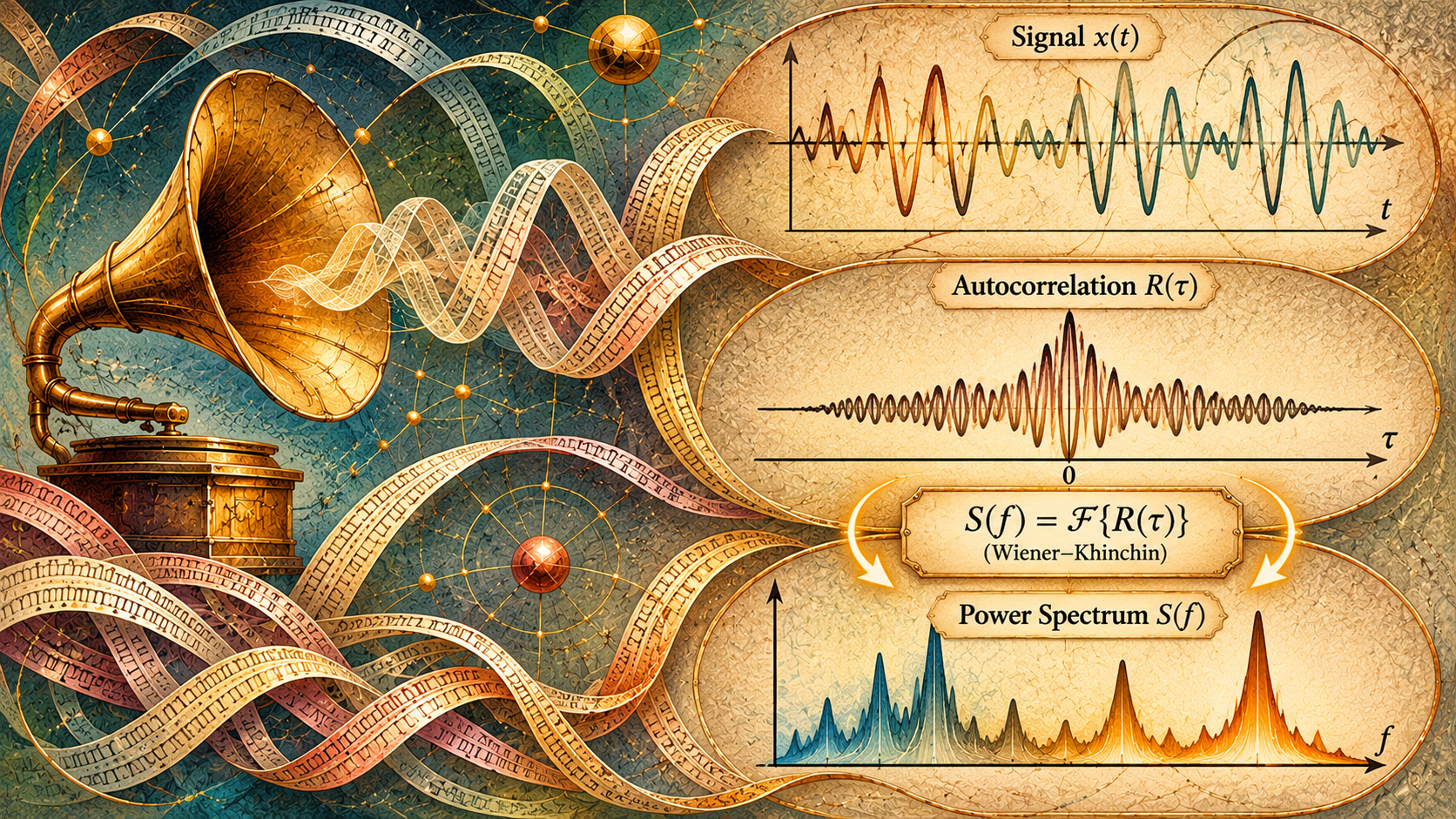
Autocorrelation reveals how a signal resembles itself across time delays. Its power spectrum describes the distribution of signal power across frequencies.
Consider interacting rhythms. The Kuramoto model describes how oscillators with different natural frequencies can synchronise through mutual coupling, without a central controller (Kuramoto, 1975, 1984; Strogatz, 2000). Related models produce chimera states, in which synchronised and unsynchronised activity coexist (Abrams and Strogatz, 2004). These results demonstrate how collective patterns arise through reciprocal influence, including arrangements in which synchronisation and persistent difference develop together. Communication involves relationships of timing, delay, repetition and mutual influence. Communities develop shared expressions, institutions reproduce characteristic responses, and opposing groups can become mutually dependent through their disagreements. Their identities are not simply established before interaction. They develop and persist through the relationships that distinguish them, including the repeated opposition through which each group recognises the other.

Coupled oscillators can develop collective rhythms without central direction, including configurations containing both synchronised and unsynchronised activity.
These relationships extend across different timescales. Sounds form words, words participate in conversations, conversations develop conventions, and conventions contribute to the histories through which people recognise themselves. Their overlapping frequencies, delays, phase differences and reciprocal influences form a harmonic structure: recurrent activity at different scales can reinforce, interrupt or modify other activity, generating recognisable configurations through changing relationships. Accusation, defence and escalation, for example, can recur between individuals, inside institutions and across political systems. The circumstances and consequences differ, but the relationships can retain recognisable characteristics. Identities emerge through these interactions rather than existing independently of them. Meaning develops through recurrence and difference: repeated associations make expressions recognisable, while established meanings influence which expressions are subsequently used. Semantics follows frequency, while frequency responds to semantics.
This suggests investigating the recursivity of communication without first classifying the meanings of individual messages. Meaning remains part of the system, but it need not determine the initial measurements. Which expressions and responses recur? At what delays? Which interactions reinforce one another? Do participants become more tightly coupled through repeated exchanges? Do recognisable sequences persist when the words or participants change? Carefully selected samples might reveal developing relationships without requiring comprehensive surveillance. Such measurements would need testing against ordinary variation, sampling bias and alternative explanations. Recurrence alone cannot establish causation, intention or importance. The possibility worth investigating is whether changes in the structure of communicative relationships can be detected before their wider significance becomes apparent.
There is an additional relationship between uncertainty, entropy and complexity. Communication continually generates variations in expression and interpretation, while existing relationships influence which variations are likely to persist. A recurring structure can maintain itself while generating substantial additional activity. An argument becomes increasingly elaborate without resolving its original disagreement. An institution introduces procedures to manage consequences of existing procedures. The number of explanations, responses and administrative demands increases while the relationships generating them remain substantially unchanged. Maintaining the structure imposes additional interpretive, communicative and administrative work upon its participants and surroundings. This is not an assertion that textual repetition is thermodynamic entropy. It concerns how persistent configurations constrain subsequent possibilities while generating variation and redistributing the complexity associated with their own reproduction.
Institutions, Authority and Change
The problem becomes particularly consequential when institutions attempt to manage communication. Governments, universities and other institutions establish procedures to address uncertainty, disagreement and collective behaviour. But institutional management is itself a communicative activity, subject to the same ambiguity, feedback and recurring biases as the interactions it seeks to influence. Established classifications determine how new information is interpreted, which responses are considered legitimate and whose interpretations receive attention. Over time, an institution can become dependent upon the language through which it defines its responsibilities, authority and identity. Its participants must work within those descriptions to remain intelligible and legitimate to one another, even when the descriptions no longer serve their purposes. Criticism may consequently be assessed through the assumptions being criticised, while corrective measures reinforce existing procedures. Authority can become self-referential, sustained by the continued reproduction of its own language rather than by demonstrated competence or public benefit. Earned authority, responsibly exercised, is another matter. The distinction concerns whether authority remains answerable to the purposes and relationships that justify it.
The capacity to explain a failure does not guarantee the capacity to change the relationships producing it. This is a structural problem, not necessarily evidence of incompetence or dishonesty. Competent people can participate in systems whose recurring behaviour defeats their intentions. Institutions devoted to knowledge are no exception: their methods of recognising expertise and maintaining authority influence which ideas receive attention, including ideas about the limitations of those methods. A university can defend its established conception of intellectual legitimacy while marginalising the unfamiliar thinking it claims to encourage. The contradiction need not be deliberate. It can arise through the ordinary reproduction of institutional identity, with participants maintaining the language and procedures through which their positions remain recognisable.
Disinformation, populism and authoritarian tendencies can be examined through the same relationships. Fear, grievance and threatened identity may reinforce one another when simplified explanations attract attention and repeated hostility strengthens group identification. Deliberate manipulation exploits these possibilities, but antagonistic patterns can also develop without central direction. Constructive relationships reproduce themselves too. Cooperation, intellectual discipline, tolerance and democratic practices depend upon recurring interactions that sustain trust, accommodate disagreement and permit correction. Neither conflict nor cooperation is guaranteed. Their persistence depends upon the relationships and circumstances supporting them. Technology changes those circumstances by altering the speed, reach and frequency of communication. Social networks, recommendation systems and generative artificial intelligence influence which expressions encounter audiences and how responses are amplified. Commercial incentives can reward repeated engagement even when the resulting activity does little to improve understanding.
The practical value of this perspective does not require everyone to understand its mathematics. When an argument repeatedly produces the same disagreement, examine how each response helps reproduce and sustain the conflict. When an institution answers criticism by reproducing its existing procedures, examine how those procedures determine what counts as an acceptable response. When authority is asserted, examine the relationships through which it is maintained and whether those relationships still justify it. When a political movement depends upon maintaining fear or hostility, examine the interactions through which those emotions are reinforced. These questions do not replace evidence, judgement or responsibility. They direct attention towards the processes generating repeated outcomes. Governments can use such understanding to examine institutional feedback, communities can identify conditions that sustain cooperation, and individuals can recognise when their own responses contribute to patterns they would prefer to change.
None of this places us outside the system. Our choices, objections, inventions and attempts at regulation participate in the same evolving ensemble. Every action changes the circumstances of subsequent actions, including the distribution of possible responses and their relative likelihoods. Those distributions are not fixed: repeated communication changes expectations, relationships and the conditions under which future possibilities arise. The probabilities of subsequent events depend upon relationships that are themselves changing through those events. We cannot know everything, nor can we eliminate the uncertainties through which communication develops. Recognising that limitation is useful because it changes how we approach disagreement, prediction and control. Natural philosophy examines these conditions across the distinctions we ordinarily make between mathematics, physics, biology, language and society. Those disciplines provide indispensable ways of understanding reality, but their concepts, methods and boundaries also arise through the processes of communication being investigated.
The world does not need another promise of certainty. It needs a better understanding of how uncertainty, recurrence and communication generate the structures through which we live. The world is not simply made of language, but much of what we recognise, negotiate, contest and preserve is mediated through it. We use language to describe our circumstances, while its inherited distinctions, conventions and expectations influence how we understand and act within them. In that sense, language also uses us. Its structures are neither permanent nor independent of our participation. They persist through relationships that can change, sometimes abruptly, sometimes through small differences accumulating over time. Understanding how they reproduce themselves will not eliminate conflict or confusion. It may help us recognise when our attempts to solve a problem are reproducing it, and when changing the relationships that sustain it offers a more constructive possibility.

A Closer Look: The Mathematics of Recurrence and Coupling
We begin with a simple assumption: communication occurs. It produces observable activity through speech, writing, behaviour, machines, recorded signals and other forms of interaction. We need not begin by deciding what every communication means, or by assuming that the participants are independent, fixed identities. We can begin with the occurrence of communication itself, the differences between events, their timing, their recurrence and the relationships through which they influence one another.
What counts as an event, how it is measured and which distinctions matter are questions for investigation. Communication does not automatically provide us with a particular mathematical representation. But once an observable sequence has been defined, its recurrence, frequency and relationships can be examined. The following equations describe three useful mathematical relationships: recurrence through time, coupling between oscillatory activities, and the emergence of collective synchronisation.
1. Wiener–Khinchin: Recurrence and frequency
The Wiener–Khinchin theorem establishes a relationship between the autocorrelation of a stationary signal and its power spectral density. In ordinary language, it connects how activity resembles itself across different time delays with how its power is distributed across frequencies.
What the equation says: The power spectrum is the Fourier transform of the autocorrelation function. For processes satisfying the theorem’s conditions, these are mathematically connected descriptions of the same activity.
- S(f): Power spectral density. Describes how the signal’s power is distributed across frequencies.
- R(τ): Autocorrelation function. Measures the relationship between the signal and a time-delayed version of itself.
- f: Frequency. Describes how frequently a pattern repeats.
- τ: Time delay. The interval separating two observations being compared.
- e−i2πfτ: The Fourier kernel. A complex exponential that relates contributions at different time delays to a particular frequency.
- i: The imaginary unit, satisfying i2 = −1. It is part of the mathematical representation of phase and frequency.
- π: Pi, the mathematical constant relating circular geometry to angular measurement.
- ∫−∞∞: Integration across all time delays, combining their contributions to the spectrum.
- dτ: Indicates that integration is performed with respect to time delay.
The consequence: Recurrence through time and the distribution of activity across frequencies are not unrelated phenomena. They are mathematically connected descriptions of the same underlying signal.
For communication, this suggests examining when interactions recur, how strongly present activity resembles earlier activity, and whether characteristic frequencies or delays persist as particular expressions and participants change. A disagreement, for example, may repeatedly generate similar sequences of accusation and defence without repeating the same words.
The theorem applies directly under specific statistical conditions, including stationarity. Communication is often nonstationary, and the measurement of its activity requires appropriate definitions and methods. The important starting point is that recurring communicative activity can be investigated through time and frequency, without requiring every message to be classified by meaning beforehand.
2. Kuramoto: Coupling and collective rhythms
The Kuramoto model describes a population of oscillators with different natural frequencies whose phases influence one another through coupling. Under suitable conditions, collective synchronisation can develop without a central controller.
What the equation says: The rate at which an individual oscillator changes its phase depends upon its own natural frequency and the combined influence of the other oscillators.
- θi: The phase of oscillator i, describing its position within an oscillatory cycle.
- θ̇i: The rate at which that phase changes over time. The dot indicates a time derivative.
- ωi: The natural angular frequency of oscillator i, describing how quickly it would progress through its cycle without coupling.
- K: Coupling strength. Determines how strongly the oscillators influence one another.
- N: The total number of oscillators.
- K/N: Scales the collective coupling contribution according to the population size.
- θj − θi: The phase difference between oscillators j and i.
- sin(θj − θi): Describes how the phase difference contributes to the interaction, including its direction and magnitude.
- ∑j=1N: Adds the contributions from all oscillators in the population.
- i and j: Indices identifying individual oscillators. They are labels, not imaginary numbers in this equation.
The consequence: Different oscillators can develop shared rhythms through mutual influence. Their collective behaviour arises from the relationships between them rather than from a separate controller directing their activity.
For communication, this provides a way of thinking about how individual patterns of activity can become mutually dependent. Participants respond at different times, repeat expressions, influence subsequent responses and develop recurring relationships. Groups may become synchronised through shared conventions, while opposing groups may sustain distinct identities through repeated interaction.
Communication is not automatically a population of Kuramoto oscillators. Applying the model quantitatively would require defensible definitions of phase, frequency and coupling. The mathematical relevance lies in the demonstrated capacity of interacting systems to generate collective rhythms through reciprocal influence.
3. The Kuramoto order parameter: Measuring collective synchronisation
The Kuramoto order parameter provides a measure of collective phase alignment. Rather than describing how each oscillator changes, it summarises the extent to which the population is synchronised at a particular moment.
What the equation says: Each oscillator contributes a unit vector representing its phase. These vectors are added and averaged. Their combined magnitude indicates the degree of collective phase alignment.
- r: The order parameter magnitude, ranging from zero to one. It measures collective phase alignment.
- ψ: The collective mean phase, defined when the average vector has nonzero magnitude.
- eiψ: A unit vector in the direction of the collective mean phase, represented using complex numbers.
- eiθj: A unit vector representing the phase of oscillator j.
- θj: The phase of oscillator j.
- N: The number of oscillators being measured.
- ∑j=1N: Adds the phase vectors from all oscillators.
- 1/N: Divides the sum by the number of oscillators to obtain their average.
- i: The imaginary unit, used here to represent angular phase in the complex plane.
When r = 1, all oscillators have identical phases. When r = 0, their phase vectors cancel exactly. Intermediate values indicate partial alignment. A small value does not necessarily mean that no synchronised groups exist: distinct clusters may cancel one another in the population average.
The consequence: Collective synchronisation can be measured without treating the population as a single, indivisible entity. The measure describes a relationship among individual phases, not an additional controller or independent collective identity.
For communication, this raises the possibility of examining how recurring activity becomes aligned across participants, groups or institutions. It also suggests investigating configurations in which synchronised and unsynchronised behaviour coexist, as in related models of chimera states. A communicative equivalent would require carefully defined observables and validation; the mathematical order parameter cannot simply be applied to words or opinions without specifying what their phases represent.
What these relationships tell us together
We began only with the occurrence of communication. From there, we can investigate observable differences, timing, recurrence and relationships without assuming that meanings, identities or collective structures are fixed in advance.
Wiener–Khinchin relates recurrence through time to frequency structure. Kuramoto describes how coupling between oscillatory activities can produce collective rhythms. The Kuramoto order parameter measures the degree of collective phase alignment arising within such a population.
These are established mathematical relationships, not proofs that every communicative system follows the same equations. Their significance here is that they offer ways to investigate how recurring activity, mutual influence and collective patterns relate to one another. The particular measurements, assumptions and models must remain answerable to the communication being examined.
Communication changes the relationships through which further communication occurs. Repeated interactions influence expectations, alter subsequent responses and change the conditions under which future patterns may develop. The structures we observe can consequently participate in their own reproduction and transformation. That is the wider problem these mathematical relationships help us investigate.
References
Abrams, D.M. and Strogatz, S.H. (2004) ‘Chimera states for coupled oscillators’, Physical Review Letters, 93(17), 174102. https://doi.org/10.1103/PhysRevLett.93.174102
Khinchin, A. (1934) ‘Korrelationstheorie der stationären stochastischen Prozesse’, Mathematische Annalen, 109, pp. 604–615. https://doi.org/10.1007/BF01449156
Kuramoto, Y. (1975) ‘Self-entrainment of a population of coupled non-linear oscillators’, in Araki, H. (ed.) International Symposium on Mathematical Problems in Theoretical Physics. Lecture Notes in Physics, vol. 39. Berlin: Springer, pp. 420–422. https://doi.org/10.1007/BFb0013365
Kuramoto, Y. (1984) Chemical Oscillations, Waves, and Turbulence. Berlin: Springer. https://doi.org/10.1007/978-3-642-69689-3
Strogatz, S.H. (2000) ‘From Kuramoto to Crawford: Exploring the onset of synchronization in populations of coupled oscillators’, Physica D: Nonlinear Phenomena, 143(1–4), pp. 1–20. https://doi.org/10.1016/S0167-2789(00)00094-4
Wiener, N. (1930) ‘Generalized harmonic analysis’, Acta Mathematica, 55, pp. 117–258. https://doi.org/10.1007/BF02546511

