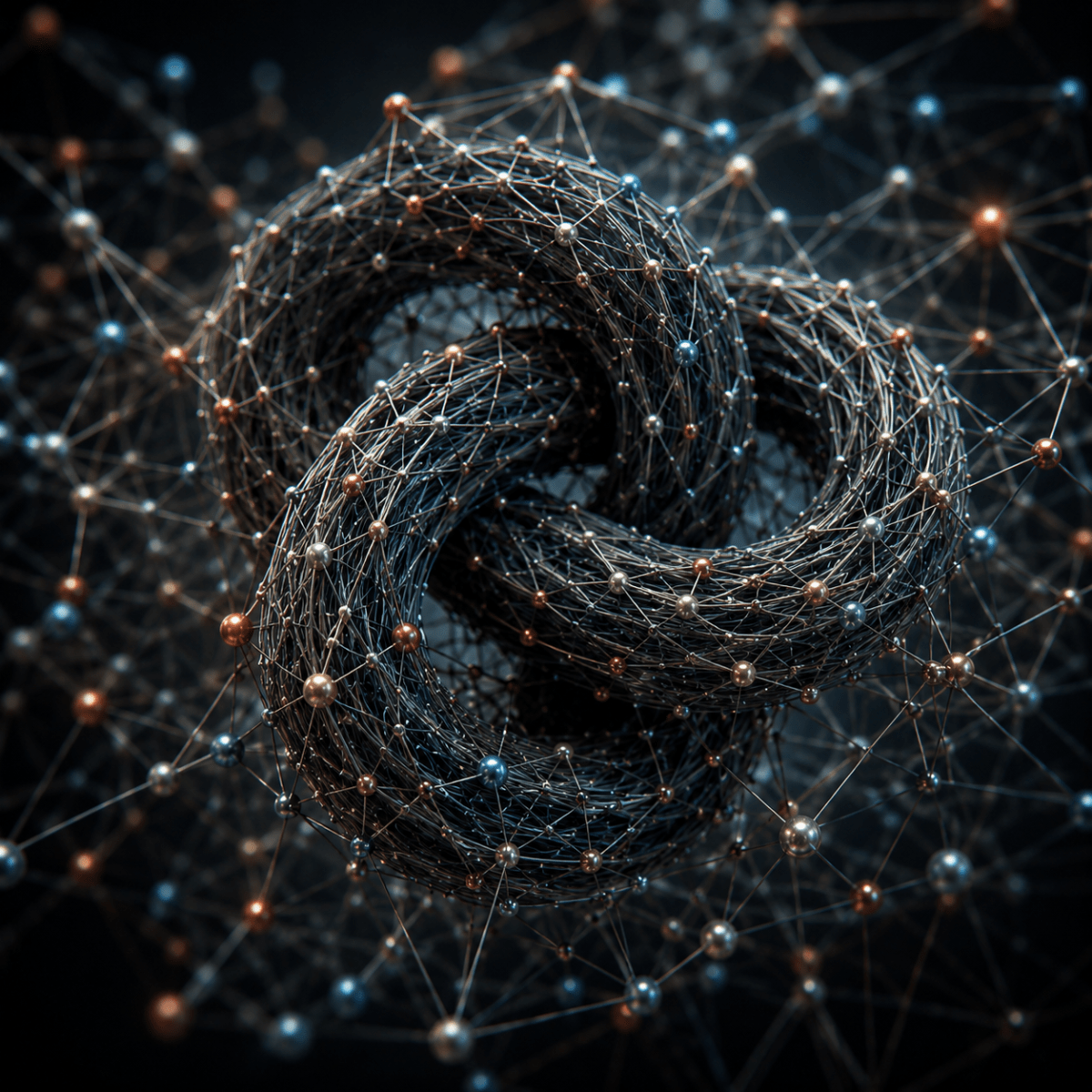
We usually imagine time as the stage upon which reality unfolds. Objects exist, events occur, and time measures the interval between them. Yet another possibility presents itself. Suppose time is not the container of relation, but relation itself as it propagates through the world. Every interaction requires a finite interval before its effects become available elsewhere. Every observation necessarily arrives after the event it observes. The difference between what is and what has arrived is not an imperfection of communication. It is the necessary consequence of communication itself. What we experience as time is finite relational propagation.
This immediately changes what we mean by a system. Systems are often described as collections of objects bounded in space, but this picture becomes inadequate once communication and persistence are placed at the centre. A flock of birds is not merely a number of birds. A language is not merely a collection of speakers. An economy is not merely a collection of transactions. Their unity cannot be located within any individual component because it exists only through the continuing organisation of relations. The abstraction is not imaginary simply because it is distributed. It is a real feature of the world.
This suggests a reversal of the usual order of explanation. Rather than beginning with objects and asking how they become related, we begin with propagating relations and ask how stable objects emerge. Identity is no longer the starting point. It is the consequence of relational organisation that persists across finite propagation times. Objects become relatively stable patterns of organisation rather than the foundations from which organisation is constructed.
The boundaries of systems also become less absolute than they first appear. Every system depends upon communication, energetic exchange, memory, history, expectation, and environmental constraint. Its apparent edge is therefore a practical modelling decision rather than a sharp ontological boundary. The environment is not simply outside the system. It participates in the very conditions that allow the system to persist.
This perspective also reframes complexity. A complex system is not simply one with many parts. It is one capable of maintaining coherent organisation across many simultaneously propagating relations despite finite delays, uncertainty, interference, and continual change. Centres, boundaries, and peripheries emerge from the distribution of propagation delays rather than from geometry alone. Coherence is fundamentally a temporal achievement.
Persistent systems continually reduce the effective propagation delays within the relations that sustain them. This increases local coherence, predictability, and stability, but never without cost. Every reduction in local delay requires work, and that work is redistributed throughout the wider relational field as thermodynamic, informational, ecological, structural, historical, political, or cognitive burden. Organisation is therefore always local, while its costs are necessarily holistic. No system abolishes those costs. It redistributes them.
This leads naturally to a broader conception of systems themselves. Classical systems theory typically begins with predefined entities and studies their interactions. Here the direction is reversed. Persistent, self-maintaining patterns of relation can themselves be understood as systems. Stable relations between those systems give rise to higher levels of organisation, which in turn become systems in their own right. Organisation therefore becomes recursively generative, producing an open hierarchy of persistent relational structures rather than a fixed hierarchy of objects.
Persistence emerges when propagating relations continually recreate the conditions necessary for their own continued propagation. Through recursive recurrence, communication becomes self-sustaining. Memory, meaning, identity, adaptation, and evolution become different expressions of the same underlying dynamic. Systems endure because they continually reconstruct the relational architecture upon which their future persistence depends.
The consequence is a different way of understanding reality. Rather than beginning with objects moving through time, we begin with propagating relations whose finite delays give rise to stable organisation across many scales. Systems are not the starting point. They are persistent patterns emerging from those relations.
This perspective lies at the heart of Field Logic and its application through Applied Field Logic. Organisation is understood not as a property of isolated entities but as an emergent consequence of recursively propagating relations. Communication, persistence, identity, complexity, strategy, and meaning are not separate subjects. They are different expressions of the same relational field viewed at different scales and resolutions.
If time is the finite propagation of relation, then persistent systems are the recurring organisations that arise from it. We do not begin with things. We begin with relation. Objects, systems, meaning, and complexity follow as persistent expressions of its propagation.
Categories
time is the finite propagation of relation
Time is not something through which relations pass. Time is the finite propagation of relation itself.