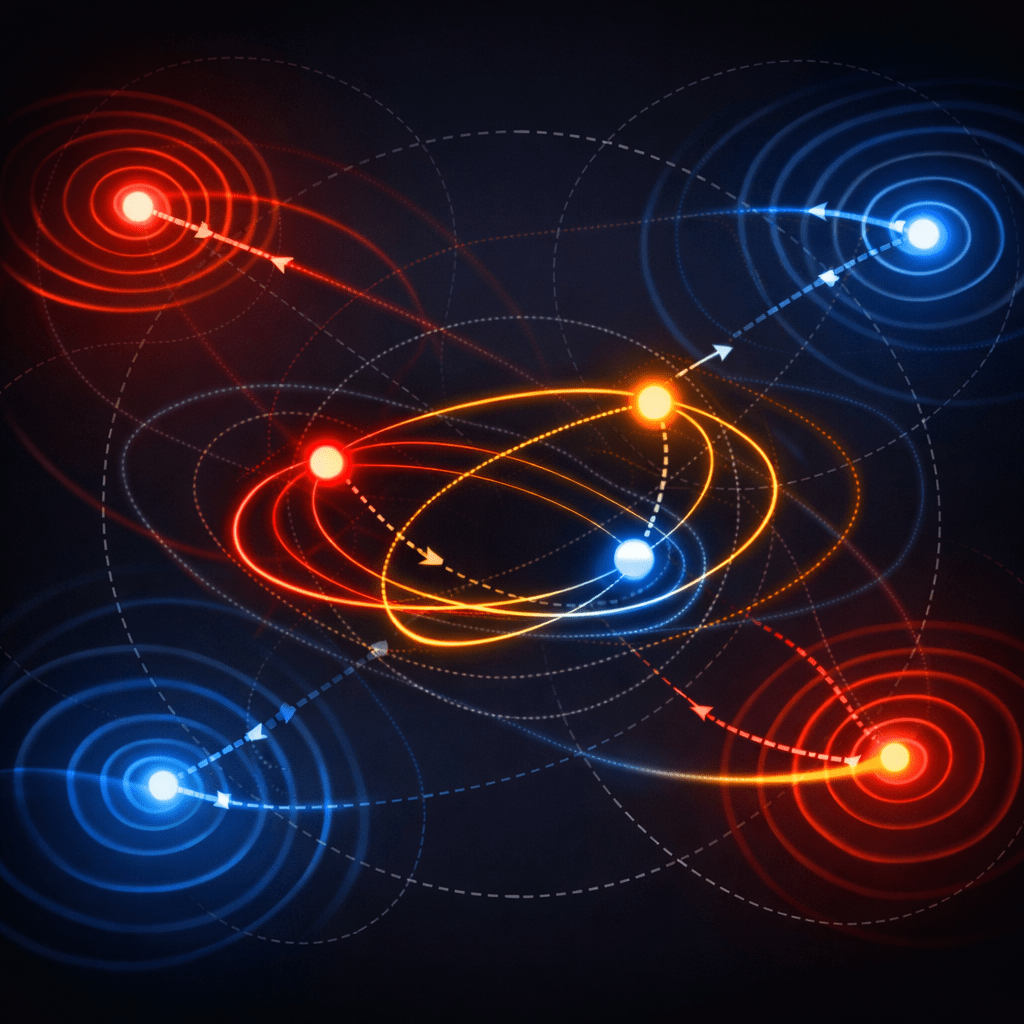
Persistence is a problem of change, not its opposite. Organisms replace matter, populations replace members, languages replace utterances, institutions replace participants, and ecosystems continually reorganise their components. What persists cannot therefore be identical material, state or configuration, nor can anything that changes fully coincide with itself across time. Persistence lies in recurrent organisation: differences and relations reconstructed through successive transformations so that previous organisation continues to constrain what can happen next. Identity is consequently neither possession nor point. It is the temporary local coherence of a pattern whose non-self-coincidence is not a failure of identity but the condition through which identity can persist.
Recurrence changes possibility. Every interaction leaves conditions different from those in which it occurred, and subsequent interactions inherit that difference. The present neither determines the future nor releases it into unconstrained randomness. Previous organisation redistributes probability: some transitions become easier, others harder, while repeated passages deepen paths along which further organisation becomes increasingly likely. History accumulates as constraint, but no single location contains that history. Memory is distributed through altered relations, and structure is the bias recurrence leaves in the field of possible futures.
Non-self-coincidence appears as difference, and difference requires interval. Relations occur across separations; without interval there is neither before and after, here and there, one process and another. Absence is therefore not simply what organisation lacks. It is among the conditions that allow organisation to form. Interval introduces delay; delay gives recurrence rhythm; rhythm establishes relative phase; phase permits reinforcement, interference, entrainment, synchronisation and displacement. No process contains this harmonic structure by itself. It appears between partially aligned processes, in the shifting intervals through which local differences become mutually consequential without becoming identical.
Persistent organisation can consequently be understood as a logical orbit: non-self-coincidence recurrently organised through changing states without exact repetition. The minimal orbit frame may be drawn as two mutually constituting poles and the relation they sustain, but the dyad is a handle rather than a limit. In complex organisation every apparent pole is itself an orbit frame, locally stabilised among further relations, and every relation can become a pole when the frame of observation changes. The result is multipolar without becoming atomised: centres appear wherever differences become sufficiently coherent to constrain one another, then move, divide, combine or disappear as those relations change. What returns is not a sovereign component or fixed configuration but an organised difference whose redistribution is part of the means by which it persists.
Phase modulation is one mechanism by which this distributed organisation changes itself. Alter the temporal relation among recurrent processes and the interactions available among them change; altered interactions modify constraints; modified constraints reshape the field of subsequent relations; the changed field then conditions the next recurrence. A local displacement can therefore propagate far beyond its point of origin, while apparently large interventions can dissipate when they fail to couple with the rhythms already carrying the system. What appears locally as causal efficacy can thus be redescribed as the propagation and transformation of constraint through a field in which local centres continually emerge from, act upon, and are reconstituted by relations extending beyond them. Neither command from above nor aggregation from below exhausts that organisation.
No privileged position stands outside this process. Complex order is realised locally while its consequences diffuse across dimensions, scales and times, recursively altering the conditions from which further local order emerges. There is no complete global description waiting above the system, because the global is not another location or hidden completed state: it is the unresolved distribution of relations through which local organisation becomes possible. The local is the switch between part and whole, not because it contains either, but because each local enactment simultaneously expresses inherited constraint and changes the field that will constrain what follows. Much of this organisation remains implicit, carried in timing, expectation, habit, resonance, inhibition and patterned response before it becomes explicit representation. What appears as unconscious depth is not an interface to some deeper hidden order; the indefinitely extensible organisation of relations among relations is the depth. Meaning is a local binding within it, coherence temporarily achieved without closure. The logical orbit therefore generates the conditions of its own continuation by passing through what it cannot contain: recurrence preserves organisation by transforming the differences through which recurrence remains possible. Description, knowledge and control are themselves local modulations of the same field. Their characteristic error is not incompleteness, which is unavoidable, but forgetting their incompleteness and converting a situated coherence into an imagined totality. Their characteristic repair is not surrender of organisation but renewed exposure to difference: reopening the relations through which the frame can change without the field collapsing into either fragmentation or identity.
Conceptual fugue
Phase Modulation and the Evolutionary Field
Evolution is treated as a distributed synchronisation process: heterogeneous biological, ecological, cognitive and linguistic processes couple, drift, entrain and resynchronise around shifting attractors rather than advancing toward a prescribed end. Selection becomes the stabilisation of timing, with persistent patterns reproducing coherence across scales while mutation and adaptation disturb phase relations and open new configurations.
The Big Empty: Consciousness, Cosmos, and the Generative Logic of Absence
Absence is not an inert gap but the structural incompleteness through which differentiation, self-reference and organisation become possible in systems without an external source of order. Because no system can fully specify or coincide with itself, delay, disturbance and unresolved tension continually generate new structure while complete closure would erase the differences sustaining coherence.
Logical Orbit
Persistence belongs neither to an isolated part nor to an externally imposed whole, but to recursive interdependence in which substructures mutually instantiate and constrain one another. The logical orbit is neither loop nor centre but invariance of form through continuous redefinition: coherence persists through asymmetric recursive entrainment while the terms that sustain it remain context-bound and incomplete.
logical orbit: organised persistence as relational invariant
Persistence is developed as the recurrent organisation of probability rather than preservation of a material, informational or structural state. Every interaction redistributes future possibilities by reconstructing relational constraints, so identity becomes the recursive maintenance of asymmetry through a probability field continually altered by its own realised history.
The Problem of Many Spaces
Living organisation cannot be exhausted by any single descriptive space because behavioural, transcriptional, morphological, physiological and symbolic domains are projections of a continuous relational field into different coordinate systems. Their coherence lies in structured difference preserved through spectral coupling across these projections: each reveals some relations and obscures others, while no single description contains the whole.
Field Logic: A Primer
Systems begin not with separate things but with unresolved relations, differences, delays, dependencies and absences through which temporary identities become possible. The orbit frame expresses this minimally as frame, anti-frame and binding absence: a distributed relation in which coherence persists because difference can neither collapse into identity nor disperse beyond relation.
Recursive Tension: Orbit Frame, Logical Orbit, and the Viability of Communication, Culture, and Ecological Systems
Coherence is sustained through bounded unresolved tension distributed across relations rather than through final equilibrium. Logical orbit carries that tension forward through oscillation, damping, fracture, re-linking and redistribution across scales, so viability depends on maintaining and reorganising imbalance rather than eliminating it.
Cybernetics and the Fiction of Objectivity
Description is itself a necessarily partial operation within the systems it seeks to define, so objectivity cannot provide an external position from which a final ontological map is issued. Explanation recursively bootstraps itself into what it explains: models gain coherence through situated definitions while the indeterminacy and absence they cannot contain remain constitutive of both knowledge and its objects.

