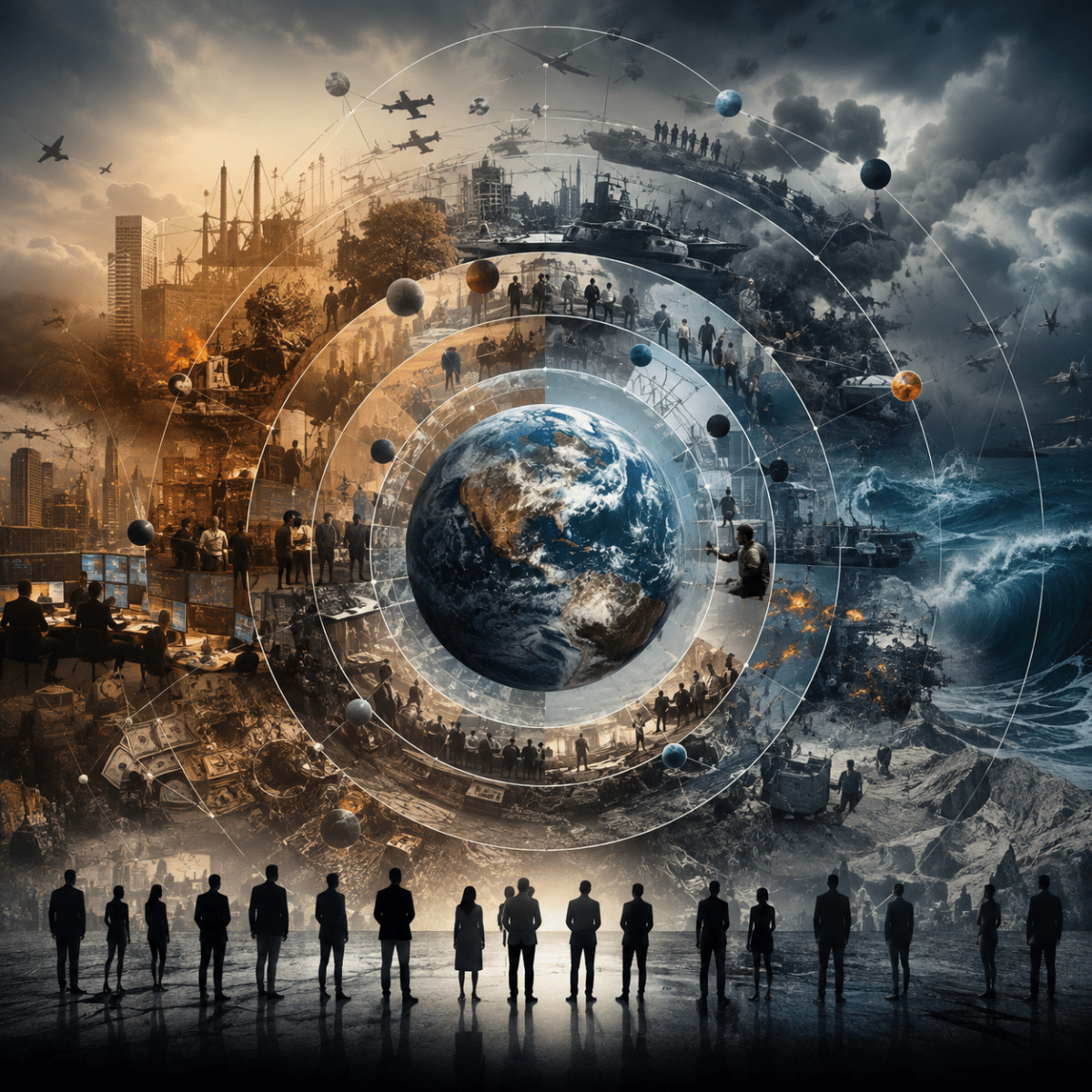
Geostrategy contains a simple trap. Every serious attempt by one state to increase its security changes the security problem faced by others. Weapons intended as deterrence become capabilities another government must plan against; alliances protect their members while changing the strategic calculations of those outside them; sanctions redirect trade, technology and political relationships rather than simply stopping them. The result is visible in the arithmetic. World military expenditure reached US$2.887 trillion in 2025, 41 per cent higher than a decade earlier, with the United States, China, Russia, Germany and India accounting for 58 per cent of the total (Liang et al., 2026). No one needs to design the larger pattern. Each state acts within conditions already altered by the actions of others, then alters those conditions in return. Procurement schedules, alliance commitments, sanctions, exercises and doctrine begin to organise around one another. One acceleration induces another. One delay generates suspicion. One new capability changes the timing of everyone else’s response. What appears as separate decision-making becomes coupled behaviour, and the coupling persists because each participant is now responding to a pattern partly generated by everyone else. Security pursued locally changes the rhythm and structure of insecurity globally; the attempt to escape the pattern becomes one of the processes sustaining it. Strategy begins too late when it treats states, leaders or decisions as the primary level of explanation. The deeper problem is the organisation of relations through which those decisions keep becoming probable.
The economy gives the same process material duration. Capital, energy, infrastructure, finance, production and consumption do not simply connect; they constrain one another across different timescales. Prices move in seconds. Credit obligations persist for years. Infrastructure persists for decades. Energy systems longer still. Expansion at one scale becomes dependency at another, and what begins as opportunity hardens into requirement. New infrastructure enables activity; once businesses, households and governments reorganise around it, its loss disrupts the activities and dependencies it has come to support. Credit brings future income into present activity and binds later production to earlier decisions. Technological investment increases productive capacity while creating new requirements for energy, networks, skills and further investment. Disturbance enters the same circulation: shortage redirects capital, risk creates demand for insurance and financial protection, destruction creates reconstruction, and technological disruption produces new rounds of expenditure. In July 2026 the IMF projected global growth of 3.0 per cent for 2026 and 3.4 per cent for 2027 while describing an economy pulled simultaneously by a Middle East energy shock and a technology-driven investment boom; global headline inflation was projected at 4.7 per cent (IMF, 2026). War and innovation are radically different events, but once they enter the economic system they travel through the same channels of prices, investment, energy, debt and supply chains. Growth therefore changes more than scale. It changes the pattern to which later activity must adjust. What is built becomes depended upon; what is depended upon must be sustained; what must be sustained reorganises what comes next.
Ideology performs the same work through meaning. Beliefs change, slogans change and political actors come and go, while the distinctions organising them remain remarkably durable: people and elite, citizen and outsider, progressive and reactionary, victim and oppressor, order and chaos. An opponent inversely defines what a group believes itself to be: who we are is organised largely through who we are not. Identity is sustained not by fixed internal content but by the repeated maintenance of difference. The repetition matters. Meaning is not transmitted once and stored intact; it is renewed through recurrence, timing, emphasis and contrast. A slogan repeated at the right moment. An outrage amplified across platforms. An enemy invoked whenever uncertainty rises. Each return restores the distinction from which the identity draws coherence. Digital communication makes this unusually efficient. Freedom House reports that global internet freedom declined for a fifteenth consecutive year in 2025 and that people were arrested or imprisoned for online expression in at least 57 of the 72 countries assessed (Freedom House, 2025). Governments, movements, platforms and audiences continually adjust to one another, while conflict concentrates attention and attention increases the probability of further conflict. Agreement is unnecessary. Groups may move further apart in belief while becoming more tightly coupled in attention, language and political mobilisation. Economic disruption, war and social change enter this communicative system as disturbances around which identities reorganise; those identities then alter the political responses to the original disturbance. Difference generates attention; attention sustains recurrence; recurrence stabilises difference. Opposition does not merely divide groups. It becomes one of the relations through which they persist.
Politics gives these recurrent relations institutional timing. Parties do not simply discover voter preferences; by selecting problems, identities and opponents, they help organise the electorate to which they later respond. Media do not simply report political conflict; the cadence of attention changes what politicians must answer, and politicians alter what the media then amplify. Elections impose one rhythm, legislative cycles another, news platforms another again. Institutions built over decades are increasingly forced to answer controversies moving by the hour. The mismatch matters because sequence matters: accusation arrives first, institutional response later, interpretation later still. Populist attacks make use of that delay. Resistance to the accusation is returned to supporters as evidence that the institution was hostile or corrupt all along. V-Dem estimates that 74 per cent of the world’s population lived in autocracies at the end of 2025 and that 44 countries were undergoing autocratisation, while Freedom House recorded a twentieth consecutive year of declining global freedom, with deterioration in 54 countries and improvement in 35 (Goplerud et al., 2026; Freedom House, 2026). These measures use different methodologies, but the direction is conspicuously similar. Removing a politician does not remove the relations that made that politician probable. Polarisation, distrust and altered media incentives remain available to organise the next actor or crisis because the pattern persists across successive participants. Political responses then redirect taxation, investment, regulation, military expenditure and infrastructure, altering the economic and strategic conditions from which later politics emerges. Nothing simply resets. Each response leaves the field differently organised for the response that follows.
The environment exposes what happens when processes remain coupled while operating at radically different speeds. Carbon released through economic activity accumulates in the atmosphere and changes climate; those changes alter oceans, ecosystems, agriculture, insurance, infrastructure, migration, government expenditure and political stability. The World Meteorological Organization confirms that 2015–2025 were the eleven hottest years on record and that 2025 was about 1.43°C above the 1850–1900 average; it also reports the highest Earth energy imbalance in the 65-year observational record (WMO, 2026). UNEP estimates that current policies place the world on a trajectory of about 2.8°C warming this century, while global greenhouse-gas emissions reached 57.7 gigatonnes of CO2 equivalent in 2024, 2.3 per cent higher than the previous year (UNEP, 2025). Economic decisions occur on quarterly and electoral horizons; atmospheric and ecological consequences accumulate across decades and centuries. The difference in timing does not weaken the relation. It hides the relation inside the delay. Ecological disruption returns through prices, insurance, migration, infrastructure and public expenditure; those pressures reorganise politics and security; political and strategic responses redirect economic activity again. The sequence is slow enough to look disconnected and continuous enough to remain causal. Environment, economy, politics and security were never separate systems that later became connected. They are different temporal slices through processes that continue to act upon one another despite their different rates of change. Delay makes connection look like separation. Recurrence makes the connection visible again.
Power is not another domain alongside these processes. It is the unequal capacity to organise their relations, timing and consequences: to accelerate some responses, delay others, amplify some signals, suppress others, externalise costs, establish dependencies and force other actors to adjust. Military capacity changes the choices available to other states; capital influences what is built and sustained; infrastructure makes some forms of activity easy and others expensive; platforms organise visibility and recurrence; institutions give some decisions duration and legal force. None of these forms of power escapes the wider system through which it operates. Wealth depends on functioning markets and currencies, states depend on populations and infrastructure, militaries depend on industry and energy, and industry depends on ecological conditions it cannot manufacture for itself. Local power is always exercised inside relations that exceed the local actor. The central contradiction follows: actors increase local power by reorganising relations on which their own persistence also depends. The consequences return through other parts of the system as economic, political, environmental and security pressures, but they return after different delays, through different channels and at different intensities. A disturbance appears first as one thing, then another: a price change, political anger, institutional change, strategic conflict. The names change because the manifestation changes. The relation persists. Across geostrategy, economics, ideology, politics and ecology, recurrence, constraint, adaptation, path dependence and delay are not separate mechanisms acting on separate domains. They are different expressions of the same continuing organisation through which activity changes the conditions of future activity. Intervening only at the level of leaders, policies, messages or individual events therefore leaves the generative organisation largely intact. Serious strategy begins below the level at which problems acquire their familiar names. War, inequality, democratic decay, technological acceleration and climate disruption bleed into one another because the processes producing them are already integral before we divide them administratively, algorithmically, linguistically. The mistake is not simply that these problems interact. It is that we keep acting on them as though the boundaries in our descriptions were boundaries in the world. Every intervention then enters the same relations it seeks to change, altering the conditions from which the next problem, response and possibility will emerge. The question is no longer how one part prevails over another, but what forms of difference the whole can continue to sustain.
References
Freedom House (2025) Freedom on the Net 2025: An Uncertain Future for the Global Internet. Washington, DC: Freedom House.
Documents the fifteenth consecutive year of declining global internet freedom, including increased censorship, repression and arrests for online expression. It supports the argument that digital communication is not a neutral channel: political actors and communication systems continually reshape the conditions under which conflict, identity and control recur.
Freedom House (2026) Freedom in the World 2026: The Growing Shadow of Autocracy. Washington, DC: Freedom House.
Records a twentieth consecutive year of declining global freedom, with political rights and civil liberties deteriorating in substantially more countries than they improved. It provides independent evidence that political deterioration is persistent across states rather than reducible to particular leaders or isolated elections.
Goplerud, M., Knutsen, C.H., Nord, M., Skaaning, S.-E., Teorell, J., Altman, D., Bernhard, M., Cornell, A., Fish, M.S., Gastaldi, L., Gjerløw, H., Glynn, A., Hicken, A., Kinzelbach, K., Lindberg, S.I., Marquardt, K.L., McMann, K., Mechkova, V., Paxton, P., Pemstein, D., Seim, B., Sigman, R., Staton, J., Sundström, A., Tzelgov, E., Wang, Y.-t., Wig, T. and Ziblatt, D. (2026) Democracy Report 2026: Unraveling the Democratic Era? Gothenburg: V-Dem Institute, University of Gothenburg.
Finds 92 autocracies against 87 democracies at the end of 2025, with 74 per cent of the world’s population living in autocracies and 44 countries undergoing autocratisation. The report supports the argument that democratic decline is reproduced through broader institutional, communicative and social conditions rather than appearing as a sequence of disconnected political events.
International Monetary Fund (IMF) (2026) World Economic Outlook Update, July 2026: Global Economy in Crosscurrents of War and Technology. Washington, DC: International Monetary Fund.
Shows the same global economy being shaped simultaneously by war-related energy disruption and AI-driven technological investment, with markedly different effects according to countries’ positions in energy and technology networks. It illustrates the argument that economic shocks and expansion propagate through existing dependencies rather than remaining confined to the sectors in which they begin.
Liang, X., Tian, N., Lopes da Silva, D., Scarazzato, L., Karim, Z.A. and Guiberteau Ricard, J. (2026) Trends in World Military Expenditure, 2025. SIPRI Fact Sheet. Stockholm: Stockholm International Peace Research Institute.
Records an eleventh consecutive annual increase in world military expenditure, reaching US$2.887 trillion in 2025 and 41 per cent above the 2016 level. The figures provide the empirical background to the security trap described here: strategic responses accumulate across states, changing the conditions to which subsequent security decisions respond.
United Nations Environment Programme (UNEP) (2025) Emissions Gap Report 2025: Off Target. Nairobi: United Nations Environment Programme.
Finds global greenhouse-gas emissions still rising and current policies consistent with warming of about 2.8°C this century. Its significance here is systemic: economic activity changes environmental conditions, and those altered conditions return through economies, infrastructure, migration, public expenditure and political stability.
World Meteorological Organization (WMO) (2026) State of the Global Climate 2025. Geneva: World Meteorological Organization.
Documents the hottest eleven-year period on record, continuing ocean warming and the highest Earth energy imbalance in the 65-year observational record. It provides the clearest physical example of delayed consequence: accumulated activity changes the conditions under which subsequent social, economic and political activity must occur.
Categories
A Bit of a Geopolitical Pickle: The Security Trap
Every attempt to secure one part of the world changes the conditions of security for everyone else. Endlessly.
 Daedelus Kite
One reply on “A Bit of a Geopolitical Pickle: The Security Trap”
It is a trap because every attempt to reduce uncertainty changes the relations producing it, generating new uncertainties to which the system must respond. But the trap is never a stable structure waiting to be escaped: complex systems persist through continual partial collapse and generative reconstruction, with order repeatedly dissolving and reorganising as relations change. Uncertainty is therefore not the failure of the system or an obstacle to reality becoming complete; it is intrinsic to the recursive logic through which a complex reality continues to generate itself.
LikeLike