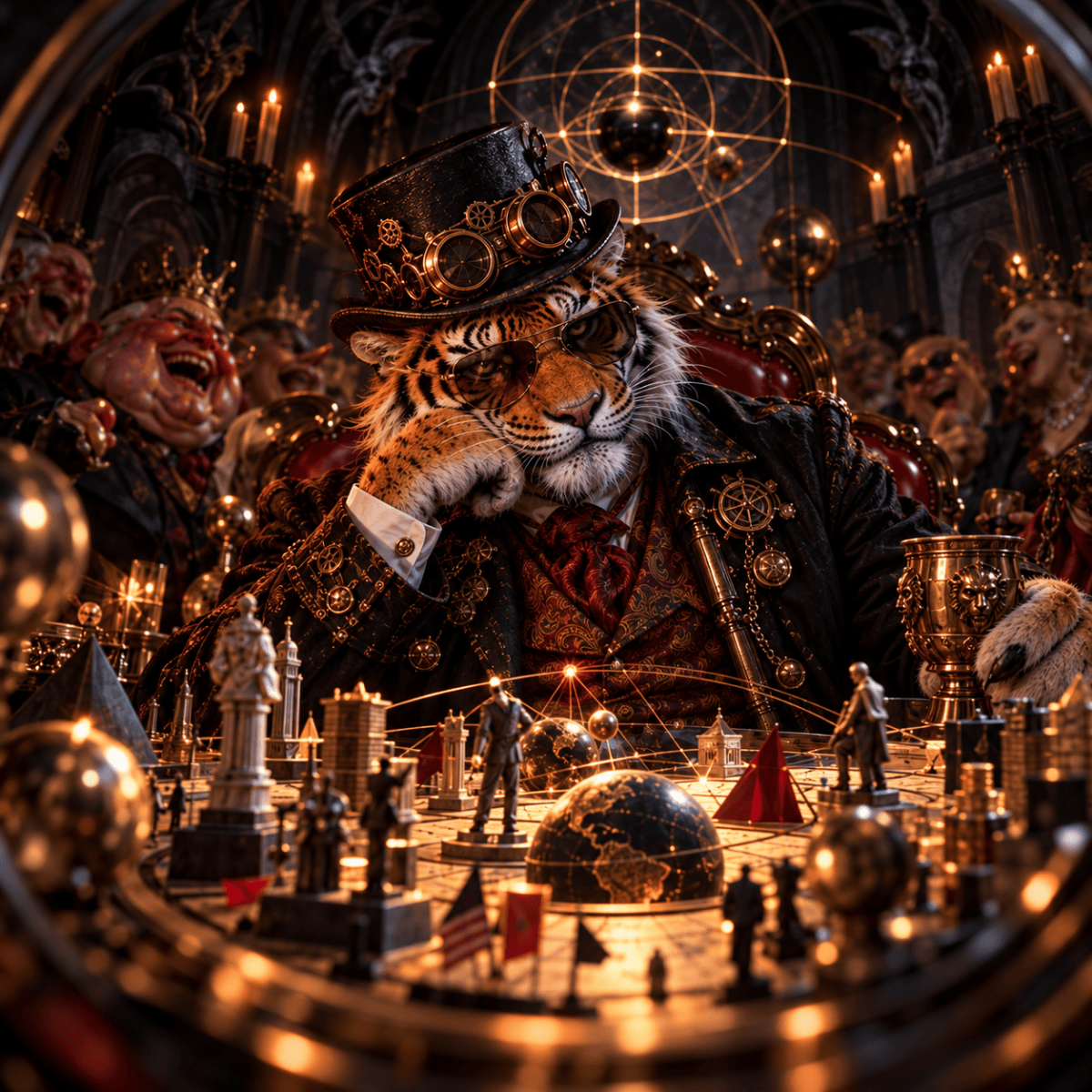
Captain Fractal had noticed something peculiar about political identity. The harder people worked to establish who they were, the more dependent they became upon whoever they insisted they were not. An identity and its opposite arise through differences that simultaneously distinguish and connect them. The interface is language: definitions, descriptions, performative roles and ritualised assumptions through which people establish who they are by repeatedly demonstrating who they are not. Every declaration of belonging renews a boundary, while every denunciation gives the opposition another opportunity to become recognisable. Political antagonists consequently participate in producing one another. Their identities persist through recurring performances of disagreement, and attempts to defeat an opponent can strengthen the relationship sustaining both. The contradiction generates continuity, but also new possibilities as each exchange changes what the participants can subsequently become. Captain Fractal considered this an extraordinary achievement. Humanity had discovered how to manufacture enemies it could not afford to lose, then developed elaborate ceremonies for pretending otherwise.
The mechanism operated through the rhythms of communication. Meaning emerges through recurring differences, their timing and their relationships. An accusation invites a rebuttal; the rebuttal renews the accusation; repetition establishes a recognisable pattern. Each recurrence changes expectations, interpretations and the probabilities of subsequent responses. Opposing identities become entrained through their disagreements, producing a shared rhythm without requiring agreement. As explored in Semantics Follows Frequency, meaning develops through the temporal relationships that sustain recognition and understanding. Social and news media increasingly optimise these patterns, selecting signals that generate predictable reactions and reinforcing their recurrence. Entropy concerns the distribution of possibilities, and concentrating attention around familiar antagonisms changes which alternatives remain accessible. The result is predictable behaviour within increasingly fragile relationships. Differences capable of generating new understanding are repeatedly channelled into established performances. The machinery becomes exceptionally efficient at reproducing disagreement while diminishing opportunities to move beyond it. Captain Fractal observed that humanity had finally developed the technology to automate its own intellectual constipation.
The greater absurdity was that institutions behaved much the same way. Governments, corporations, universities and media organisations celebrated innovation while defending the hierarchies and assumptions through which their authority persisted. Their reforms changed language, procedures and technologies while attempting to preserve established relationships of power. Yet every intervention altered the surrounding conditions, generating new differences that demanded accommodation or suppression. What appeared to be stability was continuous activity devoted to preventing meaningful transformation. Contradictions were not defects to be eliminated. They were relationships through which new possibilities emerged. By repeatedly suppressing them, institutions narrowed their capacity to adapt while amplifying the pressures their interventions generated. Humanity had built extraordinary machinery to preserve an increasingly untenable version of itself, mistaking the reproduction of familiar behaviour for the preservation of its future. Captain Fractal concluded that humanity had become extraordinarily proficient at resisting change, an enterprise whose principal achievement was making the worst-case scenario increasingly unavoidable.
Key Takeaways
- Political identities depend upon their oppositions. Definitions, descriptions and repeated performances sustain the differences through which opposing groups recognise themselves.
- Communication reproduces relationships through time. Recurring distinctions establish rhythms of expectation, recognition and meaning, allowing antagonists to become mutually entrained.
- Statistical optimisation reinforces established patterns. Algorithmic selection makes familiar reactions increasingly probable while reducing opportunities for alternative interpretations.
- Rigidity and volatility can coexist. Predictable responses within a narrow repertoire can accompany increasing fragility when unfamiliar differences emerge.
- Suppressing contradiction can undermine continuity. Institutions attempting to preserve existing power restrict the transformations necessary for their own adaptation, generating instability through their resistance to change.

