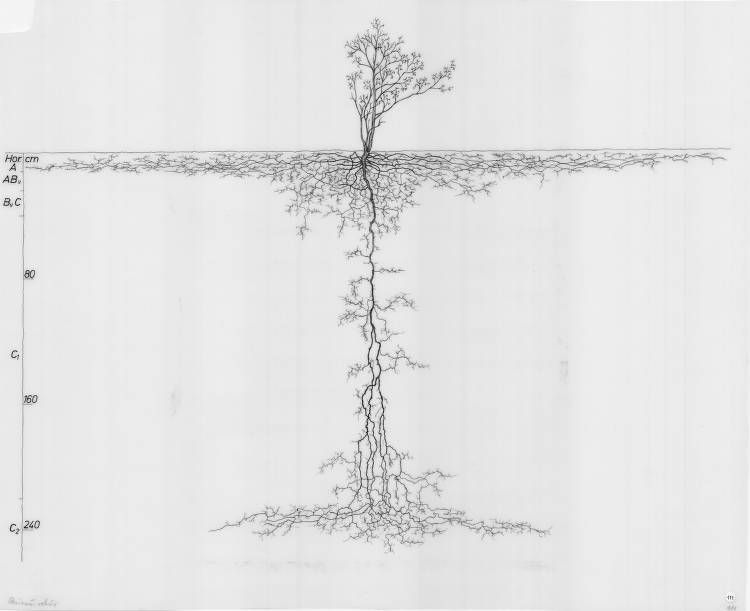
What is not seen is often as interesting as what is.
The more consequential question is how cognition changes when information processing, memory and knowledge transmission become distributed across a cultural environment.
If information processing and storage extend into an environmental context, the individual brain is no longer the exclusive location of the cognitive system. Language, tools, institutions, technologies, inherited practices and other people participate in the processes through which knowledge is acquired, interpreted and reproduced. Culture is not simply a repository into which individuals deposit information.
It is an active component of cognition, continually changing the conditions under which individuals perceive, think, communicate and act. The brain does not merely interact with this wider field. Its capacities develop and persist through those interactions.
The conventional distinction between an individual and their environment conceals the relationships through which both become identifiable. Identity is not an independently existing property subsequently connected to a world of other objects. It emerges through persistent differences, dependencies and interactions. The individual is a temporarily stable expression of a much wider relational process.
What we call the Self is neither wholly contained within the organism nor dissolved into an undifferentiated collective. It is a distinctive continuity sustained through relationships that extend beyond its apparent boundaries. This is the deeper significance of the making of identity.
These relationships are necessarily temporal. Communication requires differences to propagate, and propagation introduces delay. Memory preserves earlier distinctions while anticipation reorganises the probabilities of future interactions. Cultural practices recur through rhythms of imitation, correction, reinforcement and transformation. Shared language, institutional habits and technological conventions persist because their recurrent activity increases the probability of their own reproduction.
They establish relatively stable patterns within a changing field of possibilities. The continuity of a culture is not the preservation of an unchanging structure, but the ongoing reproduction and transformation of relationships across time.
This is why distributed cognition cannot be adequately described as information stored in multiple locations. The distribution is active. Individuals alter their cultural environment, which changes the conditions under which subsequent individuals develop. Language modifies thought while thought modifies language. Technologies transform communication while communication directs technological development. These processes are recursive, but they are not instantaneous or symmetrical.
Different frequencies, delays and dependencies create patterns of entrainment, interference and persistence. Some distinctions disappear, others propagate, and particular configurations become sufficiently recurrent to sustain recognisable identities. The logical orbit describes this continuity through recurrent relational activity.
There is an important consequence for how we understand intelligence. A society can accumulate extraordinary quantities of information without becoming correspondingly intelligent. The capacity to preserve knowledge is not identical to the capacity to interpret, revise or use it. Institutions can reproduce errors as effectively as insights. Technologies can accelerate communication while narrowing the diversity of distinctions that survive.
Collective cognition is shaped by the relationships governing attention, authority, access, repetition and correction. The same distributed processes that sustain cultural intelligence also sustain collective ignorance. The mechanisms are not separate. Their consequences depend upon the patterns they reproduce.
The continuity of identity is consequently inseparable from the transformation of its conditions. No individual, institution or culture contains everything necessary for its own persistence. Every apparent boundary depends upon relationships extending beyond it, and every enduring pattern changes the field from which its future possibilities emerge. The Self is not an isolated object looking out upon an independently existing world.
It is a persistent distinction within a field of differences, delays, dependencies and absences that continually generates both identity and transformation.
The benefit of a systems perspective is not merely that it allows us to understand cognition more comprehensively. It changes what we understand cognition, culture and individuality to be. The apparent independence of the individual is made possible by collective relationships, while the collective acquires its continuity through the differences sustained by individuals. Neither exists as a complete entity without the other.
What we experience as a separate Self is a local expression of a much larger process, one whose persistence depends upon the differences it can sustain and whose future depends upon those it has yet to encounter.
Key Takeaways
- Cognition is distributed. Brains, language, technologies, institutions and cultural practices participate in interconnected processes of information processing and knowledge transmission.
- Identity is relational. The individual Self emerges through persistent differences and dependencies rather than existing independently of its environment.
- Time is constitutive. Frequency, recurrence, phase and delay shape the continuity of cognition, communication and culture.
- Collective intelligence is not guaranteed. The same distributed mechanisms that preserve knowledge can reproduce ignorance, institutional inertia and error.
- Continuity requires transformation. Individual and collective identities persist through changing relationships that simultaneously sustain and alter their conditions of existence.

