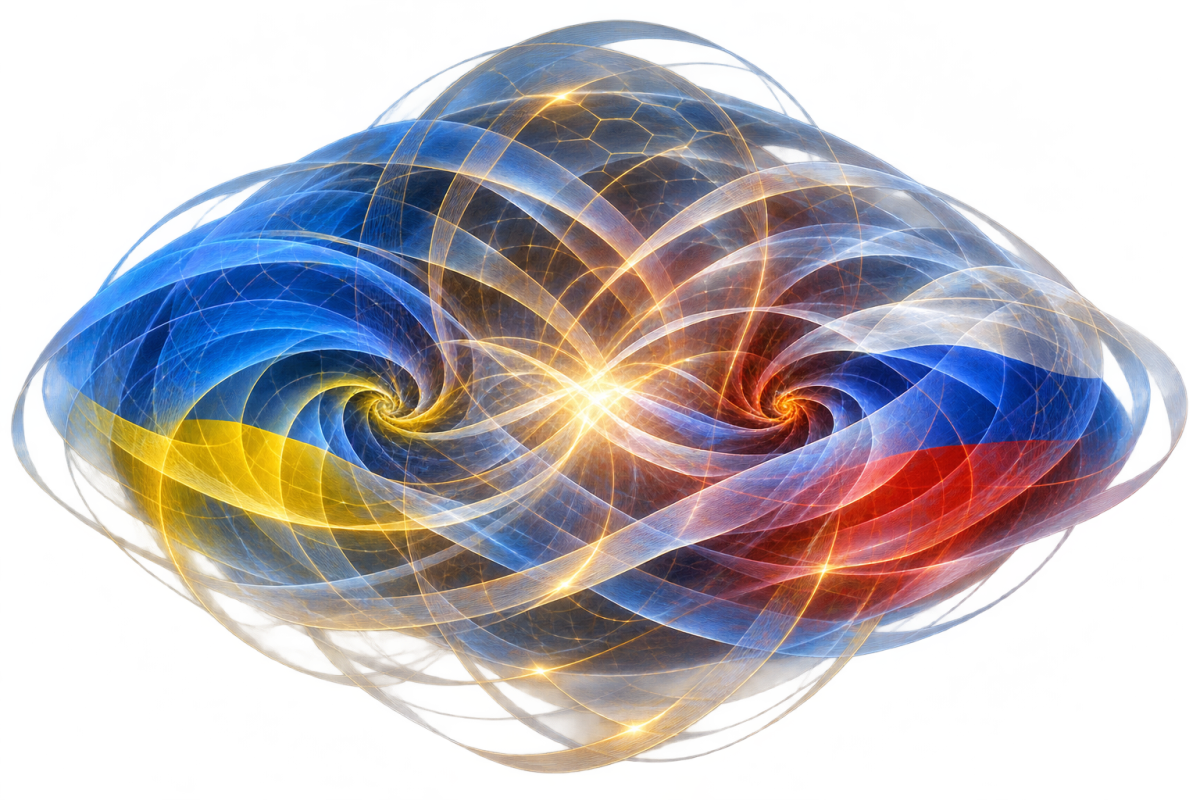
Self-Propagating Dynamics of Conflict
Whatever moral justifications are advanced by those involved in the war between Russia and Ukraine, and however their validity is understood or contested, the scale of human suffering makes detached analysis difficult. Hundreds of thousands have died, millions have been displaced, and entire communities have been devastated. Each death is an individual tragedy, even when the numbers become so enormous that human lives disappear into statistics.
Most of those killed, on either side, have had little influence over the political decisions determining their fate. The conflict has roots extending through centuries of imperial history, Soviet rule, Ukrainian independence, competing security interests and the wider geopolitical relationships within which the 2022 invasion occurred.
Russia’s military losses have fallen disproportionately upon poorer regions and peripheral populations, although the consequences extend throughout Russian society and its economy. By December 2025, estimates placed Russian military deaths at 275,000–325,000, within approximately 1.2 million Russian military casualties, including those killed, wounded and missing (Jones and McCabe, 2026; Mediazona, 2026).
Against this historical background, the conflict increasingly resembles a wildfire generating the conditions for its own acceleration.
Such behaviour is not peculiar to warfare, nor even to human affairs. Wildfires can generate their own weather, producing winds that intensify the combustion from which they arose (Riordon, 2026). Financial panics can become self-fulfilling as attempts to protect individual deposits collectively threaten the banking system (Diamond and Dybvig, 1983).
Technological and economic systems can become locked into historically contingent patterns through increasing returns, even when those patterns are inefficient or damaging (Arthur, 1989). These are different phenomena, with different physical mechanisms and consequences, yet their relational dynamics share a recognisable structure: interactions alter the conditions of subsequent interactions, reinforcing particular patterns while progressively restricting alternatives.
What begins as a response to circumstances can become a process that reproduces those circumstances. The commonality lies not in what these systems are made of, but in how their constituent relationships sustain and transform the whole.
One way of examining the war, then, is to consider the opposing sides not simply as separate actors, but as participants in a larger, historically conditioned system of reciprocal relations. This does not make them morally or politically interchangeable, nor diminish the distinction between invasion and defence. Their interactions become mutually determining as repeated cycles of action, response and adaptation establish patterns of dependency.
Military command, recruitment, economic incentives, political authority, public narratives and institutional expectations become coupled through these recurring interactions. The conflict itself acquires a relatively stable identity, sustained through the enormous throughput of people and resources, with human lives passing from recruitment into destruction.
Its incentives, roles and constraints increasingly favour the reproduction of that process, generating something resembling a vacuum that draws further resources into its operation. The persistence of this process need not correspond to the intentions of either side, nor imply any equivalence between their responsibilities.
Like a wildfire generating the atmospheric conditions that feed its own flames, the conflict reproduces the circumstances of its persistence, a dynamical process that cannot be understood through the intentions or diplomatic positions of either side alone.
Key Takeaways
- The human cost of war cannot be reduced to statistics or the political intentions of those directing it.
- Destructive systems can generate feedback that reinforces their own operation, as observed in wildfires, financial panics and technological lock-in.
- Opposing forces can become reciprocally determining without becoming morally or politically equivalent.
- The conflict reproduces the conditions of its own persistence, drawing people and resources into a destructive process that exceeds the intentions of its participants.
References
Arthur, W.B. (1989) ‘Competing technologies, increasing returns, and lock-in by historical events’, The Economic Journal, 99(394), pp. 116–131. doi.org.
Diamond, D.W. and Dybvig, P.H. (1983) ‘Bank runs, deposit insurance, and liquidity’, Journal of Political Economy, 91(3), pp. 401–419. doi.org.
Jones, S.G. and McCabe, R. (2026) ‘Russia’s grinding war in Ukraine’, Center for Strategic and International Studies, 27 January. Available at: CSIS.
Mediazona (2026) ‘Four years of war: 200,000 confirmed dead and the geography of Russian losses in the war with Ukraine’, 24 February. Available at: Mediazona.
Riordon, J. (2026) ‘NASA campaign explores clouds spawned by wildfires’, NASA Science, 2 October. Available at: NASA Science.
Coda
Examining the inevitably contested constellation of facts surrounding war without moral adjudication is extraordinarily difficult, not least because the human response to suffering and destruction is inseparable from questions of morality, choice, responsibility and consequences. War is catastrophic, whatever its causes, justifications or professed necessities.
Yet understanding how such conflicts develop and perpetuate themselves requires distinguishing moral considerations from the complex adaptive system dynamics under examination. This does not suspend moral responsibility; it allows us to investigate processes that moral certainty alone may render logically undecidable.

