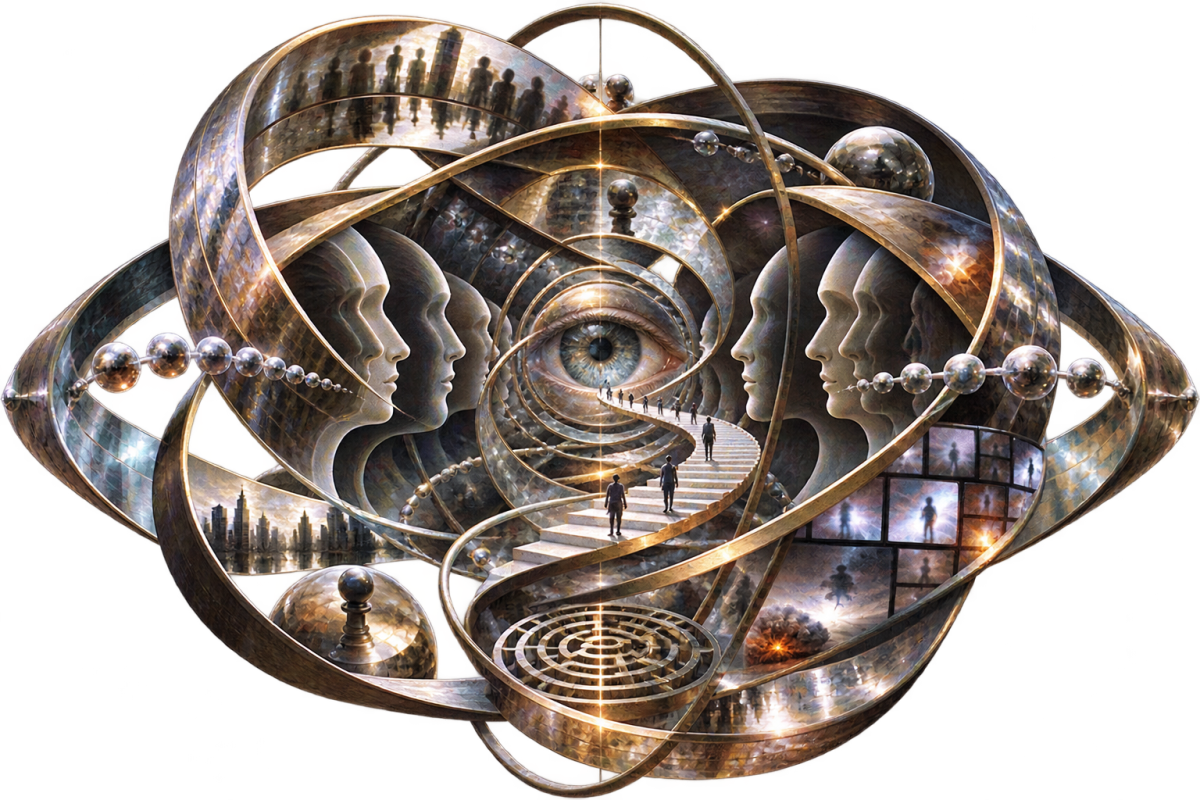
The distinction between information warfare, advertising, political communication and competitive adversarialism more generally is substantially a distinction of context, intensity and consequence rather than of underlying informational dynamics. At an appropriate level of abstraction, these are expressions of a common process through which the persistence of individual and collective identities becomes dependent upon the modification of other people’s perceptual, behavioural and communicative possibilities. Armed conflict and its associated brutality occupy the sharp end of a spectrum of informational activity in which almost everyone participates, knowingly or otherwise.
What becomes particularly interesting is that the competitive relationship is itself reciprocally constitutive. The mechanisms through which advantage is obtained transform the communicative environment within which everyone else must operate, progressively favouring the recurrence of structurally similar mechanisms. Persuasion, deception, selective disclosure and the manipulation of attention become self-propagating properties of that environment, irrespective of the intentions or awareness of any particular participant. Ordinary competitive communication does not merely resemble information warfare; it actively reproduces the conditions of its possibility and probability.
The analytical significance of this continuity lies in the selection of abstractions through which we interrogate these phenomena. Beneath the differences of purpose, method and consequence lies a common dynamical architecture: each act of communication redistributes the probabilities of subsequent communication, modifying the conditions under which meaning, influence and advantage arise. The ethical and material consequences of these activities differ enormously, but the informational dynamics of warfare are neither exceptional nor confined to its prosecution. Information warfare exploits what ordinary communication continuously generates.
Like it or not, this is the world in which we live, and we must accommodate the uncomfortable fact that deception is endemic to communication. That the production of disinformation is a subset of the production of information should surprise no one, but what prevailing academic and governmental narratives tend to overlook is the extent to which discontinuity, disruption and contradiction are themselves constitutive properties of communication. Across the ensemble of a complex communicative system, the topology of its relations is such that it reproduces itself through its own interdiction: political argument produces more politics, and the persistence of the argument becomes a function of its constitutive irresolution.

