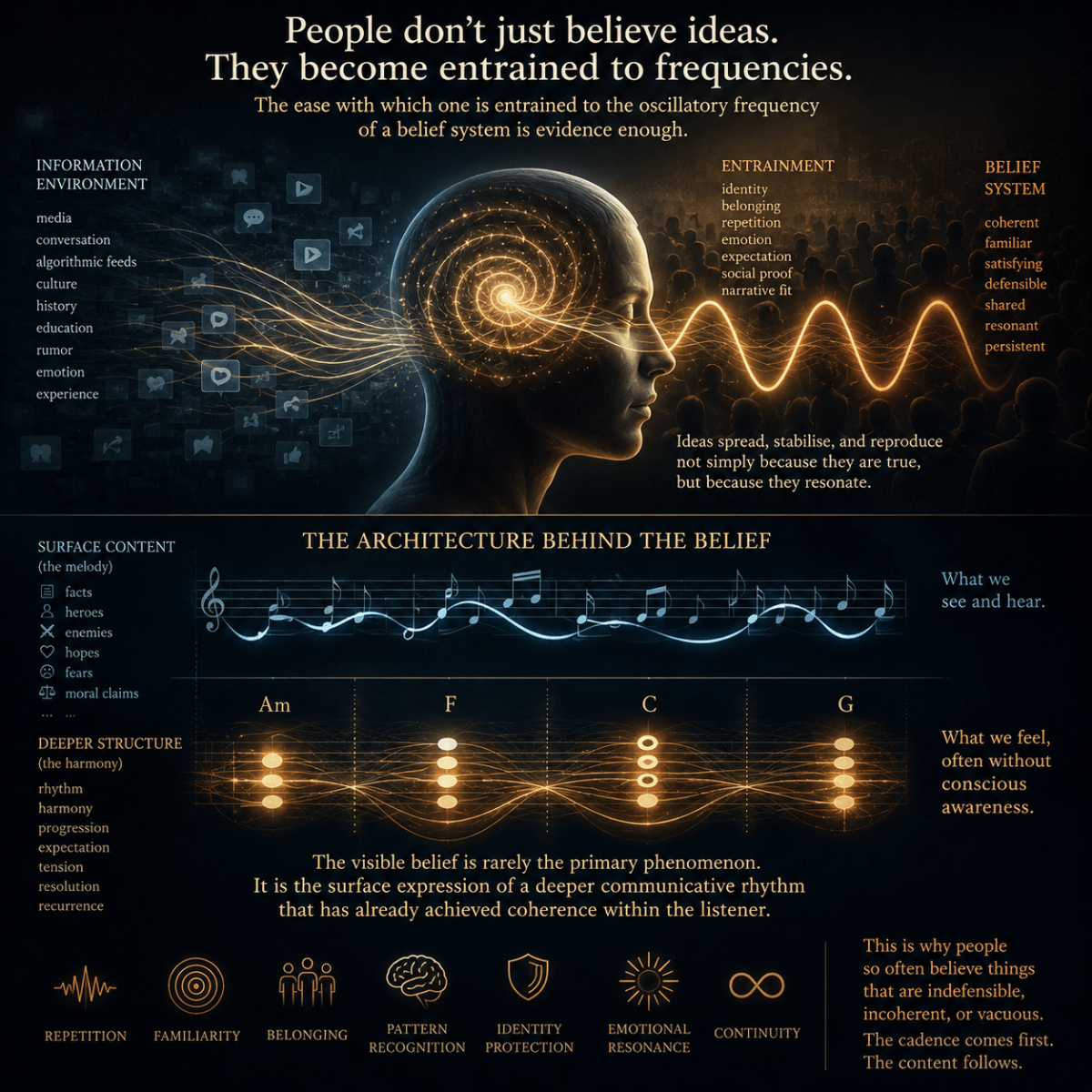
People really just want, or perhaps need, something to believe in. What that thing is often matters less than we imagine. This tendency is not merely a property of individuals but of the information and communication systems through which individuals encounter the world. The ease with which people become entrained to the standing wave structure of a belief system is evidence enough. Ideas spread, stabilise, and reproduce because they provide narrative as semantic coherence. Truth may contribute to that coherence, but it is not the only route. Identity, repetition, familiarity, grievance, hope, belonging, and expectation all play a role. What persists is often not a proposition but a pattern.
Popular music offers a useful analogy. A song’s force rarely resides in any isolated note or lyric. It emerges from rhythm, harmonic progression, recurrence, tension, and release. Belief systems appear to function similarly. Facts, symbols, heroes, enemies, and moral claims occupy the foreground, yet beneath them lies a deeper organisational cadence shaping how those elements are experienced and remembered. This helps explain why people so often come to embrace ideas that appear indefensible from the outside. The belief itself is rarely the primary phenomenon. More often it is the visible surface of a deeper communicative structure that has already achieved coherence within the listener long before its specific content is examined.
Categories
belief
Beliefs persist less because they are true than because they provide the transient continuity of narrative as semantic coherence.