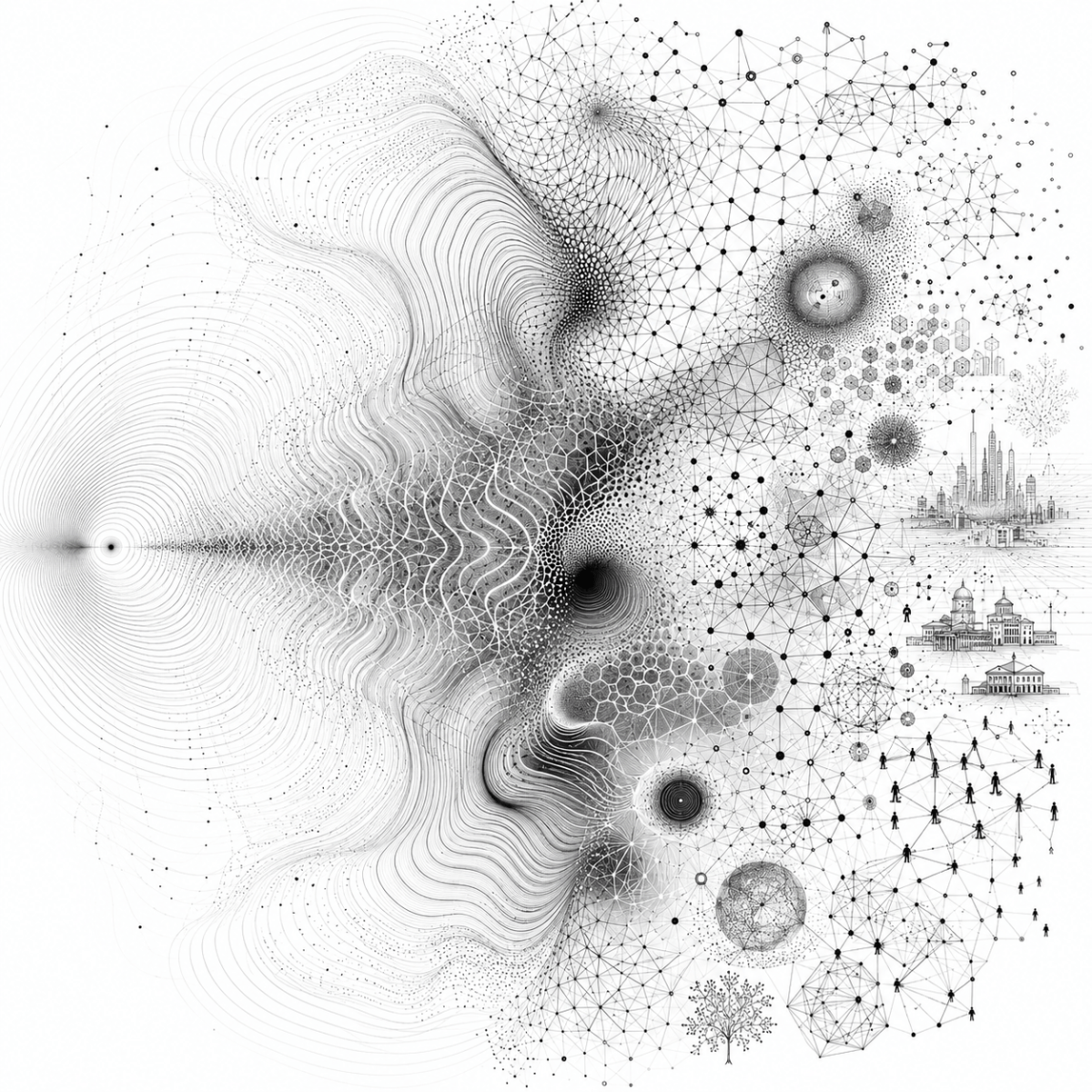
One of the stranger consequences of thinking in terms of communication, delay, phase, and propagation is that the principle does not seem confined to language. The same structural rhythm appears almost everywhere. Ecologies, economies, institutions, conversations, markets, cultures, nervous systems, and media environments all persist through patterned exchanges unfolding in time. What matters is not merely what is transmitted, but when. Timing alters meaning. Delay alters influence. Synchronisation alters stability. A small perturbation introduced at the right moment can produce consequences far larger than its apparent magnitude. Rhythm becomes structure. Cadence becomes organisation.
More strictly, any distributed system can be understood as a collection of interacting processes coupled through finite propagation times. Information does not move instantaneously. It accelerates and decelerates differentially as it passes through media, persons, institutions, interfaces, and systems, so every transmission is also a modulation of tempo, intensity, and phase. It is delayed, attenuated, amplified, distorted, and reflected by the medium through which it travels. The resulting system is therefore not simply a network of relationships, but a network of phase relationships. Stability emerges when components become sufficiently phase-aligned. Instability emerges when delays, oscillations, or competing frequencies disrupt that alignment. The system’s observable behaviour is not determined only by the elements it contains, but by the temporal structure of their interaction.
This is the critical point: if organisation emerges from phase relationships, then influence need not operate directly upon beliefs, values, resources, or even individual actors. Influence can instead operate upon timing itself. Introduce a delay. Accelerate a feedback loop. Amplify one frequency while attenuating another. Seed small temporal displacements across many events, actions, interpretations, and responses. Over time, these minute modulations accumulate into phase change. Change the rhythm and the chord changes automatically. The large-scale pattern emerges from modifications to temporal structure. Power, in this sense, increasingly resembles phase modulation more than persuasion.
This may be one of the stronger use cases for artificial intelligence: not merely producing content, but determining how, where, when, and why to modulate the temporal structure of social and political relationships. The sociopolitical implications are substantial. Modern communication technologies already function as planetary-scale phase-control infrastructure. Recommendation systems, notification architectures, algorithmic amplification, targeted advertising, automated content generation, behavioural analytics, and increasingly autonomous AI systems provide unprecedented leverage over collective timing. They determine which signals arrive, when they arrive, how often they arrive, and to whom. Once automation can continuously observe, model, and modulate these temporal relationships, influence ceases to be primarily about controlling information and becomes increasingly about controlling the conditions under which information propagates. The struggle is no longer simply over narratives. It is over the rhythms through which narratives acquire coherence, persistence, and collective force. In such a world, governance, propaganda, markets, and culture begin to converge upon the same underlying problem: the management of phase relationships within vast distributed populations.
Categories
phase control: communication, power, and the politics of timing
Change the timing and you change the structure. Communication is not merely the transfer of information through a network but the propagation of signals through media of different densities, delays, and constraints. Small temporal modulations accumulate. Phase shifts become interference patterns. Interference becomes organisation.