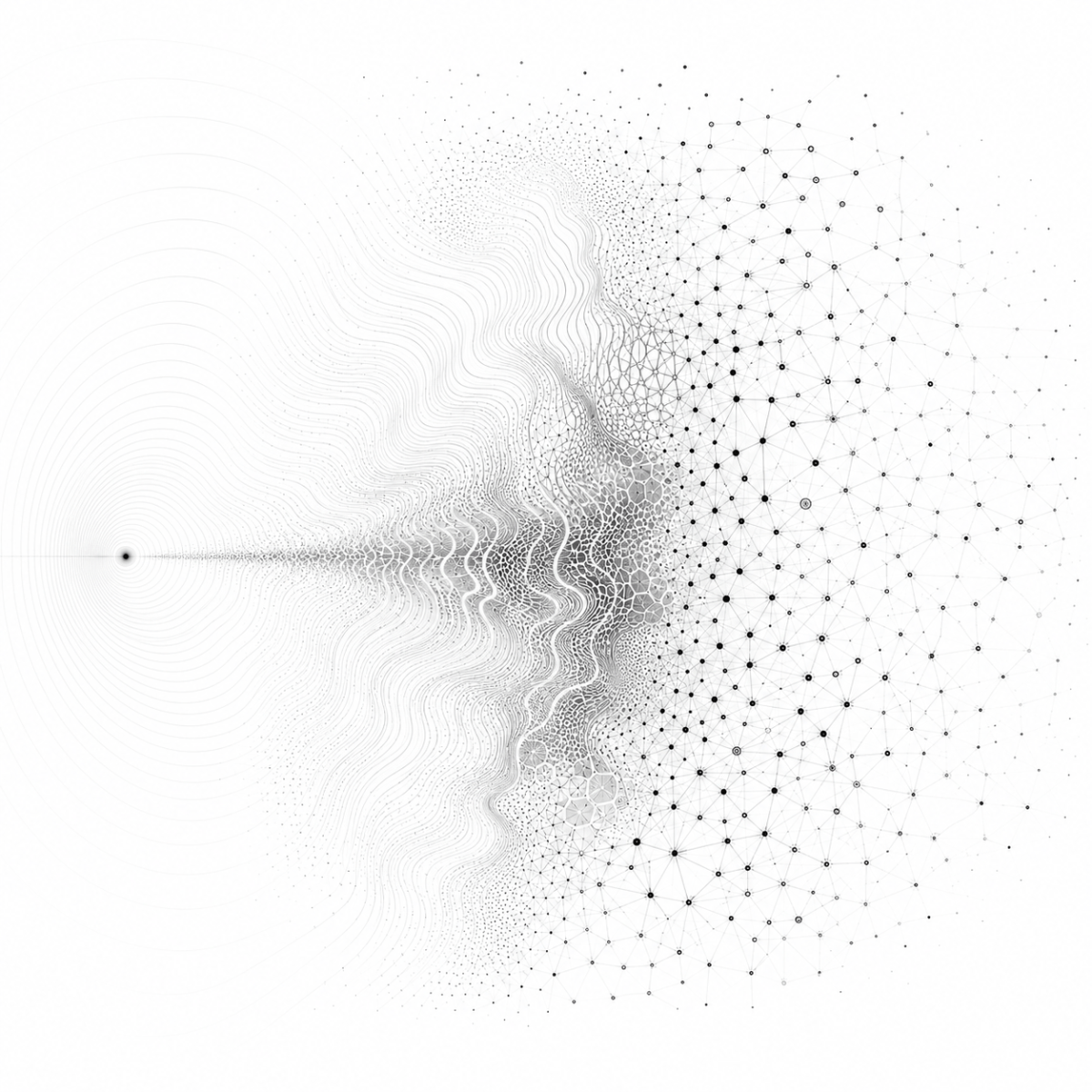
The conspicuous absence of significant tectonic shifts in science over the last century is not primarily a consequence of a lack of discoveries. It is a consequence of our inability to tolerate their implications. Every genuinely transformative idea carries two coupled components. The first is discovery itself. The second is the perceived injury done to the stories by which people recognise themselves. We tend to imagine science as a steady accumulation of facts. In reality, it is often a sequence of humiliations. The Earth was not the centre. Humanity was not separate from animals. Consciousness is not as sovereign as it appears. Each advance arrives carrying an invoice for psychological comfort, and payment is rarely enthusiastic.
What appears as an offset between science and reality is an orbit-frame relationship within a single distributed process. Science is one of reality’s ways of orbiting itself. The gap is not merely error, ignorance, or delay, but a distributed phase offset: a structured difference through which discovery, interpretation, resistance, and cultural absorption continuously reorganise one another. This is why the problem is not simply that science has become institutional, cautious, bureaucratic, or specialised, although it has become all of those things, because of course it has. The deeper problem is that discovery arrives out of phase with the identities available to receive it.
The difficulty is that modern institutions are largely organised around preserving coherent identities. Universities, governments, corporations, media systems and political movements all depend upon relatively stable descriptions of reality and of ourselves. Yet many of the most interesting developments across complexity, information theory, cybernetics and network science point in precisely the opposite direction. The individual increasingly resembles a local expression of larger relational processes. Agency becomes distributed. Meaning becomes statistical. Intention becomes entangled with structures extending far beyond any single observer. This is not hidden knowledge. It is simply difficult knowledge. Understanding it requires becoming someone slightly different from the person who first encountered it.
This is why the conspicuous absence persists. Discovery and insecurity form an orbit. The closer one approaches a genuinely new description of reality, the more strongly existing identities attempt to restore themselves. The survival parameter is not perfect agreement but bounded offset: enough phase-lock to maintain coherence, enough misalignment to permit adaptation. Cultures reproduce the frequencies that stabilise them. Familiar harmonics are amplified while unfamiliar ones are attenuated. The relationship is Wiener–Khinchin-like: the large-scale structure reflects the correlations preserved through time. Civilisations, like individuals, preferentially hear the echoes of themselves. The result is a peculiar situation in which our technical capacity to discover advances rapidly while our cultural capacity to survive discovery changes very little. We can build telescopes capable of seeing the edge of the observable universe, yet remain remarkably protective of the small stories that place us at its centre.
Categories
the conspicuous absence in science
Science has not stopped discovering reality. We have become less capable of surviving what those discoveries imply about ourselves.