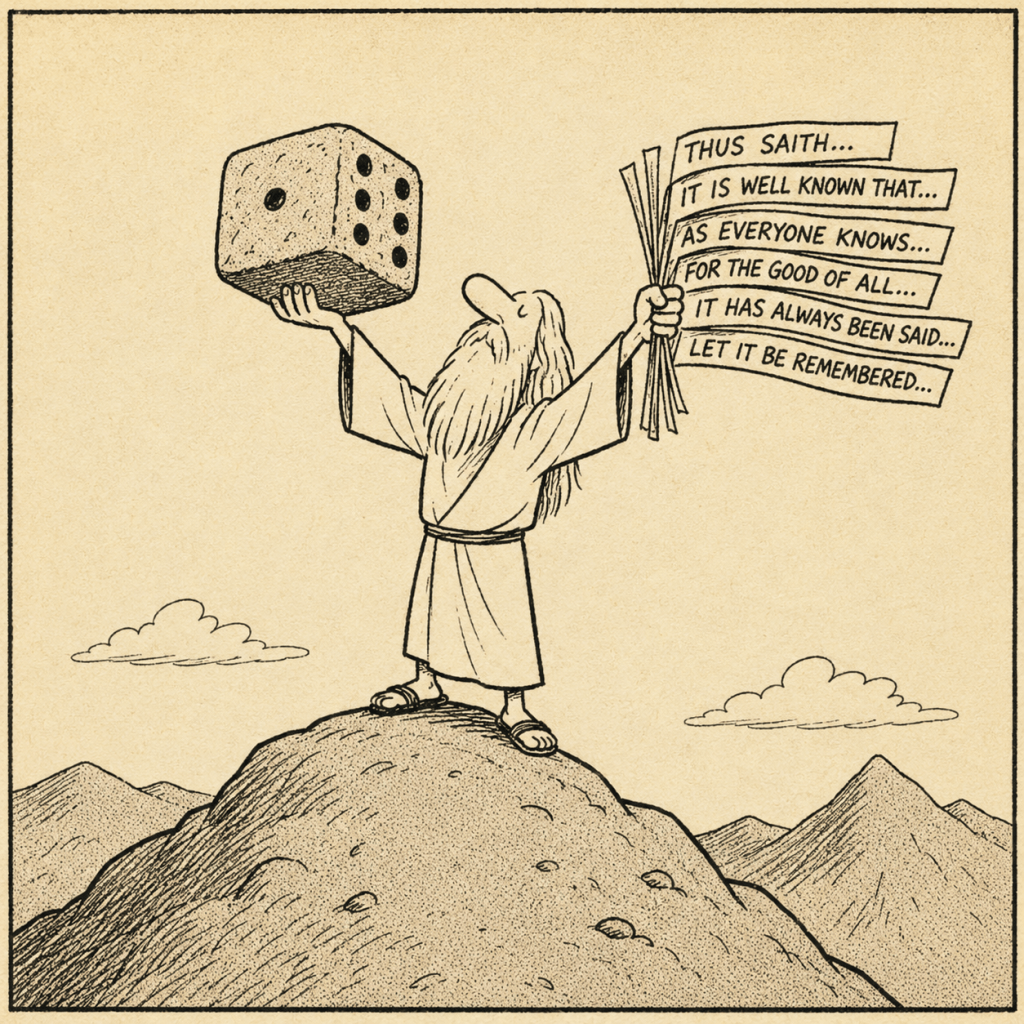
Belief and culture are stochastic organisations of recurrence.
Stochastic does not mean random, arbitrary or unstructured. It means that no single linguistic event is completely determined, while the distribution from which events emerge is shaped by what has happened before. Any word, association, response or interpretation may vary. Across sufficient recurrence, however, some relations occur more often than others, some sequences become more probable, and some forms of meaning become increasingly stable.
Organisation means this patterned constraint of relations through time. It does not imply central control, conscious design or a fixed arrangement of parts. Organisation exists wherever repeated interactions alter the probability of subsequent interactions. It persists when those altered probabilities continue reproducing a recognisable relational structure through change.
Belief and culture are stochastic because their individual expressions remain variable. They are organised because that variation is neither unlimited nor evenly distributed. Existing beliefs constrain which linguistic relations are selected, repeated and coupled, while each expression reinforces, modifies or disrupts the organisation inherited from previous expressions.
A belief is neither a fixed proposition nor a random collection of thoughts. It is a persistent organisation of probability.
Persistence requires recurrence, and recurrence necessarily possesses temporal structure. It occurs across intervals, distributes activity across frequencies and establishes relations of timing and phase. When recurrent processes interact across scales, they produce modulation and harmonic organisation. Belief, ideology and culture are persistent regions of this organisation. They stabilise meaning, coordinate participants and constrain what communication, interpretation and experience become probable next.
Persistent ideological organisation should consequently generate measurable multiscale spectral characteristics in language, from semantics and syntax through prosody to the acoustic signal. These characteristics do not deterministically identify individual beliefs. They constitute probabilistic signatures whose predictive strength increases with recurrence, coherence and duration of observation.
The representational error
Belief is usually treated as a proposition, representation or mental object that exists inside an individual and is subsequently expressed through language. Culture is then imagined as a larger collection of these objects, distributed among people and preserved through institutions, practices and texts. Language becomes the vehicle through which an otherwise independent structure is communicated.
That separation is false.
A belief system does not first exist and then acquire linguistic, emotional or acoustic form. Its existence consists in the recurrent organisation through which distinctions, associations, expectations, affects and responses persist. It lives across words, voices, gestures, memories, institutions, technologies and interactions because none of these is individually identical with it. Particular expressions remain replaceable while the relations among them recur.
The ontology is the organisation.
A belief system does not merely possess harmonic structure as a secondary property. It is not an abstract object that leaves temporal traces when expressed. Its recurrence, timing, phase and coupling are constitutive of the belief itself.
Nor is harmonic structure hidden somewhere behind experience. It is the temporal organisation of experience: the recurrence through which distinctions, meanings, expectations and affects become stable enough to be lived as reality.
A belief persists without requiring the exact repetition of identical statements. Words change, metaphors migrate, arguments are reformulated, speakers are replaced and technologies reorganise communication. The belief persists when these transformations continue reproducing a recognisable distribution of relations.
Some distinctions remain salient. Some associations are reinforced. Some transitions become ordinary, while alternatives become improbable, incoherent or difficult to express. Variation continues, but it occurs within a constrained field of possibility.
Belief is a field of differential probability.
The structure of experience
Experience is not a neutral surface upon which beliefs are later imposed. What becomes noticeable, meaningful, threatening, desirable, plausible or absurd is already organised by recurrence.
Past relations establish expectations. Expectations alter attention. Attention changes which differences become salient. Salient differences are more likely to be selected, interpreted, remembered and repeated. These selections then reorganise the field inherited by whatever follows.
Belief participates in constructing the experience that appears to confirm it.
This requires neither hallucination nor conscious distortion. It follows from the temporal organisation of perception and interpretation. A recurrent belief changes the probability that particular differences will be noticed and connected. Those relations then supply further material through which the belief persists.
Harmonic structure is not elsewhere, behind experience or imposed upon it. It is precisely the structure of experience through time. It is the recurrent coupling through which perception, affect, memory, language and expectation become organised as a coherent world.
Changing a belief consequently requires more than replacing one proposition with another. It requires reorganising the recurrence, timing and coupling through which that belief reproduces itself. A contradictory statement may be rejected, absorbed or reinterpreted while the wider probability field remains intact. The words change while the organisation survives.
Language as probability
Every utterance emerges from a history of prior relations. The next word, phrase or response is neither fully determined nor equally likely among all possibilities. Previous communication changes the probability of subsequent communication. Repetition strengthens associations. Habitual sequences reduce uncertainty. Institutions privilege particular vocabularies. Social identities stabilise characteristic distinctions. Established narratives organise which events appear related.
A belief system operates through this differential selection. It does not dictate precisely what must happen next. It reorganises the field from which the next event emerges.
This is what makes belief both stochastic and consequential. A political ideology does not force every participant to produce the same sentence. A religion does not eliminate variation among its adherents. A culture does not turn its members into copies. Each produces recurrent constraints that make some linguistic and experiential relations more probable than others.
Individual expressions remain uncertain. Aggregate organisation becomes increasingly concrete.
Computational approaches already recover meaningful structure from recurrent relations among words and documents rather than from definitions assigned in advance. Stance detection likewise demonstrates that expressed beliefs can be inferred statistically from linguistic distributions, although current methods depend heavily upon semantic content and contextual information (Burnham, 2025).
The present argument goes further. Semantic content is only one observable resolution of the organisation. If belief persists through recurrent relations, its structure should also appear in the sequencing, timing and coupling through which those relations are reproduced.
Meaning arises within this organisation rather than above it. A word means what it does through the relations that repeatedly distinguish, connect and position it. No single occurrence contains the meaning. Semantic stability is the persistence of relational organisation across changing uses.
As argued in “Semantics Follows Frequency”, recurrence builds structure, while established significance changes what becomes likely to recur (Daedelus Kite, 2026a). Meaning and frequency form a recursive relation. Repetition does not merely preserve meaning. It participates in producing, modifying and stabilising it.
From recurrence to frequency
Recurrence is temporal. Events recur across non-zero intervals, at different rates, with different delays, durations and degrees of regularity. Their activity is consequently distributed across frequencies.
Frequency here is not restricted to audible vibration. It describes rates of recurrence at every observable temporal scale.
Acoustic oscillations occur within milliseconds. Syllables, stresses and pauses organise fractions of seconds. Phrases and conversational turns unfold across seconds. Themes and semantic associations recur across minutes or hours. Narratives, doctrines and cultural distinctions may reappear across years or generations.
These processes differ in scale but share the same underlying logic. Something recurs. Its recurrence changes the relations around it. Those changed relations alter the probability, timing and form of its subsequent recurrence.
Research into speech rhythm establishes that persistent linguistic differences possess measurable temporal structure. Ramus, Nespor and Mehler (1999) identified differences in consonantal and vocalic timing across eight languages. Their results do not establish a spectral theory of culture, but they demonstrate its necessary empirical foundation: recurrent linguistic organisation becomes observable in the temporal structure of speech.
Gibbon (2019) developed a related approach in which prosodic organisation is inferred from the low-frequency spectrum of the physical speech signal. Rhythm Formant Analysis identifies clusters of activity associated with overlapping speech rhythms. Speech does not contain one rhythm at a time. Multiple temporal processes coexist, overlap and modulate one another.
Zhang, Zou and Ding (2023) provide an important qualification. They found that modulation spectra reliably tracked syllable rate only when measurements were pooled across minutes of speech, while local temporal features remained more closely phase-locked to syllable onsets. Aggregate spectral structure and local phase relations disclose different aspects of the same process. The frequency domain does not replace temporal relations. It reveals recurrent organisation within them.
Harmonic structure
Temporal scales do not remain independent. Semantic organisation affects lexical selection. Lexical and syntactic selection affect phrase length and stress. Prosodic organisation affects timing, pitch and intensity. Repeated rhetorical forms organise collective attention, participation and expectation. Activity at one scale modulates activity at another.
Harmonic structure emerges from this coupling.
Harmonic does not mean that ideology behaves like a musical instrument or that political positions can be assigned simple audible frequencies. It refers to structured relations among recurrent processes operating at different temporal scales. These relations include phase alignment, entrainment, modulation, reinforcement, interference and persistent patterns of differential timing.
A harmonic structure is not a collection of isolated frequencies. It is an organisation of relations among recurrent processes.
In “Language as Harmonic Structure”, meaning was described as a persistent harmonic organisation within a communicative field (Daedelus Kite, 2026b). Concepts, identities, institutions and cultures endure because they reproduce recognisable relations through continual change. The present argument extends that proposition into a specific theory of belief and an empirical programme for testing it.
A belief system does not first exist and then produce harmonic effects. The recurrent coupling is the belief system.
There is no ideology hidden behind the signal. What we call ideology is a persistent organisation of distinctions, associations, responses, rhythms and probabilities across a communicative field. Semantic content, syntactic form, discourse rhythm, prosody and acoustic modulation are not separate products emitted by an underlying object. They are different observable resolutions of the same distributed process.
Emotion and reason within the same field
This account removes the conventional separation between rational, emotional, doctrinal and populist discourse. These categories describe different organisations within the signal, not different orders of existence.
An argument may privilege extended syntax, explicit causal relations and specialised vocabulary. A populist appeal may rely upon repetition, compressed distinctions, rhythmic synchronisation and affective intensity. Religious discourse may organise recurrence through ritual, cadence, collective response and inherited semantic association. Emotional speech changes pitch, tempo, amplitude, timing and selection while also reorganising which responses become probable.
None escapes the field.
Rational discourse is not language purified of rhythm and affect. Emotional discourse is not noise added to an independent semantic object. Both are stochastic organisations of differential timing, recurrence and probability. They differ in structure, scale and mode of coupling.
This explains why ideological organisation exceeds its stated propositions. People may reject a doctrine explicitly while continuing to reproduce its distinctions, rhythms and relational habits. A movement may replace its vocabulary without changing its organisation. Opponents may become entrained to one another and reproduce the same ideological field through conflict.
Persistence belongs to the recurring relations, not exclusively to agreement, declared identity or any particular set of words.
Culture across signals
Evidence that cultural timing crosses between expressive domains remains limited but consequential. Patel and Daniele (2003) found corresponding rhythmic differences between British English and French speech and classical music. Their study does not demonstrate that an entire culture possesses one rhythm. It shows that temporal organisation associated with language may be reflected in another signal system.
Berrebi and Peperkamp (2025) found that relatively subtle rhythmic differences contributed to the perception of ethnic identity in Modern Hebrew. Actors also modified their speech rhythm when portraying different ethnic identities. Rhythm was not merely an involuntary residue of linguistic background. It was socially salient and, for some speakers, available for deliberate modulation.
These findings support two propositions. Social organisation becomes measurable in timing. Recurrent temporal structure can also move between speakers, identities and expressive domains without requiring identical content.
Culture is not a container within which these structures occur. Culture is the persistent large-scale organisation produced through their coupling. It exists across many participants and signals because its identity is relational rather than material. Speakers enter and leave. Technologies change. Vocabulary drifts. The organisation persists where enough relations continue to recur.
The multiscale spectral hypothesis
Existing research has established isolated parts of this structure. Speech rhythm has measurable acoustic correlates. Prosodic organisation appears in the low-frequency spectrum. Semantic and political stances can be inferred from textual distributions. Social identity affects rhythm. Linguistic timing may correspond with organisation in music.
What remains missing is the binding envelope.
If belief and culture persist by organising recurrence, their effects should not stop at the boundary between semantics and sound. The same organisation should become observable across several coupled levels:
Semantic association
Lexical transition
Syntactic recurrence
Discourse rhythm
Prosodic timing
Acoustic modulation
The prediction is not that an ideology possesses a unique pitch, tempo or spectral peak. Its signature will be distributed, multivariate and stochastic. It will lie in the shape, persistence and coupling of probability across scales.
The strongest signal should emerge where belief is coherent, recurrent and observed over sufficient time. Weakly held, unstable or briefly observed beliefs should be harder to distinguish. Long-standing ideological communities, ritualised institutions and highly recurrent media environments should produce stronger and more persistent organisation.
Predictive strength should consequently increase with recurrence and observation. More observation does not simply provide additional examples of a fixed code. It reveals more of the distributed organisation through which the system persists.
An empirical programme
The theory makes a direct prediction. Sufficiently persistent and distinct belief communities should produce linguistic samples whose cultural or ideological organisation remains statistically recoverable after particular kinds of information have been removed.
Matched corpora could be progressively transformed to remove:
Lexical identity
Explicit semantic content
Topic-specific vocabulary
Syntactic information
Long-range recurrence
Prosodic timing
Pitch and intensity
Fine acoustic structure
Classification should decline as information is removed, but it should not necessarily collapse when explicit semantic content disappears. If belief is instantiated across multiple coupled scales, some predictive organisation should remain in transition probabilities, recurrence intervals, discourse timing, prosody or acoustic modulation.
Successful classification alone would not provide strong evidence. A sufficiently flexible model can exploit incidental differences between poorly controlled corpora. The analysis must distinguish ideological organisation from speaker identity, language, dialect, geography, age, gender, education, recording conditions, genre, topic and institutional setting.
It must also generalise to unfamiliar speakers, new topics and later time periods. A classifier that recognises politicians, microphones or recurring slogans has not detected an ideological field. The relevant signature is the organisation that survives replacement of its particular carriers.
Measures should include transition probabilities, recurrence intervals, autocorrelation, spectral density, phase coherence, modulation spectra and cross-frequency coupling. Local temporal relations and long-duration aggregate spectra must be examined together. Zhang, Zou and Ding (2023) show why this matters: organisation that is weak or ambiguous in a short-window spectrum may remain visible in local phase-locking or become measurable through longer observation.
The theory predicts two complementary forms of inference.
Given a cultural organisation and its history, what linguistic relations become more probable next?
Given an observed pattern of linguistic recurrence, what persistent organisation most probably produced it?
The first tests whether knowledge of a cultural field improves prediction of subsequent language. The second tests whether recurrent linguistic organisation supports inference about the field from which it emerged. If both perform above appropriate controls, the theory becomes predictive rather than merely descriptive.
Falsification
The necessary ontological claim and the empirical claim must remain distinct.
Persistent belief systems must possess temporal organisation because their persistence consists in recurrence. Whether that organisation is measurable at every proposed linguistic and acoustic scale remains an empirical question.
The theory would be weakened if distinct and persistent belief systems produced no recoverable differences in recurrence, timing, phase or spectral organisation once semantic content and confounding variables were controlled. It would also be weakened if classification depended entirely upon explicit vocabulary and collapsed immediately when those words were removed.
Its strongest prediction is that information will degrade progressively across scales rather than disappear at one representational boundary. No single layer should contain the entire belief system because the system exists across their coupling.
Consequences
Belief change cannot be reduced to the correction of propositions. Changing a belief requires reorganising the recurrence, timing and coupling through which that belief reproduces itself.
Education, persuasion and therapy all intervene in patterns of attention, interpretation, affect, language and response. Facts remain important, but their consequences depend upon whether they enter relations capable of reorganising the wider field. A fact that leaves the recurrence structure untouched becomes another event absorbed by the system it was intended to change.
Propaganda operates through more than the transmission of claims. It repeats distinctions, synchronises attention, compresses alternatives and entrains responses. Its power lies in changing the probability of what follows until its preferred relations begin reproducing themselves.
Polarisation is not simply disagreement between two collections of propositions. It is the increasing coherence of recurrent fields that organise attention, language and response around one another. Conflict may strengthen both sides by increasing the frequency with which each reproduces the distinctions required by the other.
Culture persists through replaceable participants because its identity resides in the organisation of their relations. Ideology survives failed predictions, discarded slogans and changing leaders because no single element constitutes it. The carriers change while the probability structure remains.
Belief, ideology and culture are not objects transported by communication. They are persistent organisations of communication and experience. They exist as recurrent constraints upon what may connect, what may follow, what may be repeated and what may become intelligible.
Systems of belief are harmonic structures. There is no separation.
References
Berrebi, S. and Peperkamp, S. (2025), “Rhythm Is a Marker of Ethnicity in Modern Hebrew: Evidence from a Perception Study and Actors’ Ethnicized Portrayals”, Language and Speech, 68(1), pp. 100-117. https://doi.org/10.1177/00238309241243025
Berrebi and Peperkamp found that rhythmic variation contributed to ethnic identification in Modern Hebrew and that actors modified their rhythm when portraying ethnic identities. The study matters here because it directly connects social identity with measurable and partially controllable temporal organisation in speech.
Burnham, M. (2025), “Stance Detection: A Practical Guide to Classifying Political Beliefs in Text”, Political Science Research and Methods, 13(3), pp. 611-628. https://doi.org/10.1017/psrm.2024.35
Burnham defines stance detection as the classification of expressed belief and compares supervised classification, natural-language inference and in-context learning. It establishes that belief can be inferred probabilistically from linguistic material, while also showing how strongly existing approaches depend upon semantic content and context.
Daedelus Kite (2026a), “Semantics Follows Frequency: Why Meaning Repeats and History Rhymes”, 8 August. https://daedeluskite.com/2026/08/08/semantics-follows-frequency-language-in-the-spectral-domain
This article argues that meaning emerges through recurrent statistical relations and that established meaning subsequently reorganises what becomes likely to recur. It supplies the semantic foundation for treating belief as an evolving organisation of probability rather than a fixed object transmitted through language.
Daedelus Kite (2026b), “Language as Harmonic Structure”, 20 June. https://daedeluskite.com/2026/06/20/language-harmonic-structure
This article describes language as a distributed phase field in which meaning persists through rhythm, delay, repetition, resonance, synchronisation and interference. It provides the immediate theoretical basis for extending harmonic organisation from meaning and communication into belief, ideology, culture and experience.
Gibbon, D. (2019), “Computational Induction of Prosodic Structure”, arXiv:1912.07050. https://doi.org/10.48550/arXiv.1912.07050
Gibbon develops Rhythm Formant Analysis as a method for inferring prosodic organisation from the low-frequency spectrum of the speech signal. It provides a methodological bridge between abstract linguistic rhythm and measurable clusters of recurrent activity in the physical signal.
Patel, A.D. and Daniele, J.R. (2003), “An Empirical Comparison of Rhythm in Language and Music”, Cognition, 87(1), pp. B35-B45. https://doi.org/10.1016/S0010-0277(02)00187-7
Patel and Daniele found corresponding rhythmic differences between British English and French speech and classical music. The result matters because it indicates that temporal organisation associated with language may persist across distinct expressive systems within a culture.
Ramus, F., Nespor, M. and Mehler, J. (1999), “Correlates of Linguistic Rhythm in the Speech Signal”, Cognition, 73(3), pp. 265-292. https://doi.org/10.1016/S0010-0277(99)00058-X
Ramus, Nespor and Mehler identified measurable differences in vocalic and consonantal timing across eight languages. Their work establishes the basic empirical premise that persistent linguistic organisation produces recoverable temporal structure in speech.
Zhang, Y., Zou, J. and Ding, N. (2023), “Acoustic Correlates of the Syllabic Rhythm of Speech: Modulation Spectrum or Local Features of the Temporal Envelope”, Neuroscience and Biobehavioral Reviews, 147, 105111. https://doi.org/10.1016/j.neubiorev.2023.105111
Zhang, Zou and Ding found that modulation spectra tracked syllable rate reliably only across longer pooled recordings, while local temporal features remained more closely phase-locked to syllable onsets. Their findings prevent the theory from collapsing temporal organisation into Fourier analysis alone and show why local timing and aggregate spectra must be studied together.