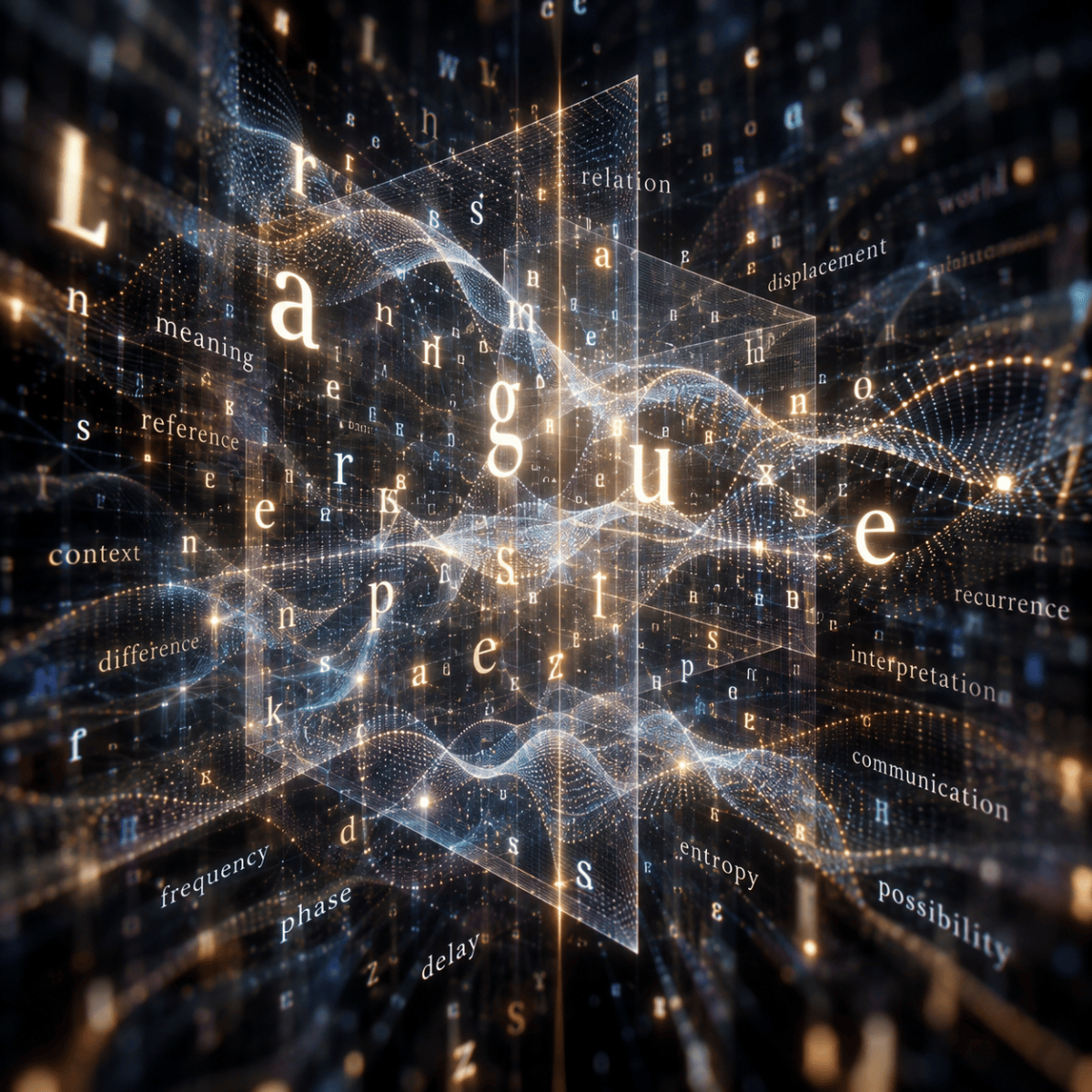
Language is constituted by displacement, difference, deferral and diffusion: every word acquires meaning only through its shifting relations with other words, contexts, speakers and moments of use. No word is what it is by itself. Reference is distributed across an immense relational field in which every distinction depends upon others that are themselves similarly displaced. Meaning persists because these displacements remain sufficiently constrained to recur. Semantics is not carried intact from one point to another. It is continuously reconstructed across the ensemble.
This is also where misunderstanding comes from. A signal produced here is reconstructed there, later, within a different relational state and among a different set of possibilities. That difference is not an unfortunate defect in language. It is constitutive of communication. Entropy belongs here in the practical sense of degrees of freedom: the statistical and combinatorial mass of possible relations, interpretations and continuations available at any moment. Every utterance enters a field of possibilities larger than itself, and communication consists in constraining that field without ever reducing it to one perfectly determined state.
Recurrence gives this otherwise enormous space of possibilities structure. What recurs acquires frequency; recurrence across intervals establishes rhythm; rhythm establishes relative phase. Language consequently possesses a spectral structure long before anyone decides to analyse it spectrally. Words, phrases, distinctions, narratives and entire systems of belief recur at different rates and across different timescales, reinforcing, interfering with and displacing one another. Meaning both emerges from this history of recurrence and changes what becomes likely to recur next. Semantics follows frequency, but frequency is itself continually reorganised by semantics. Language is not merely transmitted through time. Its temporal relations are part of what language is.
Within the larger phase dynamics, displacement is delay. Communication requires difference to propagate, and propagation places every reconstruction at an offset from what produced it. Language holds together by binding across those offsets, not by eliminating them. Its complexity is possible because reference can be deferred across words, speakers, contexts, generations and cultures while recurrent relations continue to constrain what may intelligibly follow. The remarkable thing is not that language sometimes fails. Given the combinatorial space through which it moves, the remarkable thing is that this vast distributed structure holds together at all. It does so because the delays remain related: meaning persists even though every act of communication shifts it slightly.
Categories
The Essence of Language
Language, like all communication systems, holds together not despite displacement, delay and uncertainty, but because of them.