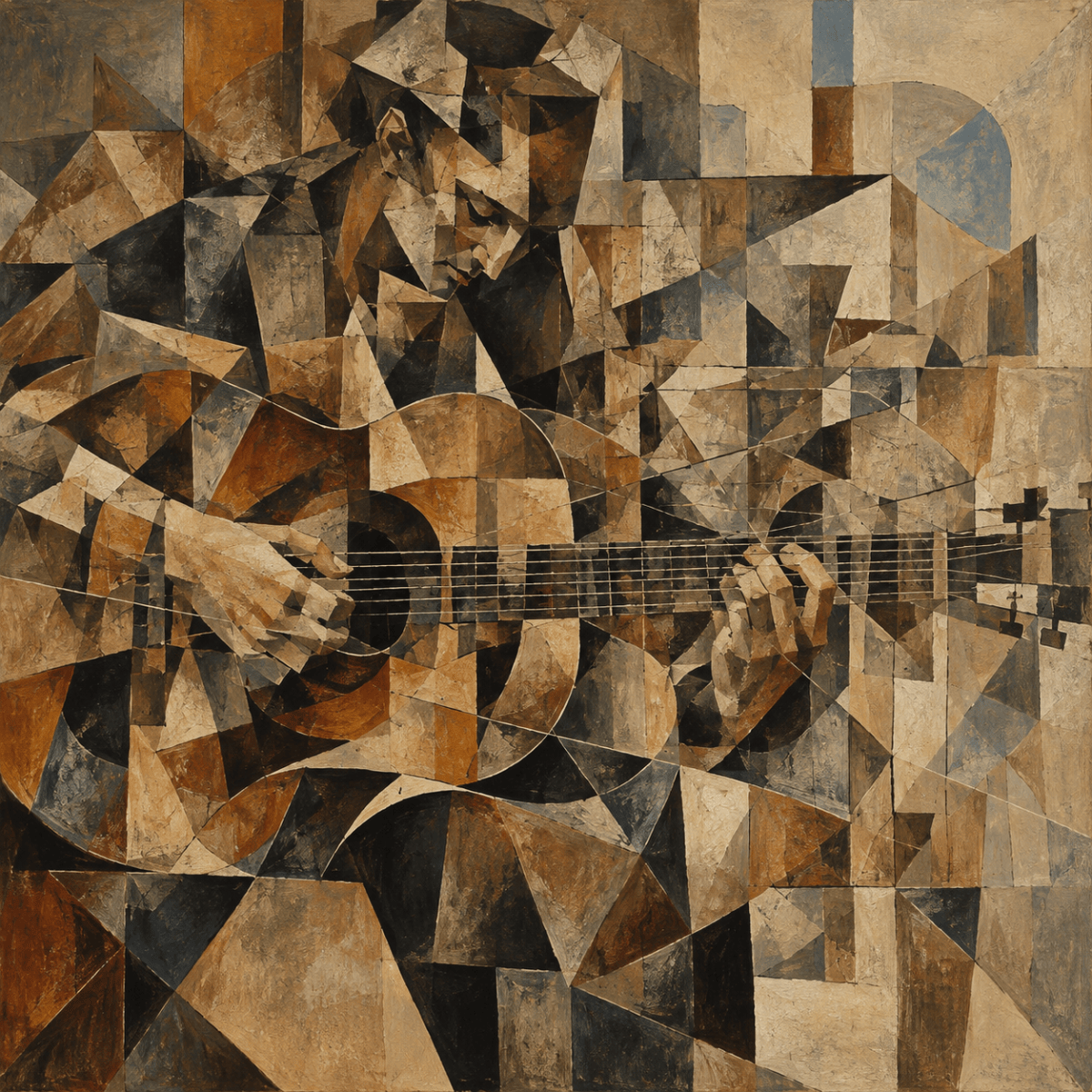
A song is never played for the first time. Even when someone has just written it, their hands arrive carrying other hands. Their ear is crowded with intervals, cadences, rhythms, mistakes, expectations, half-remembered choruses and things heard once through a wall thirty years ago. Folk music merely makes this difficult to conceal. A tune passes from one person to another, changes key because somebody cannot sing that high, loses a verse because somebody forgets it, acquires another because somebody doesn’t, crosses an ocean, changes instruments and eventually returns home claiming to be traditional. Culture has always had a fairly relaxed attitude towards version control.
What persists through all this is not an acoustic object. It is a set of relations sufficiently stable to remain recognisable while almost everything carrying them changes. The notes are different events. The voices are different bodies. The listeners bring different histories. Even the meaning of the words can wander while the song survives. Meaning does not sit inside the lyric waiting to be unpacked any more than music sits inside an individual note. Both emerge through relations among what has happened, what is happening and what has become likely to happen next. Hear enough blues and a particular interval arrives already carrying a history. Hear enough punk and three chords can arrive with an argument attached. By then you are not simply hearing the music. The music has helped teach you how to hear it. Recurrence does not merely repeat culture. It progressively constructs the conditions under which culture becomes intelligible.
All speech is song. Before a sentence means anything in the narrow semantic sense, it already has pitch, rhythm, stress, tempo, pause, recurrence, anticipation, timbre and cadence. Change those relations and the same words can become reassurance, accusation, seduction, boredom, irony or threat. Written punctuation is partly an impoverished attempt to put some of that music back onto the page. Conversation makes the structure clearer. People entrain to one another, interrupt, hesitate, accelerate, repeat phrases and leave spaces into which another voice can enter. Crowds find choruses. Arguments acquire refrains. Jokes depend upon timing and delayed resolution. Advertising manufactures hooks. Prayer, chant, nursery rhyme, protest, poetry and rap merely make explicit what ordinary speech never stopped doing. Beneath the propositions and definitions, people are still making patterned noises at one another and discovering, remarkably often, that the pattern matters as much as the words.
This is where music and language reveal much the same peculiar machinery. Difference is necessary to both, but difference alone produces neither meaning nor music. Timing matters. Sequence matters. Delay matters. Silence matters. A note held fractionally longer can transform a phrase; a word arriving after a pause can transform a sentence. Once you expect the beat, silence is no longer nothing. You hear what did not happen. The missing beat can organise the beats around it, just as the unspoken word can organise a conversation. Harmony itself depends upon frequencies remaining different while entering consequential relation, and rhythm depends upon events not occurring simultaneously. Communication does not require everyone to occupy the same position, interpretation or phase. Often it persists precisely because they do not. Complete synchronisation would be less like communication than everybody shouting the same syllable forever, which admittedly describes parts of the internet rather well.
And harmonic does not mean harmonious. Dissonance belongs to harmonic structure. So do syncopation, interruption, phase displacement, noise and unresolved tension. Punk can organise itself around resistance; jazz around displacement; comedy can hold an expectation until exactly the wrong moment; horror can make an expected event unbearable simply by delaying it. Opposition can couple people as strongly as agreement. A culture does not require everybody to sing the same song. It requires enough relational continuity for different songs to remain consequential to one another. Harmony without difference would not be harmony at all. It would be one note, indefinitely sustained, which is less a civilisation than a malfunctioning smoke alarm.
Folk traditions make the role of imperfect transmission especially clear. A song remembered incorrectly has not necessarily failed to communicate. Mishearing, forgetting, accent, reinterpretation and improvisation introduce variation through which the pattern can enter another context and persist there. The listener is not outside this process. Every remembered chorus, anticipated rhyme and recognised rhythm changes what the next sound can mean. Expressions survive for much the same reason: different people can use them without possessing identical meanings, and ambiguity leaves enough room for different histories to remain in relation. Perfect specification would close many of those pathways. Complete indeterminacy would leave nothing recognisable to recur. Somewhere between them sits the productive mess in which songs, jokes, slang, stories, dances, fashions and entire cultures reproduce themselves. The copy is never quite the original, which is fortunate because there was never quite an original to begin with.
Once this becomes visible, popular culture starts looking considerably larger than a collection of things people happen to like. Fashion reprises forms. Film genres establish expectations so individual films can satisfy, violate or displace them. Memes persist through recognisable variation. Architecture establishes visual rhythm. Ritual coordinates bodies through recurrence. Dance turns mutual prediction into movement. A city contains interacting frequencies: commuting, meals, work, sleep, nightlife, seasons, ceremonies, construction and decay. These patterns overlap without sharing a single clock. They entrain, interfere, amplify, disappear and return. Popular culture begins to look less like a warehouse of cultural objects than a field of rhythms continually remembering and differentiating itself.
Popular culture scales this process and then, being human, discovers that it can be monetised. Folk enters blues, blues enters rock, gospel enters soul, Jamaican ska and reggae collide with punk, disco disappears beneath the floorboards and returns through house, hip-hop turns quotation itself into an instrument, and pop cheerfully eats whatever remains unattended. These are not sealed genres passing discrete packages between one another. They are overlapping histories: borrowing, resisting, synchronising, fragmenting and recombining. Commerce adds leverage by concentrating recurrence. Radio once did it, record companies did it, television did it, and platforms now do it with machinery capable of measuring the recurrence while producing more of it. A hook heard once is a sound. Heard again, it becomes familiar. Familiarity changes attention. Attention changes what gets selected. Selection changes what gets produced. What gets produced changes what becomes familiar. Eventually the industry announces that it has discovered what everybody likes, having spent considerable money arranging what everybody keeps hearing.
Cognition is already inside this process. We recognise because something returns differently. We anticipate because previous recurrence has altered what we expect to happen next. A sentence becomes intelligible while it is still arriving because its beginning has already constrained its possible endings. A melody does almost exactly the same thing, only with fewer opportunities to pretend that something more respectable is occurring. Memory is not merely retrieval from storage. What has happened has changed the listener, and the changed listener changes what the next event can become. Pattern produces expectation; expectation reorganises perception; perception contributes to the next pattern. The relation folds back through itself. Music provides such a clean entrance into this larger structure because it lets us experience memory, prediction, difference, absence and recurrence before giving any of them names.
And now you are expecting this to resolve. Everything preceding this sentence has helped produce that expectation. That is the trick, although it is hardly a trick at all. Culture remembers by altering what becomes possible next. Sound becomes memory; memory changes expectation; expectation changes what is heard; what is heard changes what will subsequently be remembered. Meaning follows recurrence and then turns around and helps organise recurrence itself. The song returns differently because the world into which it returns has been partly changed by its previous appearances. So has the listener. We expect the final note because we have been taught to expect it. Sometimes it arrives. Sometimes something else does, and suddenly everything leading towards it sounds slightly different. Speech does this. Stories do it. Images do it. Cultures do it. Thought does it. The song has not failed to resolve. It has left you somewhere from which another song can begin.
Categories
The Song Remembers: Music, Language and Harmonic Structure
We do not simply hear songs, speech and culture. Their repetition teaches us how to hear what comes next, while every new encounter quietly changes the pattern that taught us.