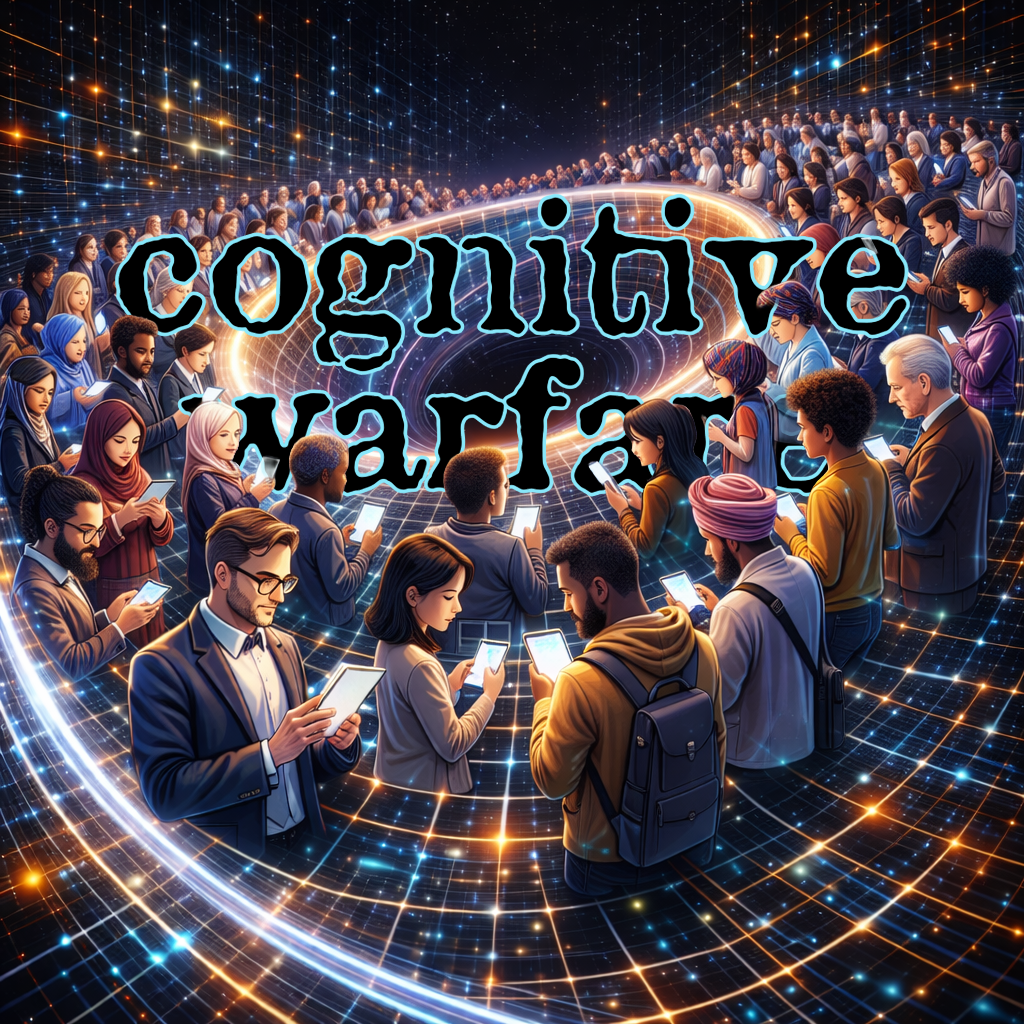
A cognitive war is not simply about what you think. It is a war over how you think, because once the structure, code, and cadence of thought, of language, of behaviour are altered, the content becomes easy to steer.
Some of these biases are ancient, natural, even necessary: shortcuts of perception, habits of inferential prediction, emotional priors, social mirroring, threat sensitivity, status seeking, and the drive to compress complexity into story. These tendencies define the forms and patterns, the methods, logics, and rationales through which thinking unfolds. Shape those conditions, and belief follows. Control the process, and the conclusions arrive on schedule. Most of the time, this happens quietly, beneath awareness, embedded in everyday life.
Many of the categories through which people understand themselves, their emotional affiliations, group identities, and social roles, are shaped by commerce and material organisation. This logic long predates modern institutions and the corporate forms that now dominate them. Control is most easily achieved not through force, but by generating the behavioural and cognitive patterns through which people regulate themselves. This is not inherently malign. Self-regulation is a condition of life.
But what is new is the scale, depth, precision, and speed with which this process is now technologically mediated. Social media made this visible. Artificial intelligence completes the loop.
It is not intelligence, not experience, not consciousness, but a system of statistical inference and instrumental optimisation. Yet cognitive capture is real. People are taught what cleverness now looks like, how to think, how to reason, how to produce, and they adapt in order to survive. For most, this does not feel like coercion. It feels like necessity.
Participation requires compliant self-regulation. Every society, institution, and group imposes grammars of thought. The difference now is the degree of that shaping. It operates at planetary scale, through computational systems. This is not primarily about controlling opinions. It is about shaping the axioms of belief and behaviour beneath them. Once the way someone thinks is modulated, what they think becomes trivial to manage.
That is the condition we are entering, ancient in form, unprecedented in scale.
Categories
Inside the Cognitive War
 Daedelus Kite
One reply on “Inside the Cognitive War”
No, it won’t all be “over by Christmas.” This isn’t a campaign, it’s a condition. The shaping of how people think, rather than what they think, long predates social media, artificial intelligence, or any of our current machinery. The field in which it happens is largely emergent and autonomous, regenerating itself through complex social, economic, and technological dynamics that none of us individually control. Commerce can harness it, power can steer it, but neither creates it; in the same way that language grows out of the world and is contained by it, this pattern does not belong to us so much as we belong to it. These dynamics arise from how complex systems organise, adapt, and propagate themselves across time. If we can learn to recognise that structure, rather than just reacting to its surface effects, we might move through it with less panic, less friction, and less catastrophic overshoot. Not mastery. Not escape. Just better navigation.
LikeLike