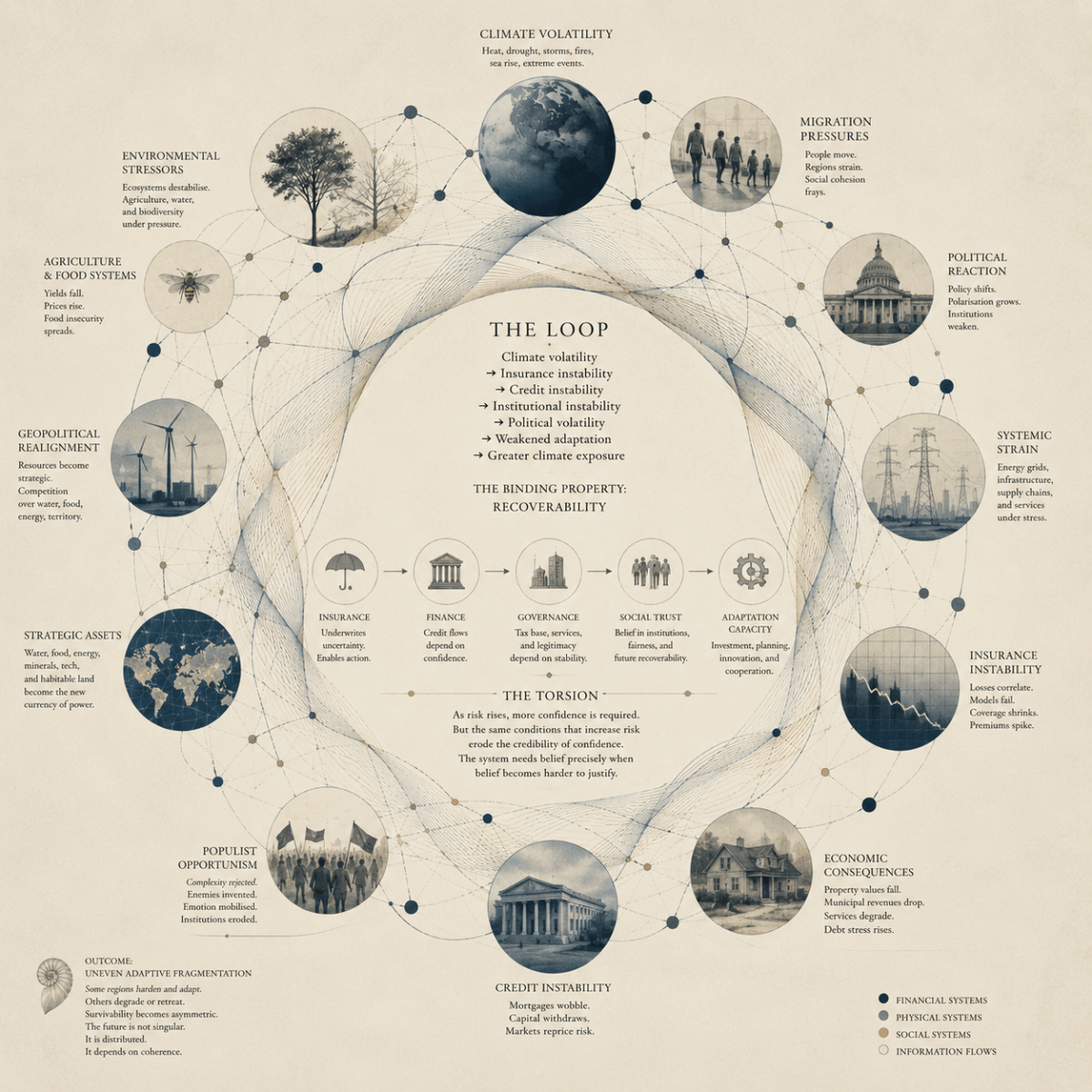
Climate change becomes civilisational risk when insurance can no longer translate catastrophe into recoverable cost.
Categories
insurance industry: climate, consequence, catastrophe
- Post author By G
- Post date May 28, 2026
- No Comments on insurance industry: climate, consequence, catastrophe
- Tags actuarial collapse, adaptive fragmentation, anthropocene, authoritarianism, cascading crises, cascading failure, catastrophe theory, civilisation under stress, civilisational risk, climate adaptation, climate anxiety, climate change, climate collapse, climate crisis, climate economics, climate futures, climate migration, climate volatility, communicative systems, complex adaptive systems, complexity theory, coordinated failure, coupled systems, crisis of modernity, dark future, democratic decline, disaster capitalism, ecological collapse, ecological systems, economic collapse, economic instability, energy crisis, entropy, environmental politics, existential risk, field logic, financial contagion, financial instability, food security, future cities, future of civilisation, future shock, geopolitical instability, geopolitical risk, geostrategy, global governance, global instability, Global Systems, global warming, housing market crash, human survivability, infrastructure failure, infrastructure resilience, institutional collapse, institutional trust, insurance crisis, insurance markets, insurance withdrawal, interconnected systems, managed retreat, metacrisis, mortgage crisis, network collapse, planetary instability, planetary risk, planetary systems, political extremism, political volatility, polycrisis, populism, recursive instability, recursive systems, reinsurance crisis, resilience, risk propagation, risk society, social cohesion, social fragmentation, social trust, societal collapse, societal resilience, strategic complexity, strategic resilience, supply chain disruption, survival politics, systemic risk, systemic-fragility, systems theory, thermal inequality, thermodynamic stress, twenty first century crisis, uncertainty, urban collapse, water security