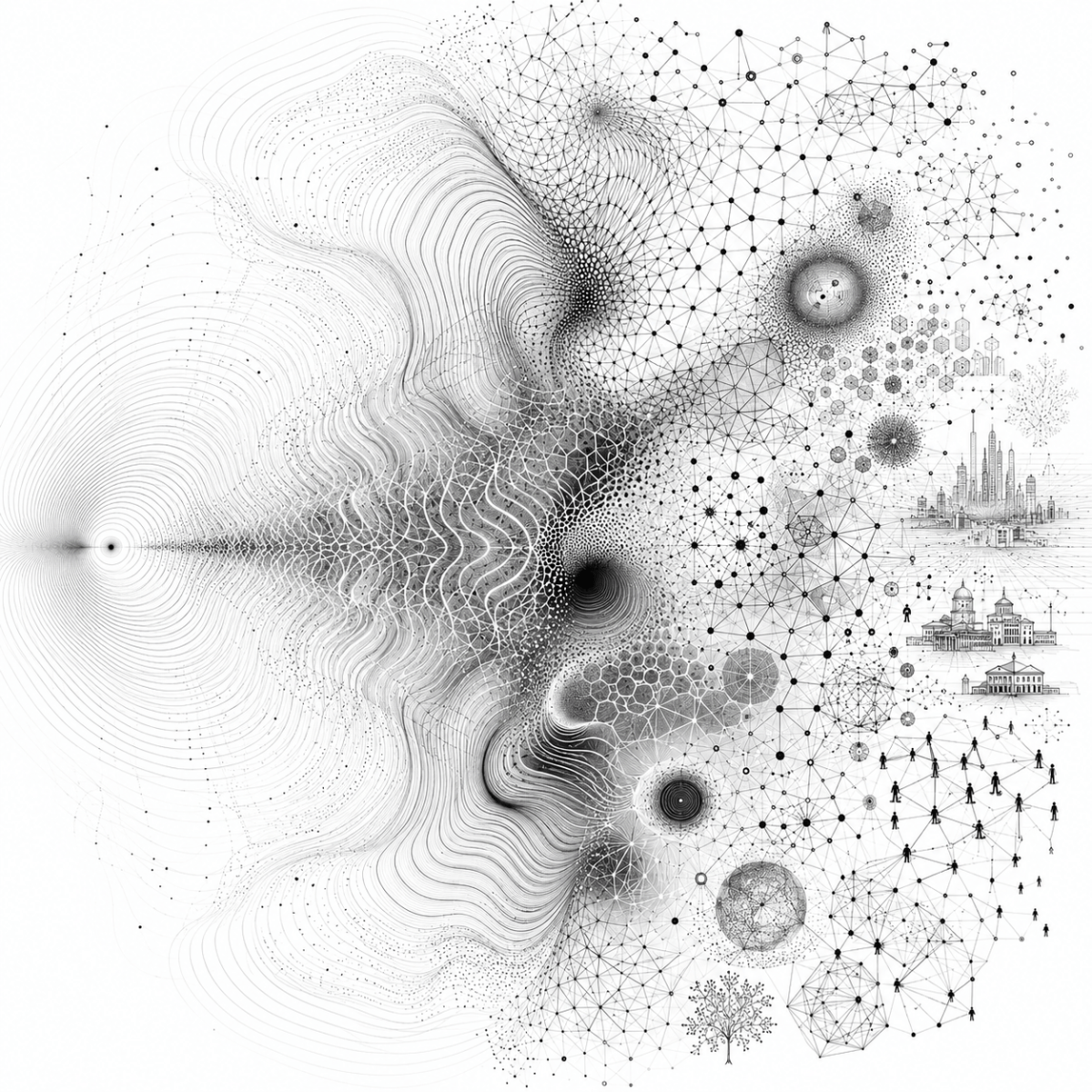
Communication is not primarily a contest between truth and falsehood. It unfolds within a field of conditioned probabilities, where every act of communication slightly reshapes the conditions under which future communication occurs. As patterns recur, the field acquires an irreducible probabilistic bias. Some interpretations, associations, and communicative trajectories become easier to activate than others. This accumulated asymmetry may be understood as semantic gravity: not a force acting upon communication, but an emergent tendency arising from the history of the field itself.
No communicative act begins from nothing. Every word, image, gesture, symbol, rhythm, narrative, and emotional cue enters a field already conditioned by innumerable previous interactions. These forms do not possess equal probabilities of persistence. Some are easier to recognise, remember, reproduce, modify, and transmit. Their continued recurrence says little about whether they are true. It says a great deal about whether they fit the organisation of the field into which they are released.
Communication is recursive rather than cumulative. Messages do not simply accumulate like books on a shelf; they continually reshape the statistical conditions under which later messages are produced, interpreted, and propagated. The field is both the product of previous communication and the medium through which future communication becomes possible. Patterned recurrence gives rise to patterned correlation, and patterned correlation gradually organises expectation, memory, interpretation, and collective behaviour. Communication remembers, even when no individual does.
Influence is best understood in this context. It is not merely persuasion exercised by a person, institution, or message. It is the capacity of a communicative form to alter the probability distribution of future communication. A phrase, image, grievance, melody, accusation, visual convention, or ritual becomes influential when it changes what later communication can easily repeat, oppose, extend, parody, reinterpret, or quietly assume. Selection dominance does not imply a deterministic evolutionary process. It simply describes the contingent tendency for some communicative structures to become temporarily more available, more repeatable, and more structurally consequential than others.
Meaning emerges from the continual conditioning of the communicative field rather than from isolated messages alone. The repeated becomes familiar, the familiar becomes intuitive, and the intuitive eventually comes to feel self-evident. Neighbouring meanings also become easier to activate, producing regions of greater semantic coherence without requiring central coordination or shared intent. Semantics can be understood not merely as the study of what symbols mean, but as our local experience of a high-dimensional probabilistic field whose organisation has been shaped by innumerable previous acts of communication.
The rapid progress of artificial intelligence has renewed interest in language while also exposing how incomplete our understanding remains. Human beings are remarkably proficient communicators, yet surprisingly poor at explaining how communication organises itself across individuals, cultures, technologies, and time. Fluency has long been mistaken for understanding. Artificial intelligence does not resolve that mistake. It makes it impossible to ignore.
This perspective stands alongside several established traditions without belonging entirely to any one of them. Ludwig Wittgenstein located meaning in use. J. R. Firth and Zellig Harris demonstrated that semantic structure is reflected in patterns of use. Claude Shannon showed that communication possesses statistical organisation independent of semantic content, while Norbert Wiener revealed the central role of feedback in organised systems. More recent work in usage-based linguistics and complex adaptive systems likewise treats language as an emergent consequence of repeated interaction. The present argument extends this vicinity by proposing that semantics, influence, conditioning, frequency, and selection are not separate phenomena but different observables of the same conditioned communicative field.
Truth remains indispensable, but truth alone does not determine propagation. Frequency biases exposure, exposure conditions expectation, and expectation shapes interpretation. Communication is not merely the transmission of meaning. It is the continual probabilistic reorganisation of the semantic field through which meaning becomes available, credible, and repeatable. Understanding communication ultimately requires more than analysing individual messages. It requires understanding the field that quietly shapes them long before anyone notices it is there.


One reply on “influence this: the probabilistic frequency structure of communication”
One observation has stayed with me from my years working in information technology. I met many highly capable professionals who were exceptionally fluent in the languages of their disciplines. They knew the vocabulary, the syntax, the conventions, the diagrams, the standards, and the procedures. They could manipulate symbols with remarkable skill, solve practical problems, and communicate effectively with their peers. Yet it was often striking how rarely anyone asked what the symbols ultimately referred to, why the abstractions had taken their particular form, or what larger structure of meaning they collectively expressed.
This is not a criticism of technical people. The same pattern appears in politics, finance, academia, law, management, and many other professions. Fluency is rewarded because fluency is useful. If one learns the idiomatic structure of a communicative domain well enough, one can participate successfully without ever developing a deep understanding of the phenomenon that domain attempts to describe. Professional competence and conceptual understanding, while related, are not the same achievement.
Artificial intelligence has exposed this distinction in an unexpected way. Large language models demonstrate extraordinary fluency while provoking continual debate about whether they genuinely understand what they produce. That debate may be asking the wrong question. Humans have long displayed a similar asymmetry. We routinely mistake fluent participation for comprehensive understanding because, in everyday life, fluency is usually sufficient.
The argument developed in this essay suggests a different way of viewing the problem. Meaning is not something hidden behind words, waiting to be retrieved, nor is it simply a property attached to individual symbols. Meaning emerges from participation in a conditioned communicative field whose organisation has been shaped by innumerable previous interactions. Idiomatic fluency is possible because people learn to navigate that field successfully. Deeper understanding comes from recognising the field itself: how it has been conditioned, how it biases future communication, and how its evolving probabilistic structure gives rise to what we experience as meaning.
Seen in this light, the distinction between fluency and understanding is less a contradiction than a difference of scale. Fluency concerns successful movement within the field. Understanding concerns the organisation of the field itself. Most professions demand the former. Far fewer encourage the latter. Yet if communication possesses the statistical structure proposed here, it is the larger organisation—not merely the symbols moving through it—that ultimately deserves our attention.
LikeLike