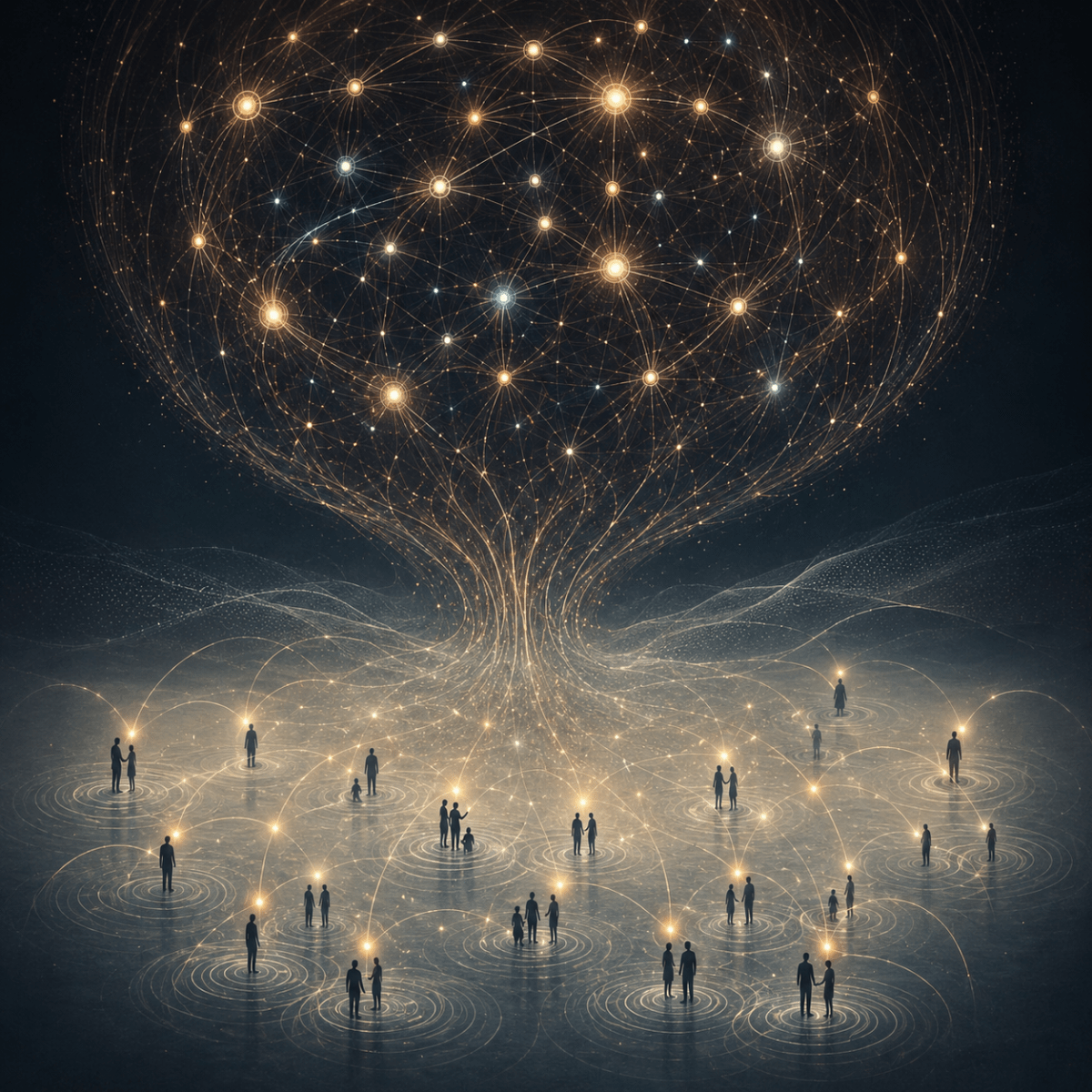
Most theories of communication begin with messages: words, signals, symbols, information.
The more interesting possibility is the reverse.
The communicative system is the persistent object. Individual communications are the transient events through which it reproduces itself. Conversations end. Messages disappear. Speakers die. Languages, institutions and cultures continue.
What matters most is not what a message contains, but how it changes what can happen next. Communication alters expectation, memory, recognition and response. Its larger effect is to reshape the conditions under which further communication occurs.
The same principle appears throughout the physical world. Independent processes rarely remain independent for long. As they repeatedly interact, each begins to influence the behaviour of the others. Over time, stable patterns emerge that no longer depend on any single event, but on the continuing interaction among them. Those patterns persist because each interaction helps recreate the conditions required for the next. Music makes this audible. Communication does the same across language, memory, culture and meaning.
Meaning is not contained inside symbols. It emerges from the larger organisation in which symbols become possible.
Communicating systems reproduce more than messages. They reproduce the conditions of communication itself.
Messages are local events. The system is what persists.
Categories
harmonic communication
Communication persists not by preserving messages, but because each exchange reshapes the system that makes further exchange possible.