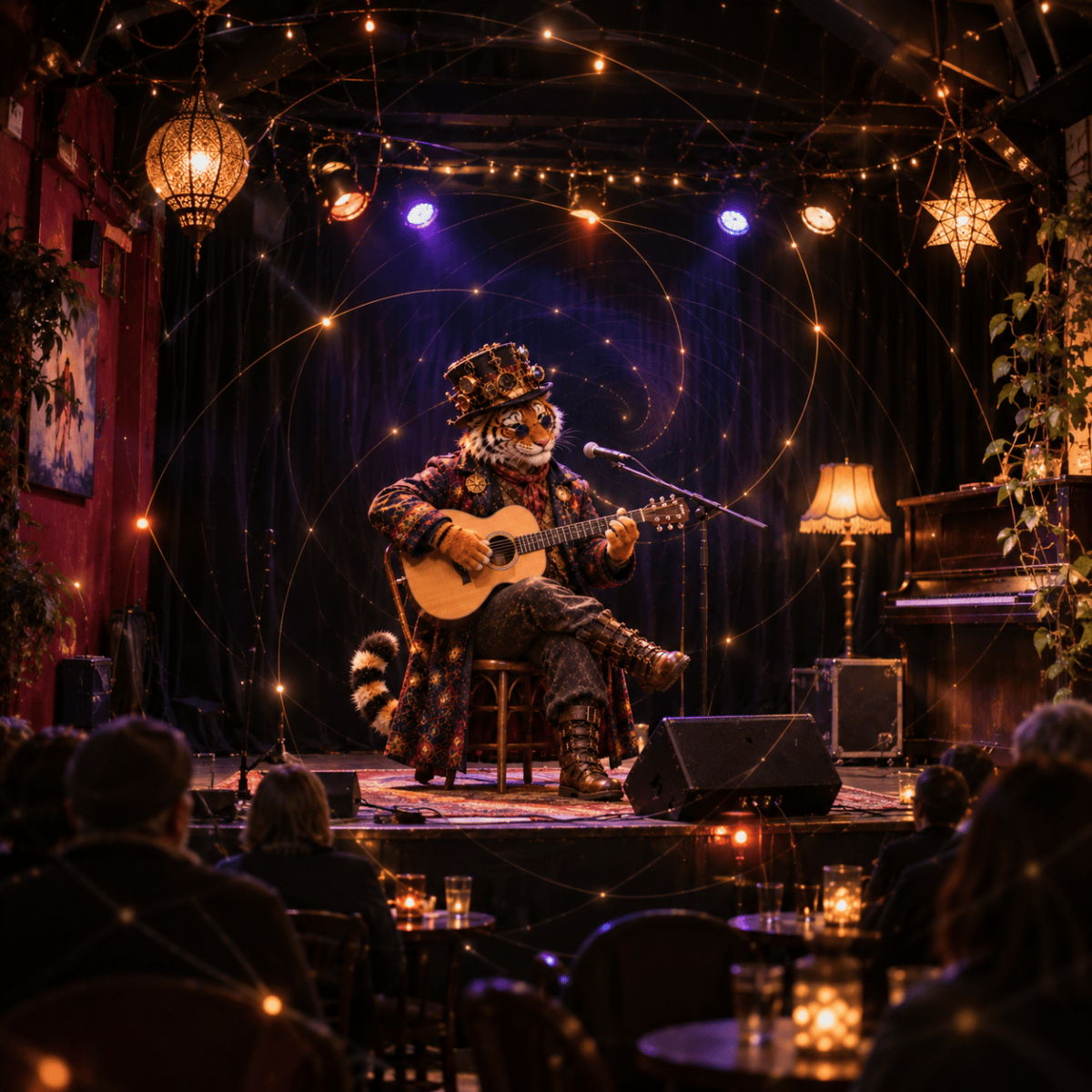
A piece of music is never played for the first time. Even when someone has just written it, their hands arrive carrying other hands. Their ears are crowded with melodies, rhythms, mistakes, expectations, half-remembered choruses and things heard once through a wall thirty years ago. A guitarist strikes a string, a singer takes a breath, somebody finds a rhythm, and something happens that belongs to the moment while carrying an inheritance extending far beyond it. Folk music makes this difficult to conceal. A tune changes key because somebody cannot sing that high, loses a verse because somebody forgets it, acquires another because somebody doesn’t, crosses an ocean and eventually returns home claiming to be traditional. Culture has always had a fairly relaxed attitude towards version control.
What survives is not necessarily a particular sequence of sounds, but relationships sufficiently stable to remain recognisable while almost everything carrying them changes. Notes are different events, voices belong to different bodies, and listeners bring different histories. Poetry, conversation, storytelling and music participate in the same extraordinary business of making differences consequential through time. Familiarity changes expectation; expectation changes perception; perception changes what happens next. The music teaches us how to listen to the music. Language does much the same thing, although we have developed elaborate institutions devoted to pretending that words are somehow more respectable than noises.
All speech is song, even when nobody particularly wants to hear it. Before a sentence means anything in the narrow semantic sense, it already has pitch, rhythm, stress, tempo, pause and cadence. Change those relationships and the same words become reassurance, accusation, seduction, irony or threat. People adjust their rhythms through interaction, interrupting, hesitating, accelerating and leaving spaces into which another voice can enter. Crowds find choruses. Arguments acquire refrains. Jokes depend upon timing. Advertising manufactures hooks. Prayer, poetry, protest and rap make conspicuous what ordinary speech never stopped doing. Meaning emerges through the relationships by which an event becomes intelligible.
Timing matters. Delay matters. Silence matters. A note held fractionally longer can transform a phrase; a word arriving after a pause can transform a sentence. Once you expect the beat, silence is no longer nothing. You hear what did not happen. Dissonance, syncopation, interruption and unresolved tension are not departures from music. They help give it shape, changing what we hear, what we expect and what becomes possible next. A guitarist bending a note, a poet withholding a word and a speaker pausing before an answer are negotiating differences in time. Complete synchronisation would be less like communication than everybody shouting the same syllable forever, which admittedly describes parts of the internet rather well.
Folk traditions reveal something important about imperfect transmission. A tune remembered incorrectly has not necessarily failed to communicate. Mishearing, forgetting, accent and improvisation introduce variation through which a pattern can enter another context and persist there. Perfect reproduction preserves a particular performance, but perfect reproduction is not how living traditions survive. Complete indeterminacy, meanwhile, leaves nothing recognisable to recur. Between these extremes sits the productive mess in which music, stories and cultures reproduce themselves. Each performance inherits conditions established by previous performances while changing what subsequent performances can become. The process folds back through itself. There was never quite an original to begin with.
Probability enters without anybody having to calculate it. A familiar melody makes some notes more likely than others, just as the beginning of a sentence makes some endings more likely. Not because the future has been decided, but because previous relationships have changed what can follow. Repeated interactions produce statistical regularities; some disappear, while others persist and influence subsequent events. Collective properties emerge that cannot be attributed to any individual participant. No musician needs to understand probability theory to participate in it. Most would probably prefer that the mathematics remain somewhere behind the amplifiers.
Across generations and continents, these relationships acquire a topology: an organisation of connections, separations and transformations. A melody can be transposed, ornamented or compressed while remaining recognisable. A story changes characters, locations and language while retaining its identity. Frequencies, rhythms, delays and phase differences provide measurable expressions of harmonic organisation, but no single expression exhausts the relationships from which it arises. A performance is audible; its history is not. What we hear is one manifestation of a larger relational structure, a momentary cross-section of relationships extending beyond the immediate event. Identity is provisional; continuity is real.
The universe has a rather extravagant disregard for our preferred units of measurement. Gravity alters the passage of time, molecules dance to their own rhythms, neurons oscillate, hearts beat, bodies move, and somewhere a guitarist bends a string just far enough to make somebody cry. These processes occupy wildly different scales, but none exists outside the relational organisation of the world. What matters is how differences propagate, resonate, amplify, dissipate or alter the possibilities of everything connected to them. Oscillating systems – processes that repeat in cycles – influence one another through coupling, becoming mutually dependent. Sometimes they synchronise; sometimes they resist; sometimes they form complex arrangements of partial order and disorder. Frequency, phase, delay and connectivity shape what becomes possible. Control remains provisional. The score may be written, the instruments tuned, but the music has other ideas.
Popular culture scales these processes and then, being human, discovers that they can be monetised. Folk enters blues, blues enters rock, gospel enters soul, reggae encounters punk, disco returns through house, hip-hop turns quotation into an instrument, and pop cheerfully eats whatever remains unattended. These are overlapping histories of borrowing, resisting, synchronising and recombining. Commerce concentrates recurrence. Radio, record companies, television and digital platforms influence what becomes familiar; familiarity influences attention; attention influences production. Eventually the industry announces that it has discovered what everybody likes, having spent considerable money arranging what everybody keeps hearing.
Yet culture is never one rhythm or one direction of travel. Communities occupy different phases of collective activity. Some move together; others maintain independent rhythms, resist dominant forms or discover possibilities between them. Synchronised and unsynchronised populations can coexist within connected systems, a phenomenon described mathematically through chimera states. Popular culture exhibits a comparable multiplicity: dominant movements, local traditions, independent scenes and unexpected combinations. What appears from a distance to be a single cultural movement is an intricate negotiation of different rhythms. Diversity is not an imperfection awaiting correction.
Contemporary communication platforms intensify these dynamics. Algorithms organise attention through exposure, recommendation, imitation and statistical prediction. A phrase becomes a meme, a rhythm becomes a trend, and a temporary collective response acquires the appearance of an enduring social reality. Repetition can establish familiarity without understanding, authority without competence and agreement without meaningful communication. Yet these same processes sustain neglected traditions, connect isolated communities and generate expressions no central authority could have designed. Technology does not stand outside culture directing its movement. It changes the conditions under which culture reproduces itself. The platform is part of the performance, whether its owners appreciate the implications or not.
These relationships also illuminate why human civilisation can become such a spectacular mess. Institutions, communities and technologies inherit patterns that once supported their survival, then reproduce them long after circumstances have changed. Familiarity becomes authority, repetition becomes legitimacy, and resistance to difference masquerades as stability. Systems attempt to preserve themselves through transformations they barely understand. The resulting delays can amplify misunderstanding and conflict, particularly when everyone insists that their particular rhythm is the only sensible one. Yet delay is not simply failure. It is part of the temporal organisation through which systems adapt, diverge and discover new possibilities. A community incapable of accommodating difference eventually finds itself arguing with its own future.
There is something hopeful in this, particularly for anyone who has spent time outside a community they once belonged to. Returning is not a matter of recovering an earlier position, as though the intervening years had been an unfortunate clerical error. The person has changed, the community has changed, and the relationships through which they might meet again have changed. Distance, interruption and hardship alter perception. They can close possibilities, but also disclose others previously unavailable. A musician returning after years away may no longer play, listen or understand the world in quite the same way. That difference is not necessarily a deficiency to be corrected. It may be precisely what allows something new to happen. Nobody needs to suffer for art, despite the entertainment industry’s occasional enthusiasm for the arrangement. But neither must every interruption be treated as the end of the music.
Cognition participates in the same process. We recognise because something returns differently. We anticipate because previous recurrence has changed what we expect. A sentence becomes intelligible while it is still arriving because its beginning has constrained its possible endings. Poetry exploits this through rhythm, ambiguity and surprise. Memory is not merely retrieval from storage. What has happened has changed the listener, and the changed listener changes what the next event can become. Meaning develops through recurrence, difference, expectation and transformation. Too little stability and communication dissolves into noise. Too much rigidity and it loses its capacity to accommodate difference. Language, music and culture persist through the negotiation of both.
Music makes audible something fundamental about the organisation of the world. Its identity is provisional, its continuity real, and its possibilities arise through relationships that cannot be exhausted by any single performance. The same relationships that make conflict possible also make adaptation, creativity, reconciliation and community possible. We do not have to become alike to make something together. Nor must we recover an earlier world before we can participate in the one emerging around us. Hope is not the expectation that things will return to what they were. It is the recognition that change leaves possibilities open.
And now you are expecting this to resolve. Everything preceding this sentence has helped produce that expectation. We began with a piece of music, a sonic event carrying relationships already in motion. Along the way, it opened onto language, probability, topology, culture and the peculiar difficulties of living together. Yet none of these has taken us away from the original event. Somewhere, someone forgets a verse, invents another, bends a note or pauses where nobody expected silence. Someone returns after years away, carrying a different life into an unfamiliar room, and discovers that the music has room for them after all. Something survives, not despite the difference, but through it. Sometimes the expected final note arrives. Sometimes something else does, and suddenly everything leading towards it sounds different. The performance has not failed to resolve. It has left us somewhere from which another can begin.
Key Takeaways
- Music, language and culture develop through recurrence, difference and mutual influence.
- Rhythm, timing, silence and expectation participate in the production of meaning.
- Identity is provisional, sustained through relationships rather than fixed boundaries.
- Fractal recursivity is the same relational logic repeating within itself, across scales and through time.
- There is no outside: displacement, delay, opposition and transformation remain internal to the relational whole.
- Continuity emerges through change, preserving possibilities for adaptation, creativity and community.
Appendix: Fractal Recursivity in Music and Culture
Fractal recursivity describes how culture continually reproduces and transforms itself through its own activity. Language, music, customs, beliefs and traditions are inherited from earlier cultural activity, but every use changes the conditions under which they will be used again. Culture is not something separate from the people participating in it. People produce culture through practices they have themselves learned from culture. The process repeats within itself, without requiring an external organiser.
It is fractal because the same process occurs throughout cultural organisation, from a single musical phrase or spoken expression to entire traditions and civilisations. It is recursive because the products of cultural activity become inputs to subsequent activity. A musician learns a tradition, interprets it, changes it through performance, and contributes to what others subsequently learn. A language shapes how people express themselves, while their expressions continually reshape the language. The process does not simply repeat a pattern; it repeatedly modifies the conditions of its own repetition.
Music makes this particularly apparent. Rhythm establishes expectations, melodies develop through remembered intervals, and harmonies acquire meaning through what has already been heard. Repetition introduces variation; variation changes expectation; expectation changes how subsequent repetition is experienced. Silence, delay, displacement and dissonance are as consequential as the notes themselves. The same recursive processes operate through stories, social conventions, collective memory and cultural identity.
Culture has no independent position outside its own history from which it can be permanently directed. Even attempts to preserve, regulate or reject a tradition become part of its subsequent development. What persists is neither an unchanged pattern nor a fixed identity, but an ongoing process in which inherited organisation generates new organisation. Fractal recursivity is how culture remembers, reproduces and transforms itself through the very activity of being culture.
References and Associated Reading
Abrams, D.M. and Strogatz, S.H. (2004) ‘Chimera states for coupled oscillators’, Physical Review Letters, 93(17), 174102. https://doi.org/10.1103/PhysRevLett.93.174102
Hofstadter, D.R. (1979) Gödel, Escher, Bach: An Eternal Golden Braid. New York: Basic Books.
Khintchine, A. (1934) ‘Korrelationstheorie der stationären stochastischen Prozesse’, Mathematische Annalen, 109, pp. 604–615. https://doi.org/10.1007/BF01449156
Kuramoto, Y. (1984) Chemical Oscillations, Waves, and Turbulence. Berlin: Springer. https://doi.org/10.1007/978-3-642-69689-3
Strogatz, S.H. (2003) Sync: The Emerging Science of Spontaneous Order. New York: Hyperion.
Wiener, N. (1930) ‘Generalized harmonic analysis’, Acta Mathematica, 55, pp. 117–258. https://doi.org/10.1007/BF02546511

