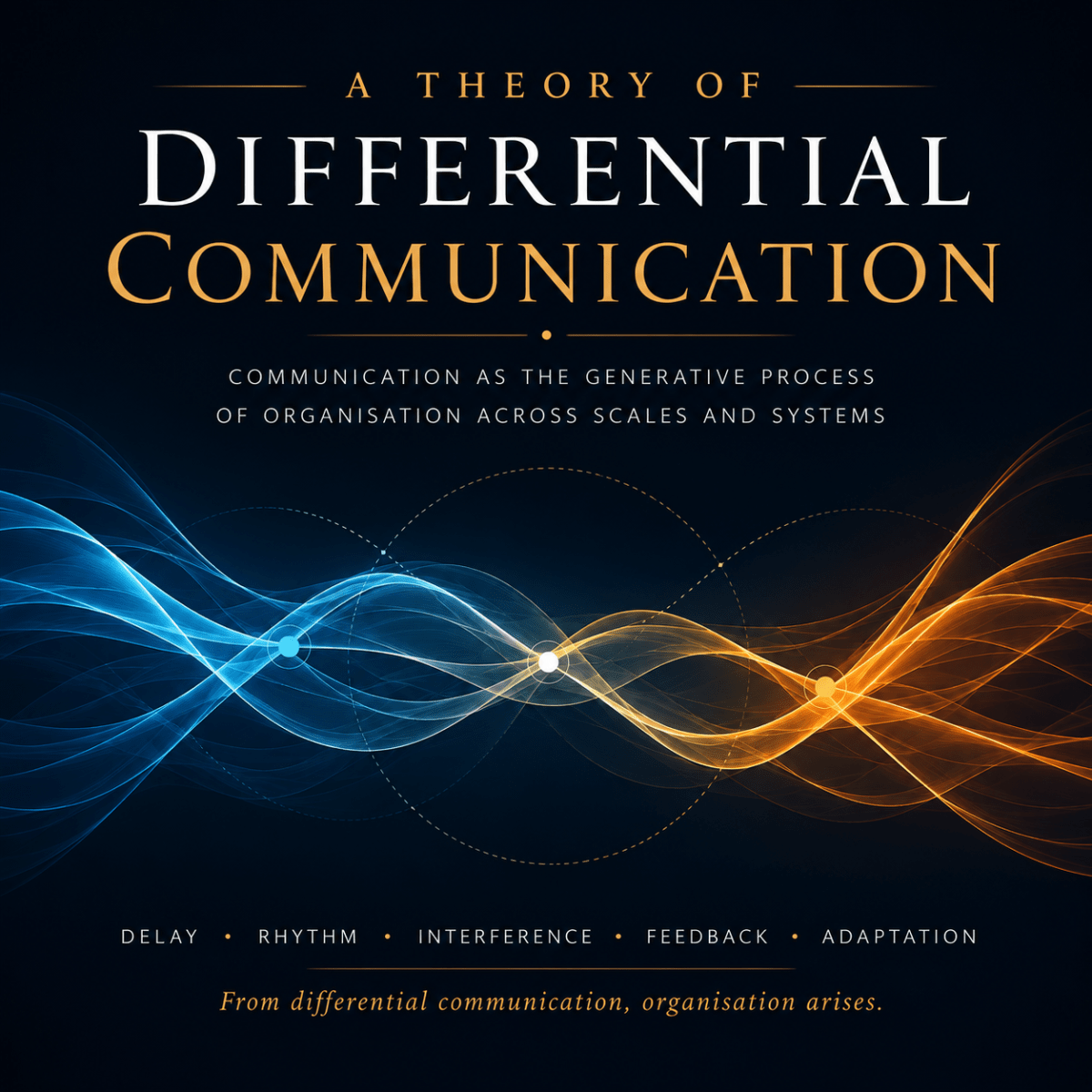
This work proposes a theory of differential communication in which communication is understood as the fundamental process through which organised systems emerge, persist, adapt, and transform. The theory begins from the observation that every organised system exists within a continually evolving field of interacting processes, each operating according to its own dynamics and timescale. Communication is consequently treated not as the exchange of fixed meanings between fixed entities, but as the continual modulation of relationships through timing, delay, persistence, attenuation, amplification, interference, feedback, and response. Organisation is understood as an emergent consequence of these differential interactions rather than a precondition for them.
Within this framework, communication resembles the propagation and interaction of waves through a shared medium more closely than the transfer of discrete objects between isolated agents. Communicative processes reinforce, cancel, distort, resonate, and reorganise one another according to their relative timing and structure. Information therefore emerges from distributed patterns of interaction rather than from individual messages considered in isolation. Stability is not a permanent property of organised systems but a continuously renewed achievement arising from coherent patterns of differential communication maintained across many interacting processes.
The same principles apply across scales. Biological organisms, nervous systems, ecosystems, markets, governments, technologies, scientific communities, and cultures all depend upon the continual coordination of processes evolving at different rates. Their apparent persistence reflects dynamic equilibrium rather than static structure. As delays accumulate, interfaces change, rhythms drift, or patterns of interference reorganise, these systems adapt, fragment, merge, or dissolve. The theory therefore offers a common framework for understanding organisation without requiring separate explanatory principles for different domains.
Inference occupies the same communicative landscape. No organised system encounters the world directly; every observation is mediated by propagation, delay, filtering, prior organisation, and interaction with countless concurrent processes. Interpretation, prediction, and decision-making therefore emerge from the continual regulation of differential relationships rather than the passive reception of information. Meaning, knowledge, identity, governance, and institutions are understood as relatively persistent organisational patterns arising within this broader communicative field. They endure only while the differential dynamics capable of reproducing them remain sufficiently coherent.
The central implication is that communication is not a specialised activity performed by organised systems. It is the generative process through which organisation itself becomes possible. By treating differential communication as the common substrate underlying physical, biological, technological, and social organisation, the theory seeks to provide a unified framework for understanding persistence, adaptation, complexity, and change without privileging any particular medium, discipline, or scale of analysis.
Categories
a theory of differential communication
Communication does not move through organised systems; organised systems emerge from the interference patterns of communication.