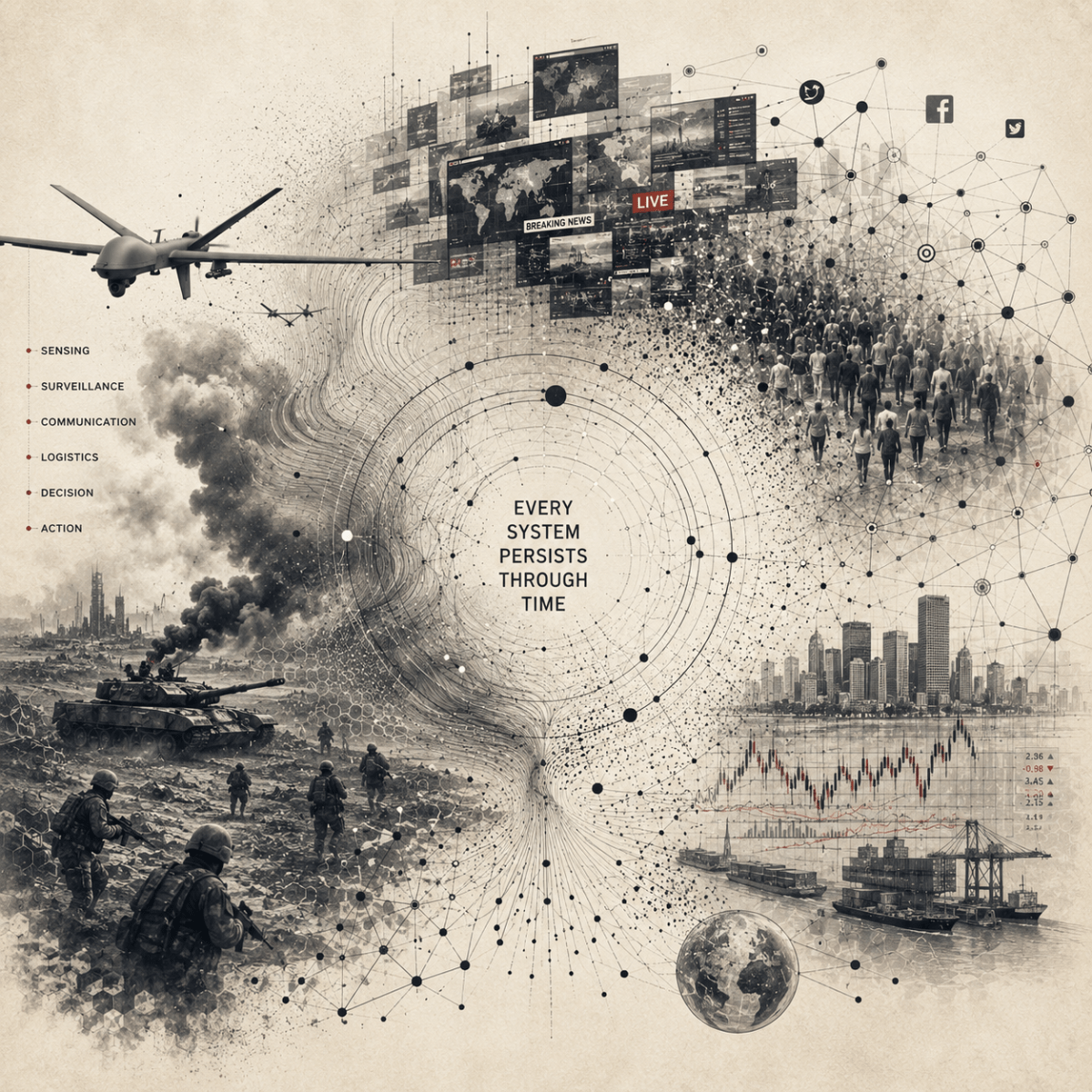
Every morning, millions of people wake up and watch another update from another war. Maps shift by a few kilometres. Drone footage appears online within hours. Analysts debate strategy. Markets react. Politicians respond. Algorithms amplify the latest development before the smoke has cleared. Somewhere, people are fighting for their lives. Somewhere else, millions of us quietly synchronise our attention around the same unfolding events.
The conflict is not only occurring on the battlefield. It is propagating through communication. Every map, every briefing, every satellite image, and every casualty figure reveals something real while leaving something else beyond its frame. The war always exceeds the representations through which we attempt to understand it. The more carefully we observe, the more obvious it becomes that no single description can ever contain the whole.
History suggests this is not unusual. The First World War reorganised industry, logistics, medicine, aviation, and the modern state. The Second World War accelerated radar, rocketry, nuclear physics, computing, antibiotics, and international institutions. The Cold War reshaped communications, satellite technology, and the digital world that now surrounds us. Every conflict appears unique, yet each reorganises civilisation in recognisably similar ways because the underlying relational conditions continually return in new forms.
The prolonged stalemate in Ukraine echoes an older pattern. Industrial firepower once outpaced mobility, producing years of trench warfare in which neither side could convert destruction into decisive manoeuvre. Today, drones, electronic warfare, precision weapons, and persistent surveillance have again increased the cost of movement. The deadlock is not simply military. It is organisational. The important question is no longer which weapon breaks the stalemate, but what new organisation dissolves it. The decisive transformation is unlikely to be a single invention. It will emerge from the distributed relationships that bind sensing, communication, logistics, autonomy, and decision into a coherent whole.
As Virilio (1989) recognised in describing the growing fusion of vision and weaponry, and as Bousquet (2017) later developed in his analysis of the eye as a function of the weapon, perception increasingly becomes part of the weapon system itself. Yet the eye, whether biological or technological, is fundamentally a sensor. Every sensor is temporal. It receives only what has already travelled through the world. The observer and the technical system therefore belong to the same communicative continuum rather than to separate domains. The significance of modern warfare lies not simply in smarter weapons, but in the increasingly coherent organisation of sensing, communication, decision, and action.
Watching these conflicts unfold, I have become less interested in the wars themselves than in the recurring structures that produce them. Every generation explains its conflicts differently: empire, religion, ideology, resources, nationalism, security, economics. Each explanation captures something real, yet none captures the whole. Analysis has always searched for the properties that unify apparently different phenomena because finding sufficient description provides leverage within a complex world. In an age of increasing dynamical complexity, that search becomes more important than ever. The answer may be simpler than it first appears. These systems are united because they are processes. They persist, adapt, reorganise, and transform through time. The deeper question is no longer what organised systems are, but how organised systems continue to be.
No finite system of distinctions exhausts the relational continuity from which those distinctions arise. Reality exceeds every local logic. Every organised description is necessarily partial, not because it is mistaken, but because organisation always extends beyond the distinctions through which it becomes intelligible. Every explanation illuminates one set of relations while revealing the existence of further relations beyond it. The horizon is not the failure of understanding. It is one of the conditions that makes understanding possible.
The same movement appears everywhere. Biology repeatedly discovers similar forms because similar environments repeatedly favour similar solutions. Languages, markets, ecosystems, governments, technologies, economies, and civilisations likewise rediscover analogous organisational forms because they repeatedly encounter analogous relational conditions. Conflict is not an historical accident. It is one of the recurrent ways distributed relational tension becomes organised, visible, and consequential. It is less an exception to organised life than one of the ways organised life repeatedly reorganises itself.
Communication is how those organised processes persist. As systems become increasingly coupled, shared temporal structure emerges. Coordination gradually becomes easier than continual reconstruction. Complexity becomes one of the ways entropy is locally realised. The battlefield, the newsroom, the financial market, the supply chain, the political system, and the public imagination increasingly organise around the same evolving rhythms. War reveals these dynamics with unusual clarity because conflict compresses them into forms that are difficult to ignore.
This changes how we think about ourselves. We experience intention, agency, and choice, yet our lives unfold within languages, histories, technologies, institutions, memories, and cultures that continuously shape the possibilities available to us. The personal and the structural are not separate worlds. They are different resolutions of the same ongoing organisation. We inherit civilisation, but we also reproduce it continuously through the relationships we maintain, the distinctions we preserve, and the patterns we reinforce.
This is the deeper significance of contemporary conflict. The decisive transformation is no longer the weapon itself but the organisation of the relationships that connect perception, communication, adaptation, and action. The battlefield merely makes visible a broader transition already reshaping civilisation. The challenge before us is not simply to understand war, but to recognise the recurrent patterns through which organised processes persist, reorganise, and become something new.
References
Bousquet, A. (2017) ‘Lethal Visions: The Eye as Function of the Weapon’, Critical Studies on Security, 5(1), pp. 62–80.
Virilio, P. (1989) War and Cinema: The Logistics of Perception. London: Verso.

