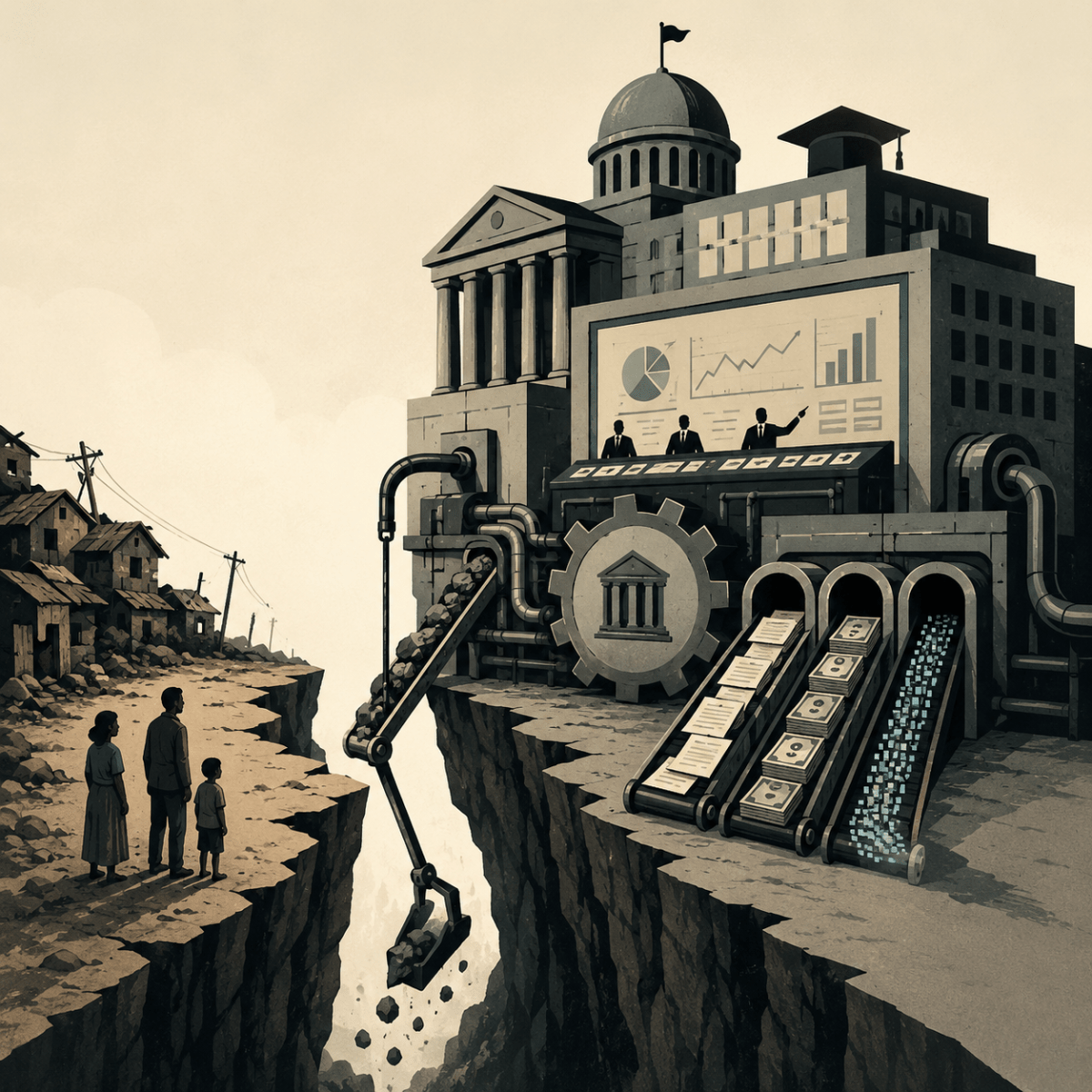
Capitalism is often described in terms of markets, private ownership and competition. These describe how it operates, but they do not explain why it persists. Its deeper logic is the continual expansion of what becomes possible while simultaneously reconstructing differential access to those possibilities. Every technological advance, productivity gain or new form of abundance generates fresh opportunities, but it also creates new ways of limiting who can meaningfully participate. The system reproduces itself not simply by producing wealth, but by continually reorganising the conditions under which wealth, opportunity and security remain unevenly distributed.
Housing illustrates this clearly. Better construction methods, financial innovation and rising productivity should make secure housing increasingly accessible. Instead, housing repeatedly becomes a mechanism through which differential access is reconstructed. The same dynamic appears in education, healthcare, communication, information, digital services and cybersecurity. Progress continually expands what is possible while institutions reorganise scarcity around access, timing, finance, regulation and ownership. Its unresolved contradiction is not merely a defect. It is one of the principal conditions through which the system continues to adapt, innovate and reproduce itself.
This is not unique to capitalism. It is a property of complex systems that persist by continually reorganising the differences through which they reproduce themselves. Capitalism simply expresses this logic with unusual efficiency. Once we begin looking beneath its familiar institutions, the deeper dynamics become increasingly difficult to ignore. See also: The Architecture of Absence, what is economic reality?, can’t buy me love, and system time.
Categories
how capitalism reconstructs scarcity
The institutions assigned to solve our deepest problems are sustained by these, the very relations they are unable and/or unwilling to question.


One reply on “how capitalism reconstructs scarcity”
One of the stranger features of the present moment is that many characteristics routinely denounced as “communist” or “totalitarian”—the concentration of power, ideological conformity, administrative intrusion, pressure to self-censor, and the fusion of political, economic and technical authority—are reproduced with equal efficiency inside contemporary capitalist systems. This is also, though not only, a function of technocratic overreach: institutions increasingly govern through metrics, platforms, automated controls and managerial systems that present themselves as neutral while steadily extending their authority over everyday life. The labels differ, but concentrated systems repeatedly converge upon similar forms of control. The important distinction is not capitalism versus communism, but whether political, economic and technical power remains distributed, contestable and constrained.
Food for thought.
LikeLike